Showing posts with label New York Times. Show all posts

Sunday, May 15, 2011

A Weird Article on College Education in the New York Times

While I agree that trying to impose the business model on academia is wrong and that high standards of education should be maintained at all costs, I am often baffled by how people go about defending these useful ideas. Take, for example, the recent article in The New York Times titled "Your So-Called Education." After reading it, I realized that, according to the article's authors, the greatest problem in higher ed is me. Let's look at some of the points the article makes.

The quality of college education is slipping because:

1. "In a typical semester, for instance, 32 percent of the students did not take a single course with more than 40 pages of reading per week."

I must be a real underachiever because in my undergraduate courses, I never assign more that 30 pages of reading a week in any given course. I teach literature and culture, so reading is pretty much all we do. However, my goal is not to get the students to skim through as many pages as possible. I want them to read critically, to engage with the text, to try to go through it slowly. If you read 3 pages a week but manage to come up with some analysis of it, it's a lot more useful than gulping down 100 pages of a text just to fulfill some silly requirement.

2. "50 percent did not take any course requiring more than 20 pages of writing over the semester."

In my trademark course on Hispanic Civilization, students write several short essays that come up to less than 20 pages per semester. The writing component is crucial to that course. (Because I decided that it should be.) However, I don't see how it helps anybody to get the students to hand in reams of poorly written garbage. If a student manages to produce a single beautifully written page at the end of the semester, I will believe that my goal in the course has been accomplished. Students come to this Freshman course with no understanding of what distinguishes good and bad writing. Giving them humongous writing assignments will only lead them to reproduce the same horrible writing techniques they brought to college from their high schools.

3. "The average student spent only about 12 to 13 hours per week studying — about half the time a full-time college student in 1960 spent studying."

I wonder if anybody has counted how many of those hours a student in the 1960 spent hunting for information and doing manually all those things that today are simplified to an incredible degree by the Internet and text processing. If we take into account how much faster the writing becomes thanks to text editors, I'm sure we will arrive at a conclusion that today students work more.  

4. "Not surprisingly, a large number of the students showed no significant progress on tests of critical thinking, complex reasoning and writing that were administered when they began college and then again at the ends of their sophomore and senior years. If the test that we used, the Collegiate Learning Assessment, were scaled on a traditional 0-to-100 point range, 45 percent of the students would not have demonstrated gains of even one point over the first two years of college, and 36 percent would not have shown such gains over four years of college."

I must have poor critical thinking skills myself because I truly fail to understand how critical thinking and complex reasoning can be measured on "a traditional 0-to-100 point range." The authors of this article bemoan the fact that the business model has been imposed on academia, but they fail to notice to what incredible degree they have been infected by this very model. Good reading and good writing for them are about a number of pages. Complex reasoning is about a number of points. In short, numbers rule supreme.

5. "Expanded privacy protections have created obstacles for colleges in providing information on student performance to parents, undercutting a traditional check on student lassitude."

The idea that educators would somehow benefit from having even more helicopter parents buzzing around them is bizarre. Has anybody ever developed their critical thinking skills because they were afraid their parents might scold them in case they didn't? 

6. "Too many institutions, for instance, rely primarily on student course evaluations to assess teaching. This creates perverse incentives for professors to demand little and give out good grades."

The idea that professors who demand little and hand out easy grades are the ones who get good student evaluations is completely misguided. If I told you what percentage of students I fail each semester, I think you'd agree that I'm anything but an easy grader. My evaluations, though, have always been fantastic. Students actually don't like professors who ask too little of them. In my teaching experience, the only way to get students to evaluate you highly is to demonstrate that your knowledge of the subject matter is profound.

7. "And the Department of Education could make available nationally representative longitudinal data on undergraduate learning outcomes for research purposes, as it has been doing for decades for primary and secondary education."

Given that primary and secondary education in this country have gone completely to the dogs in the past couple of decades, this suggestion really mystified me. "Longitudinal data on learning outcomes" is the bureaucracy-speak version of teaching to the test. This model inflicted untold damage on our secondary education on a daily basis, but now we are to inflict it on higher education as well.

In short, even when The New York Times is trying to do something good, it ends up  producing the exact opposite.

Monday, March 7, 2011

The Grim Future of The New York Times

The New York Times almost went bankrupt in 2009. That year proved to be tragic to the print media as over 100 newspapers closed down. Readers are refusing to pay for subscriptions to papers where irresponsible, lazy journalists publish their unintelligent, badly digested and clumsily worded opinions which they try to sell to us as news. When I need information, I don't go to newspapers. I go to the Internet where intelligent, well-informed bloggers offer me a wealth of facts accompanied by intelligent analysis completely for free. Of course, there is a lot of rubbish floating around online but as soon as you find a list of blogs and websites you like, you will never need to purchase the silly lies sold to you by the print media.

In view of this wealth of information people can now find for free online, The New York Times decided to make access to its content. . . more difficult. More and more articles now require that one register before getting access to them. This policy is part of the newspaper's plan to make its online readers pay annual fees for reading The New York Times

Twice today I followed a link to an article in The New York Times only to be told that I need to register before I'm given access to it. In my experience, this newspaper isn't even worth 2 minutes it would take to register, let alone the money they want me to pay for reading it. Instead of improving its content, firing Ross Douthat and avoiding hiring losers who can't read their own credit card statements to report on finance, NY Times tries to save itself from impending bankruptcy by getting people who are used to getting their information for free online to pay up. All this will do is hasten the newspaper's demise. And good riddance, too.

Monday, February 28, 2011

The War on Women

The New York Times published an article that condemns the Republican war on women. We have witnessed such egregious assaults on the rights of women recently that even this conservative newspaper can no longer be silent on the issue:
Republicans in the House of Representatives are mounting an assault on women’s health and freedom that would deny millions of women access to affordable contraception and life-saving cancer screenings and cut nutritional support for millions of newborn babies in struggling families. And this is just the beginning. The budget bill pushed through the House last Saturday included the defunding of Planned Parenthood and myriad other cuts detrimental to women. It’s not likely to pass unchanged, but the urge to compromise may take a toll on these programs. And once the current skirmishing is over, House Republicans are likely to use any legislative vehicle at hand to continue the attack.
Once again, the Republican hypocrisy I wrote about recently is self-evident. On the one hand, legislation aimed at curtailing women's rights to an abortion is being discussed in a variety of states. The Republican majority in Congress states openly that it's main goal at this point is repealing abortion rights. (Jobs? What jobs? Who the hell cares about anything as ridiculously unimportant as that when you can rummage in a woman's uterus instead?). On the other hand, Republicans are trying to make sure that children who have already been born are deprived of health care and nutrition:
Beyond the familiar terrain of abortion or even contraception, House Republicans would inflict harm on low-income women trying to have children or who are already mothers. Their continuing resolution would cut by 10 percent the Special Supplemental Nutrition Program for Women, Infants and Children, better known as WIC, which serves 9.6 million low-income women, new mothers, and infants each month, and has been linked in studies to higher birth weight and lower infant mortality. The G.O.P. bill also slices $50 million from the block grant supporting programs providing prenatal health care to 2.5 million low-income women and health care to 31 million children annually.
After all this, how can anybody be blind enough to believe that the Republican anti-abortion frenzy has anything to do with "saving babies"? How can anybody be inhuman enough to support these cannibalistic measures?

I have always been fascinated - in the same way that one is fascinated with really nasty insects - with people who support Republicans. Anybody who has been graced with an ounce of brain matter can see very easily that this is a party that would rob everybody to benefit the tiny group of the extremely rich. That hates women to the degree of having a near epileptic fit whenever a woman tries to live her own life. That would gladly see children from poor families die out. That has come as near fascism as possible and is eagerly awaiting the opportunity to take the next step. How can anybody keep supporting them and still live with themselves? Isn't it obvious that these are vile creeps whose tenancy on the garbage heap of history has been guaranteed for a long time now?

Come on, people, try to forget about women's uteri for a while and concentrate on how many times the Republicans have lied to you. Weren't you told that their goal was to help you through this devastating economic crisis? Well, they lied as usual. Right now they are not only attempting to kill off poor babies but are also trying to destroy the housing rescue programs instituted by Obama's administration. There will be over 2,000,000 foreclosures this year.

Do you really hate women so much that you would keep voting for a party that is robbing you blind? Really? 

Tuesday, January 25, 2011

The New York Times Uses the Tragedy in Moscow to Reinforce Stereotypes

In case you haven't noticed, I don't like The New York Times. It engages in irresponsible, biased journalism way too often for my liking. There are moments, though, when one would expect even the silliest journalists in the world to control their desire to advance some sort of an agenda. Unfortunately, even then journalists who work for The New York Times can't keep their desire to put a convenient spin on everything in check.

On January 24, 2011, Moscow was shaken by a horrible act of terror that claimed the lives of many people at the Domodedovo Airport and left many others seriously wounded. This is a tragic moment that should not be used to advance any kind of unfair and ridiculous stereotypes of the Russian people. An entire country is in mourning. Why can't its tragedy be respected, at least for a little while?

It is shocking to me that Andrew Kramer at The New York Times chooses this particular moment to advance a particularly unpleasant image of the Russian people in his article titled "After the Bombing, It's Business as Usual." The title itself is quite offensive. If the author of the article is trying to advance the idea that the Russians are so jaded that such a tragedy causes them no grief, he is a prejudiced, uninformed fool. How would he have felt if journalists from other countries had written this kind of articles hours after the tragedy of 9/11?

In his unintelligent article, Kramer tries to demonstrate that the Russian people are somehow more "fatalistic" than people of other countries:
Meanwhile, people continued to arrive to pick up loved ones and to embark on flights out of the city. It was as if officials, passengers and Muscovites in general were displaying a particular brand of Russian stoicism, if not fatalism. “Of course we feel sorry for the people who suffered,” said Olga Y. Vishnyakova, a departing passenger, as she squeezed through a crowd in the check-in area. “Some people refused to come to the airport because they were worried about their personal security,” she said, noting that just nine months ago a suicide bombing in the subway had been followed immediately by an attack at a nearby station. “But I thought, “Well, you cannot escape God’s fate.’ And then I thought, ‘It’s been a few hours and nothing’s happened. Why not? It’s probably OK.’ ”
I have no doubt that this conversation with a passenger did, in fact, take place. Still, the Russian Federation is a huge country that has 83 federal subjects. It has a population of 142 million people of different races, ethnicities, religious persuasions, and linguistic identities. It spans 9 time zones and is the largest country in the world. Drawing conclusions about "all Russians" on the basis of a couple of rushed conversations with a few traumatized passengers makes very little sense. I'm glad that major newspapers don't publish articles of the "All Jews are greedy" variety any more. Is it too much too ask that the same courtesy be extended to the Russian people?

P.S. Those who have been following this blog for a while know that as a former colonial subject of Russia I am not a huge fan of that country. Still, it is jarring to me when a whole huge nation is stereotyped in such an unfair and unfounded manner. I probably have had a chance to spend more time with the Russian people than anybody else who reads this blog and I can assure you that they are neither more nor less fatalistic than any other people. I can tell you more: they are all different. Just like the Americans. Or the Argentineans. Or the Nigerians.

Monday, January 3, 2011

A New Year Brings a Fresh Bout of Stupidity from Douthat

Forget about the fact that I consider Ross Douthat's ideology disgusting and his writing sloppy and incoherent. What I find the most annoying is how easily he distorts reality and fills his silly articles with lies. His most recent piece of conservative inanity begins with an outright lie, which The New York Times apparently finds it acceptable to publish:

The American entertainment industry has never been comfortable with the act of abortion. Film or television characters might consider the procedure, but even on the most libertine programs (a “Mad Men,” a “Sex and the City”), they’re more likely to have a change of heart than actually go through with it.
I don't know what's so "libertine" about the profoundly patriarchal Sex and the City, but its leading characters did have abortions. An entire episode was dedicated to Carrie remembering an abortion she had a while ago and reaching a conclusion that it was absolutely the right decision for her. Samantha and Miranda had several abortions and never felt sorry about it.

Whenever an article starts with such a blatant lie, I find it very difficult to take anything else its author proposes seriously. If he disrespects his readers to this extent, who's to say where his lies and distortions will end? Shouldn't a journalist know how to verify his information? Especially the information that's as easy to unearth as anything that has to do with Sex and the City? (Please don't tell me that Douthat made an honest mistake here. This information can be verified in a matter of two minutes at most, which he chose not to do.)

Douthat, who has turned his NYTimes column into a platform for spouting his anti-women beliefs*, suggests that instead of aborting women should give birth and offer the babies up for adoption. As any vile male chauvinist, he doesn't have a foggiest idea of what pregnancy and childbirth entail. This sad buffon, who obviously has never seen an actual woman in his close vicinity, never stop to consider that there might be some effort, work, pain, suffering, loss of productivity, health risk, danger of dying involved in carrying a pregnancy to term and giving birth.

Douthat is one of the reasons I would never subscribe to The New York Times. I can't respect a newspaper that offers a weekly column to somebody so shallow and dishonest. I understand that an intelligent, well-informed conservative journalist is hard to come by, but surely that's no excuse for torturing readers with the stupid concoctions of an unscrupulous Douthat.
*In case you missed it, you can trace my anti-Douthat campaign here.

Monday, October 11, 2010

The New York Times Dispenses Advice to Scholars of Literature

Nothing is as annoying about the hateful New York Times as their constant attempts to earn their conservative credentials by ridiculing the long-haired, Derrida-reading elite hippie professors. This newspaper is especially virulent against the scholars of the Humanities, which is understandable since we are overwhelmingly progressive in our politics (as opposed, for example, to our colleagues in sciences, many of whom are, for some incomprehensible reason, very conservative and even vote Republican.) Recently, The NY Times joined the campaign to destroy the institution of tenure in this country. The Times can't fail to realize that the destruction of tenure will mean the end of any respectable system of higher education in the US. Of course, if that happens, this newspaper can expect a huge influx in subscribers, since the level of stupidity in this country will sky-rocket.

Today, The New York Times decided to attack the scholars of literature, ridiculing us and presenting us as complete losers who have no idea what we are doing. Some paid gun from the University of Chicago wrote a piece called "In Defense of Naive Reading" where he makes a series of completely disingenuous claims about the way literature is supposedly taught in universities. These completely spurious claims are enough to make the helicopter parents who read the paper flip out and go on a perennial "What is our children learning?" rant.

So here are some statements the author of the essay makes:

1. Too much theory is being taught in college literature courses. According to the author of this piece, we expose our students to the endless lithany of "psychoanalytic criticism, new or formal criticism, semiotics, structuralism, post-structuralism, discourse analysis, reader response criticism or “reception aesthetics,” systems theory, hermeneutics, deconstruction, feminist criticism, cultural studies." Now, this is just a lie, pure and simple. There was an explosion of interest in literary theory that occurred in late 70ies and early 80ies. This all came to an end, though, over 20 years ago. After the huge progressive gains of the 70ies, American society shifted dramatically to the right. A strong push to turn away from theory originated in Ivy League universities in the mid-eighties. Today, this de-theorizing tendency has won a resounding victory. (If you want to argue with me about this statement, try mentioning the word "deconstruction", or even worse, "feminism" in a literature class at Yale. Then, we can continue this discussion. As somebody who has tried writing a doctoral dissertation that mentioned - just mentioned - reader response criticism and cultural studies at an Ivy League school and paid the price for trying to do it, I can tell you that the author of the NYTimes piece is either a complete dufus or a liar.)

For those who want an informed (and a beautifully written) account of this turn away from theory, I highly recommend After Theory by the amazing Terry Eagleton who, unlike the author of the NYTimes article, is a world-famous scholar of literature.

2. Professors of literature still haven't figured out how to evaluate their students' work. If that were true, as the author of this offensive article suggests, we should all be fired on the spot. Or at least have our tenure taken away because we obviously have no idea what we are doing. Of course, Robert Pippin has no idea what he is talking about. His claim that there is an "absence of any consensus" on "whether the student has done well or poorly" demonstrates a profound ignorance of our field of knowledge. Pippin could have talked to any of the excellent scholars of literature on his own campus, who would have enlightened him on our methods of evaluation students. A small hint: using the clumsy expression "the fact that" twice in such a short article and creating an argument based on false assertions would have earned him a grade of C- in any of my courses.

3. The last accusation that Mr. Pippin (I'm not trying to be offensive to the guy, that's his real name) wages against professors of literature is that we are on the verge of applying voodoo science in our classrooms: "One already sees the “application” of “results” from the neurosciences and evolutionary biology to questions about why characters in novels act as they do or what might be responsible for the moods characteristic of certain poets. People seem to be unusually interested in what area of the brain is active when Rilke is read to a subject." Why we should waste time on reading Mr. Pippin's delusional visions is left unexplained in the article. There is also no explanation for who these mysterious "people" he mentions are. Of course, they sound like complete quacks, and I wouldn't want them in my field of knowledge. The only problem is that they are a figment of Mr. Pippin's over-active imagination. Nothing like that is happening in the field of literary studies. For some reason, though, the author tries to make the impressionable readers of The Times believe that the field of literary criticism is filled with quacks who apply brain measurements to the work of Rilke.

Mr. Pippin ends his rambling and weird article with an attempt to provide a "good" analysis of a work of literature. What's truly funny, though, is that his reading is heavily indebted to psychoanalytic theory, which has been outdated for about 30 years. This reminds me of Moliere's immortal character, M. Jourdain, who had no idea he was speaking in prose. Mr. Pippin should realize that in his attempts to berate scholars of literature he looks just as ignorant and foolish as M. Jourdain.

Friday, July 16, 2010

New York Times Keeps Kissing Bankers' Asses

I'm always appalled how print journalists manage to combine the most idiotic journalistic actions with endless whining about their profession dying out. In a recent issue of The New York Times, a journalist called Eric Dash attempts to entertain his readers by singing praises to Jamie Dimon, the CEO of JP Morgan. Dash is practically swooning at the mention of Dimon's "successes":
The crisis cemented Mr. Dimon’s reputation as a financial superstar — a bold dealmaker who buys when others are selling, a strict risk manager who resisted the type of exotic businesses that felled others and a charismatic leader who charms lawmakers and credit traders alike. He is now commonly referred to by a single name, like Pelé or Madonna. . . At age 54, Mr. Dimon has only begun trying to build the kind of global banking empire he initially set out to create with Mr. Weill at Citigroup. While JPMorgan’s share price fared better than most of the banking sector through the turbulence of the last few years, at around $40.35, it remains roughly where it was when Mr. Dimon took over as chief executive in December 2005.
Of course, it is of no interest to Dash that the practices this vile crook has adopted are going to lead us into yet another round of this crisis. Dimon is one of those people who have learned nothing as a result of the crisis (and why should they? They always have the government to offer them handouts that will save them.) He is handing even more credit cards now than he used to before: 

Chase Card Services, meanwhile, has introduced three new types of credit cards in the last year. In the second quarter alone, it mailed out an estimated 164 million applications, according to data from Synovate, a research firm. That was more than twice the number sent out by American Express, the next most active issuer, and made up nearly one-third of the industry’s total mailings.When the head of the credit card division offered to scale back as losses spiraled, Mr. Dimon was emphatically opposed. “We don’t want to do stupid things because we are losing a lot of money,” Mr. Dimon said, anticipating a rebound in the card business. “Hell no. We are going to do the right thing as fast as we can.”
 And this is the kind of person that The New York Times journalists are gushing over. Has anybody at this so-called news source ever considered that the role of journalists is not to see who manages to stick their tongue deeper into some crook's anus? Have people like Eric Dash ever heard that being a journalist doesn't mean singing praise to every wealthy criminal that comes along?


When the new round of this economic crisis comes along, I sincerely hope that one good result of it will be that The New York Times will finally go out of business and take people like Dash with it into a well-deserved oblivion. They will always be able to make a living by prostrating themselves in the dirt under the feet of these bankers to prevent them from muddying up their expensive shoes. 

Thursday, June 24, 2010

We Are All So Screwed

From the New York Times:

Great Recession? What recession? The world’s millionaires and billionaires — now totaling 10 million — saw their overall wealth jump 18.9 percent last year, to $39 trillion.
The surge in the stock market in 2009 restored many people back to the ranks of the rich as the financial crisis abated. The number of people with at least $1 million in assets beyond their homes and household goods climbed 17 percent, according to a report on the world’s wealth by Merrill Lynch and Capgemini, a Paris-based business consulting firm. Their total wealth approached the 2007 peak of $40.7 trillion, after a 20 percent plunge to $32.8 trillion in 2008.
“We are already seeing distinct signs of recovery, and in some areas a complete return to 2007 levels of wealth and growth,” Sallie Krawcheck, president of global wealth and investment management at Bank of America, said in a statementAs expected, the most millionaires could be found in the United States, where their ranks rose 16.5 percent, to 2.87 million, last year, according to the report. Their total wealth in North America rose 17.8 percent, to $10.7 trillion. 
 I don't know what this tells you, but for me this means that the same clueless jerks who got us all into the current mess have gone back to their irresponsible lending, borrowing, paper-pushing practices. Why is nobody discussing the very distinct possibility (which by now has become a strong probability) that these losers will get us into a new round of this economic crisis petty soon?

Sunday, April 4, 2010

Immaturity and the Housing Bubble: Review of Edmund Andrews's "Busted"

Andrews is a long-standing reporter for the economics section of the New York Times. This is what makes the story he tells in Busted: Life Inside the Great Mortgage Meltdown so scary. Andrews's book presents two closely connected stories: the history of the creation of the US housing bubble that started the current economic crisis and his personal story of getting into an incredible amount of debt in the years that led to the collapse of the housing market.

This is a book that needs to be read, even though it will make you lose your faith in humanity for a long time to come. Andrews analyzes in great detail how the lending institutions gradually became more and more driven by the desire for instant profit without stopping to think for a second what will happen long term. The author also brings to light the incredible, mind-boggling stupidity of Greenspan, Bernanke, and Co. He demonstrates how corrupt and dishonest the Bush Jr. administration was.

None of this, however, is very new. At least not to me. From the moment I moved from Quebec to the US, it became obvious to me that the housing prices in this country were ridiculously over-inflated. I saw my friends and colleagues pay really insane, seven-figure prices for poky little apartments in Manhattan or run-down bungalows in Connecticut and immediately realized that this was the game I would never agree to pay. Mortgaging away your life for the next 30 years in hopes that the bubble will get even bigger and the price of your house would magically grow seemed like a genuinely stupid proposition even for someone like me, who at 27 was woefully ignorant about economy. Today, when I understand the workings of this country's economy and politics a lot better, I am even more reluctant to participate in this insanity.

What really bothered me in Busted: Life Inside the Great Mortgage Meltdown was not the story of the housing bubble. It was the story of a nearly fantastic immaturity. Immaturity on both sides, the lenders' and the borrowers'. Those who handed out completely unsecured loans to people incapable of ever paying them off and those who accepted loans they could never even imagine paying off. Andrews was one of those who accepted. And accepted. And accepted some more.

The immaturity and total intellectual impotence of this man - who, once again, writes for the economics section of The New York Times - is mind-boggling. He decides to take out a loan to buy a half-million dollar house. As a result, he knows that his entire paycheck will go towards his alimony payments and the mortgage with not a dime left over for the bills. Of course, he hopes that his new wife will make enough money to cover all of their living expenses. Nothing would be all that wrong about this picture, if it weren't for one tiny detail. His new wife has been a house-wife who hasn't worked a day in the past 20 years. Besides, she is accustomed by her former husband to living the life of luxury. She didn't even do any work around the house because her first husband paid for a housekeeper. On top of that, Andrews gets this woman to move to a completely different part of the country. Then, he expects her to find a well-paying job - with no skills, no connections, no experience of being an employee - and start paying all the bills: "We had both assumed she could earn enough for us to get by. We didn't have any idea how she would do it; we were both simply sure that she could do it." It is incredible to encounter such profound intellectual impotence from any one over the age of 12.

This is not the weirdest thing about Andrews's relationship with Patty, the woman who eventually became his second wife. He left his first wife and proposed to Patty before Patty and he had ANY kind of a relationship. They hadn't even as much as kissed, let alone had sex or lived together. And these are not some horny teenagers. These are people who are almost 50 at the time. During marriage counselling, Andrews and Patty discover that they do not see eye to eye on 90% of issues discussed. This, however, does not suggest to them that it might make sense to postpone the wedding until they actually get to know something about each other.

Andrews's path to penury begins when he takes out a sub-prime mortgage on his new house. Over the next few years he gets so far into debt that you couldn't dig him out of it with an excavator, just to keep the stupid super expensive house. And you know why? In his own words, "Even though it was all about buying a house in the suburbs, it felt vaguely exciting, edgy, and a little gangsta." When a balding, paunchy, white gentleman in his late forties is motivated to take out an impossible loan because he wants to feel "gangsta", of all the stupid things, you know that something is seriously wrong here. And this is supposed to be a well-educated upper-middle-class individual, who works as a journalist, for Pete's sake!

In order to climb out of the financial hole he has dug for himself, Andrews tries every crazy borrowing practice out there. He runs up a staggering credit card debt, empties his pension account, and even hits up for money his elderly mother. There is just one thing he doesn't do: try to cut down the costs. Andrews goes through his wedding to his second wife in throes of a panic attack over mounting bills and huge debt. After that, he proceeds to pay the caterers that were hired for the wedding. Of course, the idea that people who can't pay the electricity bill might be able to do without a catered wedding never crosses his mind.

For a while, Andrews's family income rises to $200,000 per year. I don't know about you, people, but for me this is a staggering amount of money. One could live like a king on half that amount. Still, Andrews cannot make ends meet. Even though the debt is growing and his interest rates become sky-high, he keeps spending on things that cannot possily be considered necessary expenses: cable telivision, HBO, beach house, Ipods, expensive clothes, the list is endless.

Andrews criticizes the irresponsible lenders virulently. He never stops to think, though, that those who criminally handed out unsecured loans were motivated by the same basic immaturity that got him into so much trouble: have fun now and assume that things will somehow work out in the end. These people, who are so immature that it makes my hair stand on end in horror, are the ones that got us into this mess. They mortgaged away our future, and their children's and grand-children's future because they wanted that Ipod, that house, that vacation right now and didn't want to pay for them. Now, we will all have to pay for their lack of responsibility and their inhuman immaturity for decades to come.

[To be continued...]

Monday, February 22, 2010

Poor Ross Douthat Still Ain't Getting Any

Would some charitable individual just fuck Ross Douthat of the NY Times already and spare us the boredom of his weekly "I-hate-everybody-who-has-sex-because-I-haven't-been-getting-any-for-the-past-decade" opinion column? As spring is approaching, Douthat is getting into his public fits of hysteria over other people's sex lives more and more often. Not surprising, since he so obviously has none of his own.

Today's column is dedicated to Douthat gushing with admiration (the only thing he's been gushing with for oh, so long) over the tabloids' prurient interest in the sex lives of famous people. Oh, how much the sex-deprived Douthat would love to dedicate his life to going through the dirty underwear of politicians, actors, and athletes. Revealing who slept with whom when and in what position has an important social purpose. Besides giving Douthat an outlet for his unrequited sexuality, that is. According to Douthat,
there’s a case for erring on the side of prurience. Some private acts should be publicly disqualifying, and the media need to be willing to go digging for them.
You can just imagine Douthat foaming at the mouth with his enthusiasm for digging for the information on the sex acts of others.

As usual, the "why-are-the-Democrats-incapable of-bipartisanship" Douthat cannot refrain from showing us his blatant use of double standards. (Of course, he would gladly show us something else, but nobody is willing to look.) Where McCain has a
complicated relationship with a female lobbyist
Bill Clinton engages in "philandering". Douthat's attempts to attract attention to the sex scandals within the Democratic Party (which even by the most modest calculations never come close to the staggering numbers of sex scandals among the sex-starved Republicans) lead him to pronouncements that are nothing short of shameless:
If the supermarket tabloid’s reporters hadn’t gone digging where other journalists declined to even tread, we might never have learned how close the Democratic Party came to nominating a truly disgraceful character for the presidency.
Imagine that, a disgraceful character as a presidential nominee, or possibly even as the President. But wait, that's nothing new. We'd had a really disgraceful character as our president for 8 endless years. And his crimes were kind of a little more serious than having a child out of wedlock. Like lying to the American people in order to start an illegitimate unnecessary war that would bring death to thousands. Or authorizing torture. Or taking away our constitutional freedoms. or destroying the middle class.

But why would a NY Times journalist care about all those things when he can gasp over the real horror of an extramarital affair.

Friday, December 11, 2009

The New York Times Blames Me for Americans Getting into Debt

I'm honestly getting to the end of my rope with The New York Times. Every single time I have opened this paper in the past couple of months, I have seen something annoying and weird.

Today's opinion column, for example, has revealed to me that the person to blame for the fact that more and more Americans get deeper and deeper into debt is . . . me. And other people like me. In the article "Is the American Dream Over?", David Brooks suggests that people "who can manipulate ideas and abstractions," who have "unique mental skills," and who are highly educated are to blame for the growth of the uncontrollable culture of consumption that drives people into debt. At a first glance, this point of view seems completely bizarre. When you read Brooks's line of reasoning that led him to this strange conclusion, however, you realize that, in terms of bizarre, you truly ain't seen nothing yet.

These highly educated people, says Brooks, "have tremendous cultural influence" and "unwittingly set the norms everybody else must live up to." Television networks, for example, fall over themselves to depict our upper middle-class, highly educated lifestyles. For Brooks, these educated cultured lifestyles consist of having "the bigger house (which now seems normal) or the multiple cars or the flat screen." People who don't have our high educational levels and the same sophisticated set of skills try to catch up with this lifestyle that we, the educated people, uphold and advertise. However, since they don't have the same set of skills, they go into debt, and "the consumption merry-go-round will begin again."

As a university professor with five degrees from extremely prestigious schools, I have to say that Brooks's vision of how educated people with "tremendous cultural capital" live is extremely strange and evidently inspired by silly TV shows. My current house is big, but it is rented, as I have no interest whatsoever in buying real estate ever. I don't drive, so there is no question of a single car, let alone multiple ones. And my TV is tiny and cost $260. The last time I shopped for clothes was May. And not because I don't like clothes, but because shopping is very boring to me. Over 20% of my income goes towards buying books. Otherwise, you have to possess a really wild imagination to see me as participating in the "the consumption merry-go-round."

Honestly, I'd love to have more influence on setting the cultural standards. I sincerely believe that everybody would win if we spent more money on books and less on cars, gas, expensive huge TV sets, and silly crap like that. Somehow, however, I don't feel that my high education has turned me into a cultural icon. A lot more people are influenced by the lifestyles of Paris Hilton and the like than by the way of life of even the most prestigious thinkers and philosophers.

The conservatives' favorite bugbear is the "educated elites" who have supposedly colonized mass culture and tell everyone how to live and what to do. (Thomas Frank's What's the Matter with Kansas?: How Conservatives Won the Heart of America talks about it beautifuly and hilariously.) This article is one more attempt to present people with high degree of education as hateful, superficial, and bad. If you take Brooks's argument to its logical conclusion, it seems that the best way to repair the US economy and cure people from consumerism would be to remove the educated people altogether, or at least to reduce our number significantly. This hatred of the educated people by the conservatives is very logical on their part. Anybody who is even marginally acquainted with what it means to think for yourself would be incapable of buying into any single item on the Conservative agenda. They need mindless drones, who would produce and shut up. Anybody with a mind of their own is potentially dangerous and should be silenced.

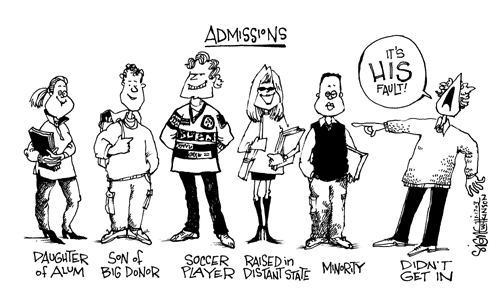
It is still curious to see, however, how far some people go in their desire to blame the educated people for every single of the world's ills.

Sunday, September 13, 2009

Parenting: Fashion and Style

The New York Times has published a very interesting article discussing the influence parental fears have on their children's independence. The article makes a very important point that parents who don't let their children walk a couple of blocks to school and prefer to drive them there instead actually put their children in a  lot more danger than letting them walk by themselves ever would: "Critics say fears that children will be abducted by strangers are at a level unjustified by reality. About 115 children are kidnapped by strangers each year, according to federal statistics; 250,000 are injured in auto accidents." 

I wish the article discussed the psychological consequences of helicopter-style parenting, but still it's a good, thoughtful piece that discusses a very important issue. That's why it's so surprising that the New York Times placed it in the "Fashion and Style" section. The logic behind this placement of the article is difficult to fathom. Do the newspaper's editors watch too much reports about the lives of Britney Spears and the like, which makes them believe that children are a fashion accessory? Do they consider parenting to be as trivial an issue as fashion? Do they think that parenting is by definition a "female" topic and has to be relegated to the "female" section of the paper?

It's funny how the New York Times offers pride of place to Ross Douthat's weekly inanities but relegates a truly interesting piece to the depths of a secondary section that concentrates on mere trivialities.

Friday, August 14, 2009

Male Bodies


So which of these male bodies do you find more attractive? According to the New York Times' Guy Trebay, it's becoming more and more prestigious for men to look like picture 2 rather than like picture 1. According to Trebay's article, "it's hip to be round" for a man.
Of course, different body types attract different people. What's curious about Trebay's article, however, is the ideological spin he puts on male potbellies. There are two main reasons why, according to Trebay, men don't favor having ripped bodies anymore. One is a dislike of President Obama and the qualities we associate with him. Men, says Trebay, "may be reacting in opposition to a president who is not only, as the press relentlessly reminds us, So Darn Smart, but also hits the gym every morning, has a conspicuously flat belly and, when not rescuing the economy or sparring with Kim Jong-il, shoots hoops."
Another reason for the alleged male cultivation of potbellies is a resistance to being seen as gay: "“I sort of think the six-pack abs obsession got so prissy it stopped being masculine,” is how Aaron Hicklin, the editor of Out, explains the emergence of the Ralph Kramden. What once seemed young and hot, for gay and straight men alike, now seems passé. Like manscaping, spray-on tans and other metrosexual affectations, having a belly one can bounce quarters off suggests that you may have too much time on your hands. “It’s not cool to be seen spending so much time fussing around about your body,” Mr. Hicklin said."
As we all know, a patriarchal society places the burden of chasing after an impossible standard of beauty on women. If we are seen as nothing more than a piece of meat, the best we can hope for is to be an attractive, always ready for consumption piece of meat. The idea of being judged according to the same standard often reduces men to a nearly hysterical state. The Washington Post's Mark Regnerus is a prime example of how far men would go to convince themselves that a wallet can more than make up for the lack of beauty and youth in a man. That's it, if you pay a woman enough, she will overlook your lack of physical attraction. Regnerus prefers to believe that there is some part of a female body that gets physically excited at the sight of a big wallet. (We all now that if there is something big we want in a man, it's something other than a wallet, but let's not stress Regnerus out too much.)
I would have really appreciated it if Trebay and Regnerus just honestly said that the contemporary standard of beauty is difficult for both men and women to maintain. That it's painful like hell to be ashamed of your body. That it's a waste of time and energy to chase after the images of beauty sold to us by the media on a daily basis. That it creates feelings of insecurity and promotes eating disorders.
Instead, these authors go to great lengths to convince themselves that they can somehow escape from the cruel demands of today's media-inspired standards of appearance. Even when the very existence of articles such as theirs betrays a profound angst at being judged solely on the basis of their looks.

Thursday, August 6, 2009

The Myth of the Liberal New York Times

As if Ross Douthat's weekly column weren't enough, he now spread out to the regular conversation column with Gail Collins. She normally shares this column with David Brooks in a very weird format where she plays the role of a little lady in need of being enlightened by a big smart man. Now that Brooks is on vacation, Douthat substitutes for him.

Douthat's and Collins's debut column is titled "Are Liberals More Corrupt?" The title alone begs the question of why anybody would claim that this is a liberal-leaning newspaper. They could have asked, of course, "Are Conservatives More Corrupt?" or at least "Which Party Is More Corrupt?" But no, our liberal paper par excellence has no interest in exploring even the possibility of the Republican corruption.

In his response to Collins's vapid questioning, Douthat plunges into theorizing about a vague possibility of liberal corruption. There are no actual facts this "journalist" can offer. All he gives us is this truly bizarre conservative reasoning about how the very existence of government fosters lobbying. Lobbying is bad, hence we have to reduce government to reduce the effects of lobbying. He never stops to consider, of course, that a reduced governmental control will allow companies to do whatever the hell they please without even wasting time and energy proving their case to anybody. Besides, taking out the government in order to reduce corruption is like cutting off your head in order to avoid having to buy hats.

Another scary thing is that in an article about governmental corruption there is not a word about the incredible extent of corruption we have seen under the Bush administrations. Has Douthat heard the words "defense industry"? Did he snooze through the Hurricane Katrina debacle? Is he really so out of touch or is he following the well-known sales technique of "fake it till you make it"?

Monday, July 20, 2009

Race in America


I only managed to watch a small portion of Sonia Sotomayor's confirmation hearings on television. The part I saw was the speech by one of the New Haven firefighters who feels unjustly persecuted on racial grounds by Judge Sotomayor. I have to confess that it was pretty surreal to see a young white male more or less accuse a Latin woman of racism. The firefighter (whose name I unfortunately failed to catch) was on the verge of tears when he talked about being racially discriminated in America.

Today, I saw a replay of the same attitude by yet another white male. This time, it was a New York Times journalist Ross Douthat who decided that somehow his perspective on racism is valuable enough to be shared with thousands of readers. In his article "Race in 2028," Douthat takes on the issue of affirmative action. Of course, no white person who is against the affirmative action will ever honestly tell you what really bothers them about the concept. The arguments against affirmative action always follow the same scenario. "Of course, I hate racism," says the white person (who now, at least in some cases, thankfully omits to say that some of his closest friends are... you know). "But we have to keep in mind," the white person in question immediately adds, "that there are inherent dangers that always accompany this practice."

The ingeniousness of these imaginary "dangers" ranges from simply bizarre to outright freaky. Douthat's justification for his dislike of affirmative action, Sonia Sotomayor and Barack Hussein Obama (don't the conservatives just love the president's middle name) is corruption. "A system designed to ensure the advancement of minorities will tend toward corruption if it persists for generations, even after the minorities have become a majority," he says and later continues: "But if affirmative action persists far into the American future, that experiment will have failed — and we will all have been corrupted by it." Of course, there is no explanation of how he manages to connect affirmative action and corruption except a hint towards "the backroom dealing revealed by Ricci v. DeStefano, where the original decision to deny promotions to white firefighters was heavily influenced by a local African-American “kingmaker” with a direct line to New Haven’s mayor." For anybody who has lived in New Haven (as I did for several years) the idea of some kind of African-American mafia that influences the mayor and corrupts court proceedings in that city sounds outlandish.

Racism in New Haven is palpable. It's something you live and breathe every single day. That's why it was so shocking to see the white firefighter who somehow managed to dissociate his speech at the confirmation hearings from the everyday reality he experiences in his town. I look at people like the firefighter and Douthat and I wonder how it is even possible for them to avoid the simple realization that absolutely everything they have, do, and experience is the result of centuries of racial discrimination in America.

Affirmative action must come "with a statute of limitations" claims Douthat. It needs to be "phased out" very soon or the white folks will start to get upset and it will turn into "a source of permanent grievance among America’s shrinking white population." It's curious to observe that Douthat honestly believes that it's the white population who has a cause for "permanent grievance." Note the weird, convoluted logic here. Centuries of slavery and segregation only deserve a couple of years of redress. The existence of affirmative action for several decades, however, will justifiably provoke a permanent sense of grievance on the part of folks like Douthat.

Another thing that bothers me in the discussion about affirmative action is this idea that affirmative action is something that racial minorites need and we, the kindly white people, give to them out of sheer niceness. Albeit in different ways, racism hurts every one. It's not the problem of African-Americans or Hispanics. It's the problem of the entire society. It's not a question of what "we" do for "them". It's a question of what all of us should do for ourselves, our society.

I'm very much in favor of affirmative action for my university. I want African-American, Asian, Hispanic, and Native American students in my class. But not because I'm so nice and kind and want to do something good for them. As a teacher, I need these students desperately. I need their contribution, their perspective, their knowledge, their presence, and their talent. I hate Douthat and Co's attempts to coopt my voice as a representative of the "shrinking and permanently aggrieved white population." Racism is what permanently aggrieves me, not affirmative action.

Monday, June 29, 2009

Douthat Comes up with Something Half Decent


I'm very glad that I didn't give up on Ross Douthat after his series of silly and chauvinistic articles. Because today he finally came up with a piece that isn't half bad (If it came from anybody else, I would say the article is pretty much intellectually impotent. Coming from Douthat, however, it's almost a revelation). In his NYTimes article "The Way We Love Now," Douthat talks about how romantic and sexual experiences vary across class lines.

Clyde Griffiths, the protagonist of Theodore Dreiser's amazing novel An American Tragedy, realizes that what distinguishes him from the class of rich and powerful men he desperately wants to join is their seeming indifference to sex. In order to succeed in America, you have to tame your sex drive to the point where it will only exist within the strict patriarchal norms of a Puritanical society. Clyde doesn't manage to do that and sees his dreams of social ascension crumble.

Almost 90 years later, Ross Douthat arrives at the same idea: "The difficult scramble up the meritocratic ladder tends to discourage wild passions and death-defying flings. For bright young overachievers, there’s often a definite tameness to the way that collegiate “safe sex” segues into the upwardly-mobile security of “companionate marriages” — or, if you’re feeling more cynical, “consumption partnerships.” This tameness has beneficial social consequences." Of course, if Douthat had read Dreiser in college, he wouldn't have to struggle so much to come up with this analysis. At this point, however, I'll take whatever I can get.

Of course, Douthat's solution is, as usual, shocking in its blatant contempt towards the lowly proles. The poor should give up on sexual excesses, which in turn should be reserved for the Douthats of the world: "Better, perhaps, if this dynamic were reversed. Our meritocrats could stand to leaven their careerism with a little more romantic excess. (Though such excess is more appropriate in the young, it should be emphasized, than in middle-aged essayists and parents.) But most Americans, particularly those of modest means, would benefit from greater caution and stability in their romantic entanglements."In spite of the parenthetical disclaimer, Douthat's entire piece is obviously motivated with envy towards those who are either too high up or too low down on the social scale to care about the repercussions of their "romantic excess." It's great to see, however, that - whatever the cause - Douthat finally manages to arrive at a thought that can be turned into something productive.

Friday, June 26, 2009

Anger


An article by Dr. Robert Allan suggests that it's not a good idea to vent your anger. People who express their rage are more likely to die of a heart attack, according to this doctor.

So many people are very very angry today. They are angry because of the loss of their savings, because they have suddenly found themselves unemployed, because their house has been taken away from them, because they've been on the job market with no results for months and there is still no prospect of a job in the foreseeable future.

I have no doubt that Dr. Allan, whose main point is to teach people that directing their rage at those who have harmed them is dangerous and wrong, will never have any problem with getting funding for his research. His strategy is great: scare people with the possibility of disease. Since those people who are the angriest right now are also the ones with no medical insurance, it might really work.

I'm not saying that the good doctor is doing this on purpose. It's just that, somehow, he found the right spin he can put on the results of his research. The social (as opposed to medical) value of his data soared.

I'm not a doctor but I disagree with Dr. Allan. Anger is good, it can lead us to very productive things. It can lead us to look at our lives critically and change what we don't like. Behind every movement for social justice there's been a lot of anger. My favorite feminist sticker says "If you are not outraged, you are not paying attention." So, to hell with this doctor's advice. Let's be angry.

Wednesday, June 17, 2009

Fat-Shaming

Why does it happen that every time I attempt to read the New York Times I immediately encounter some truly outrageous piece that makes me angry? I keep asking myself why on Earth people keep insisting that it is a liberal newspaper?

Today, Maureen Dowd decided to repair her destroyed reputation and came out with a really snarky article that epitomizes fat-shaming. In her op-ed piece "Hold the Fries," she analyzes President Obama's eating habits in order to slip in her tired fat-is-bad message. The main idea of the article: when alone, Obama eats healthy, but when cameras are present he sometimes - oh, the horror, the horror! - consumes hamburgers to cater to the tastes of us, lowly fat people. She writes with reverence about how once "over a three-hour meal, he managed the impossible feat of nibbling only one French fry." The language of the quote is very telling. "Nibbling" is obviously a good thing for this journalist. You can just feel Dowd's admiration flowing. Forget about being elected as a first African-American president in history. The real feat is managing to avoid the fries.

The conclusion of Dowd's article is equally condescending: "Maybe when Charlie Gibson and Diane Sawyer come next week to broadcast a special on health care from inside the White House, the president should forgo the photo-op of the grease-stained bovine bag and take the TV stars out for what he really wants and America really needs: some steamed fish with a side of snap peas." See how this journalist knows exactly what we need to eat? Her disgust with "grease-stained bovine bags" is palpable. Actually, the word "grease" seems to be an important part of Dowd's vocabulary. A fast-food place for her is necessarily a "greasy spoon."

In short, the message is clear: nibbling good, eating bad. When the President "nibbles" he gets approval, when he eats more than one fry he's a self-promoting hypocrite.

Dowd must believe that without her valuable contribution there isn't enough fat-shaming in the media already. Not enough people suffer from anorexia and bulimia, not enough people hate their bodies and spend their lives looking for the next miracle diet. Let's help the dieting industry grow some more by promoting the image of a popular President as someone who "wants to stay skinny." Dowd has no interest in analyzing how and why the word "skinny" has come to be perceived as invariably positive. Obama wants to be skinny (which might not even be true), so we all should.

As we all know, there has been absolutely no proof that being "skinny" is beneficial to anybody's health. There is, however, more than enough data about the physical and psychological damage fat-shaming causes. Under the false pretense of worrying about the nation's health, Dowd's article (among many many others) causes a lot of harm and benefits no one. Except the companies that push diet pills, of course. I wonder if they thought of sending Dowd flowers. She's trying to boost their profits so hard that she definitely deserves some recognition.

Tuesday, June 9, 2009

Ross Douthat's Hatred of Women

On the pages of the New York Times, a newspaper that some people mysteriously claim is liberal, Ross Douthat continues to regale us with the sputum he produced as a result of his latest anti-women fit of hysteria. This time, Douthat uses the murder of Dr.Tiller, an incredibly tragic event for any decent human being, in order to bring to light his contempt of women. Of course, he tries to hide his chauvinism behind a tide of empty verbiage but this kind of hatred is too noticeable to be concealed.

Unlike reasonable, enlightened, healthy men with satisfying personal lives (such as President Obama obviously is), Douthat can't concede that women are capable of deciding what happens within their bodies for themselves. He feels that, in spite of not being likely to get pregnant any time soon, he needs to have an opinion on pregnancies. He speaks at length of the difference between a healthy and an unhealthy pregnancy in an attempt to convince his readers that he, Douthat, and not the actual pregnant women and their doctors are better qualified to make that distinction.

He also joins the group of those who try to justify Dr. Tiller's assassination by suggesting that Dr. Tiller performed abortions "on healthy mothers and healthy fetuses." Yet again, I highly doubt thaat Douthat saw these women or these fetuses. He does, however, consider himself qualified to diagnose a group of people he has never seen. And all this just in order to suggest that Dr. Tiller has actually deserved being murdered.

The goal of this piece is to suggest that abortion be "returned to the democratic process." What that means for a virulent chauvinist like Douthat is that we should stop the discussion of third-trimester medical exemptions and move on to the attempt to prohibit second-trimester abortions. Can anybody guess what the next step would be?

Of course, a possibility of stopping any discussion of third, second or first term abortions in order to leave this decision to women and their doctors is too painful for Douthat to contemplate. Women, deciding what to do with their bodies??? Never! Mr. Douthat can make that decision so much better.

Why is Douthat incapable of accepting that women can make reasonable, intelligent, well-informed decisions about their own bodies? I can't help suspecting that the reason lies in this individual's personal history with women. If he accepts this, he will also have to accept that all the women who denied access to their bodies to him (many, many women, judging from his level of hatred) did this because they are unreasonable, stupid, and don't know what's best for them.

P.S. Here is a link to an article by the talented Jodi Jacobson exposing Douthat's lies and distorions.

Monday, June 8, 2009

School Reform

What is it with the New York Times and school reform? Every new article they publish on the subject is even more hilarious than the previous one. Yesterday's article by Harold Levy titled "Five Ways to Fix America’s Schools" contains some pretty interesting suggestions. They are, however, undermined by certain statements that cannot possibly be taken seriously.

Consider at the following sentence: "Just as we are moving toward a longer school day (where is it written that learning should end at 3 p.m.?) and a longer school year (does anyone really believe pupils need a three-month summer vacation?), so we should move to a longer school career. " In my opinion, EVERYBODY would absolutely benefit from a 3-month summer vacation. I most certainly do and I'm not a child. Do we aim to make kids hate school by forcing them to spend their entire lives there? Do we want to turn them into little adults, who work 9-5 workdays 50 weeks per year? This regimen, in my view, is even detrimental to grown-ups, let alone children.

But this is far from being the most egregious (or the most entertaining, depending on how you choose to look at it) part of the article. This is how Mr. Levy proposes to fight against truancy: "But truant officers can borrow a page from salesmen, who have developed high-pressure tactics so effective they can overwhelm the consumer’s will. Making repeated home visits and early morning phone calls, securing written commitments and eliciting oral commitments in front of witnesses might be egregious tactics when used by, say, a credit card company. But these could be valuable ways to compel parents to ensure that their children go to school every day. " This is so bizzare on so many levels that I hardly know where to start. What kind of parents would allow a truancy officer to barge into their house early in the morning and bully their child in front of them with the purpose of "overwhelming the child's will"? Also, what is the use of education that is so violently enforced? You can force somebody into the school building but you cannot force them to learn. You just can't. The only way of making anybody learn anything is through making them interested in the subject. There is no other way.

In conclusion, I want to say that when I was younger I practiced truancy as a way of life. I wouldn't show my face in school for months. I would come up with most egregious lies possible to justify my truancy. This did not, however, prove to be in any way detrimental to my life or education. I have 5 scholarly degrees, one of which is a PhD from an Ivy League school. As an educator, I never punish my students for missing class. My goal is to make them want to be in my classroom. If they only come because they are scared of the repercussions, their presence in class is useless both to me and to them.