Showing posts with label mystery. Show all posts

Saturday, May 14, 2011

Jo Nesbø’s The Snowman: A Review


The inexplicable success of Stieg Larsson’s mysteries is the best thing that has happened to Scandinavian writers since Selma Lagerlöf. Larsson’s untimely death left a void that publishers are trying to fill desperately. Scandinavian names, long descriptions of cold weather and depictions of carnage in Sweden, Norway and Denmark are suddenly in vogue. Since many Americans are a bit confused on where Sweden is actually located, all European mystery authors are experiencing a surge of interest in their books.  


As you can see from the cover of Jo Nesbø’s The Snowman, this author’s publishers are doing all they can to milk Stieg Larsson’s fame for all it is worth. This, however, is something that, in my opinion, this author doesn’t need. This book is very good. Its only defect is that it is too drawn out. In his zeal to create as many twists to the plot as humanly possible, Jo Nesbø goes a bit too far and creates a 100 or so pages somewhere in the middle of this long book that feel quite redundant.

If I had to compare Jo Nesbø’s style of mystery writing to another author’s, I would say he bears no similarity to the weirdly boring Stieg Larsson. Rather, Jo Nesbø is the Norwegian version of Michael Connelly. (Connelly apparently agrees and has published rave reviews of this writer’s work.) Nesbø’s protagonist called Harry (sic!) Hole is a police officer on a mission. He is also a lonely drunk and a die-hard romantic who gets treated badly by the woman he loves. Nesbø isn’t nearly as good as Connelly in creating a complex and richly-layered protagonist. His Harry looks a little cartoonish at times. He is much better than Connelly, however, in writing the ending to his mystery. Connelly’s endings tend to be much too abrupt. This gifted writer doesn’t seem to realize that you cannot announce the culprit’s name on the last page and just be done with it. The laws of the genre require that after the culmination there should be a winding-down period where the readers are offered an explanation of either what drove the murderer to commit the crimes or a description of the deductive process of the detective that resulted in solving the mystery. Nesbø’s ending is absolutely perfect.

The Snowman is a serial killer mystery. In the novel, Norwegians seem quite frustrated with the fact that they alone, of the three Scandinavian countries, have failed to produce a serial killer of their own. There are other cute moments in the book that have a very specific Norwegian flavor. See, for instance, the following passage that would have Ayn Rand die all over again were she around to read it:
'It's a very small shop. We don't have many customers. Almost none until the Christmas sales, to be honest.''How. . .?''NORAD. They support shops and our suppliers as part of the government's trade programme with Third World countries. The message it sends is more important than money and short-sighted gain, isn't it.'
This is, of course, a very dangerous game that the third richest country in the world (after Luxembourg and Qatar) is playing. Oil comes and goes while people who have been corrupted by such ridiculous handouts remain.

There are some sparks of wisdom in this novel that I wanted to share with you. One of the characters says, for example:
Our generation has turned itself into servants and secretaries of our children. . . There are so many appointments and birthdays and favorite foods and football sessions that it drives me insane.
Anybody who has observed the frantic scrambling of the Western parents to organize endless play dates and activities for their children will have to agree with this observation. 

I enjoyed this book quite a bit and recommend it highly. Of course, it didn't hurt that snow was mentioned pretty much on every single page making this summer heat somewhat more bearable.

Saturday, May 7, 2011

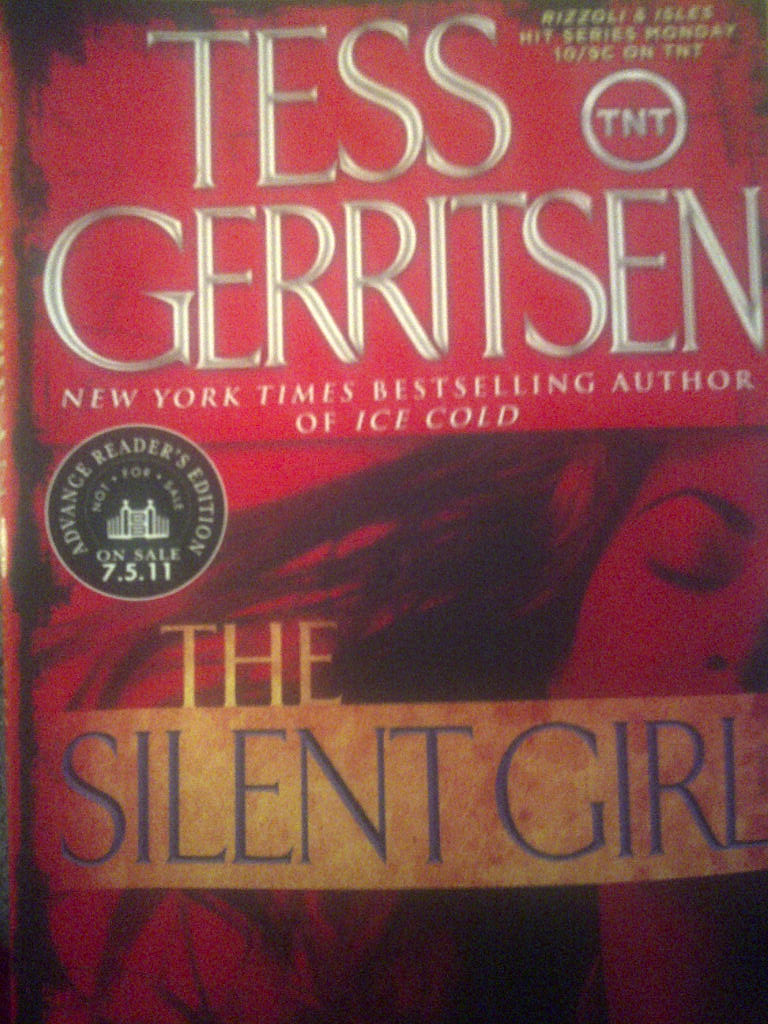
Tess Gerritsen's The Silent Girl: A Review

Tess Gerritsen used to be a very unique mystery writer. Her Rizzolli and Isles series featured a police officer, Jane Rizzolli, and a medical examiner, Maura Isles, whose unconventional personal lives and intense personalities made the series especially interesting to follow. Gerritsen was a writer who did blood and gore especially well. If you are into the mystery novels filled with descriptions of human entrails glistening against the snow, torture and detailed autopsies, Gerritsen was the writer for you. She never shied away from explicit scenes and, as a result, managed to create some of the most memorable serial killer novels around.

And then television happened. A very stupid show started being filmed based on Gerritsen's novels. The Silent Girl is the first novel by Gerritsen that came out since Rizzoli & Isles hit TNT. It isn't a bad book at all, mind you. The mystery is good, the culprit is difficult to identify, the plot has quite a few twists and turns, the book reads very easily. The problem with The Silent Girl is that it isn't a Gerritsen novel. It's another installment of a very mediocre TV series. Rizzoli and Isles have been transformed into good girls whose personal lives are boring enough to be suitable for prime time. To give an example, Maura Isles isn't engaged in her long-standing affair with a priest any more. She has now turned from a cold and harsh person into a weepy, miserable creature who is all of a sudden dedicated to wannabe mothering of a teenager more than to her career. Gory scenes have been substituted with descriptions that would look good on TV: Chinatown, martial artists, an obligatory scene with a mafioso, a grieving parent or two, mythical creatures leaping from roof to roof, etc. 

I used to look forward to Gerritsen's new novels coming out. Now, however, she is no different than hundreds of other authors who produce sanitized, conventional mysteries that aim to be filmed rather than read. Until Rizzoli & Isles gets cancelled, it hardly makes any sense to read another Gerritsen mystery.

The Silent Girl will come out on July 5. 

Tuesday, April 26, 2011

Male and Female Sleuths, Part II

The reason why I enjoy Michael Connelly's Hieronymus Bosch series is that this writer manages to create a truly complex and ever-evolving male protagonist. This is a risky proposition since it means that the novels in the series have to be read in order. Otherwise, Harry Bosch's personality simply doesn't make sense. I have now read seven of the novels in the series and the main character still manages to surprise me. 

There is, however, one area of Harry Bosch's life where he sadly resembles the classic male sleuths of Conan Doyle, Agatha Christie and Chesterton. What Holmes, Poirot and Father Brown have in common is a complete absence of any personal life whatsoever. Not only are these characters completely and utterly sexless, they also lack any family members. It is true that Miss Marple is also not known for her wild sexual exploits. She does, however, have a slew of relatives whose stories provide her with clues she uses to solve her mysteries.

The reason why the classic male protagonists of mystery novels lead such sexless lives is, in my opinion, that the authors of these books cannot afford to antagonize their female readers. In the noir genre and the spy novels that are geared mostly towards male readership, male protagonists engage in numerous sexual adventures. Female readers, however, do not appreciate male characters who have too much sex. When recently Elizabeth George killed off the character of Helen, Inspector Lynley's wife, and had Lynley have sex with another woman, a huge number of her readers reacted with outrage. 

Of course, Connelly couldn't have Bosch, a police officer in Los Angeles at the turn of the XXI century, lead a completely sexless existence. Instead, the writer chose the path of turning Bosch into a constant and wistful victim of women who use him, manipulate him and dump him. Every single one of Bosch's love affairs follows the same path: he acts the role of a sad troubadour to a woman whom he keeps serving long after she betrays and abandons him.

Connelly's Bosch novels are an important step in the direction of creating believable, multi-faceted male sleuths. This project, however, is far from being complete, and even Connelly took a huge step back when he introduced his new Mickey Haller series which features a one-dimensional protagonist who follows all of the worst conventions of the genre.

Male and Female Sleuths, Part I

It is extremely rare to find a male detective in a mystery series who has a complex, multi-faceted personality which grows and transforms over the course of the series. Male sleuths tend to be assigned a set of quirky characteristics in the very first novel of the series. Then, references to these quirks and tics are made in the subsequent novels to remind us of what this character is supposed to be like. Even Ruth Rendell, whose greatest talent (among many) resides in creating complex, fascinating characters, fails to do so with her Inspector Wexford. In Rendell's Inspector Wexford series, we see this character over the course of fifty years and can safely say that he experiences absolutely no changes in terms of his personality. For this reason, I have always found this series to be quite boring.

Or take, for example, Elizabeth George's Lynley and Havers series. Lynley, the male sleuth, is always the same. If you have read a single one of these novels, you know all there is to know about this character's personality. Female sleuths, however, fare a lot better. They are given personalities that are complex, profound, growing, changing with every new installment. Barbara Havers, the female protagonist of George's series, differs from her male counterpart Inspector Lynley in that her experiences in these novels help her grow. The Havers of A Great Deliverance (the first novel in the series)  is not nearly the same person we encounter in This Body of Death, which is the most recent installment.

The same could be said about many other female detectives. Laura Lippman's Tess Monaghan, Lisa Gardner's D.D. Warren, Tess Gerritsen's Jane Rizzoli and Maura Isles are complex, interesting characters whose personalities undergo profound transformations in the course of the series.

I believe that the reason why male sleuths are frequently so flat, cartoonish and boring lies in the tradition of the early classics of the mystery genre. Sherlock Holmes, Hercule Poirot and Father Brown are the models on which the entire cast of later male sleuths was built. These three classic sleuths are quirky and original. They are, however, always the same. Poirot's personality is exactly the same in The Mysterious Affair at Styles as he is in Curtain. As for Holmes and Father Brown, I have read all stories featuring these characters (usually more than once) but for the life of me couldn't figure out the chronological succession of these stories.

(To be continued. . .)

Tuesday, April 12, 2011

Why Didn't I Discover Michael Connelly Sooner?

My brain was about to melt from all the philosophy I had to read in the past two weeks, so I realized that I needed a new mystery series to provide a distraction from the complexities of Badiou and Laclau. Since my fellow Kindle owners are really into Connelly these days, I decided to start reading him, too.

All of my favorite mystery writers are women. There is a single male author whose work I follow (John Lescroart) but the rest are women. I'm over the cozy mystery genre, which is what male writers do best. If you want scary, gritty and bloody, you have to go with female writers every single time. Male mystery authors are squeamish about blood and gore, while their female colleagues pile up horrors in a very cavalier fashion.

Michael Connelly, however, is very good. He has two series that sometimes overlap: the police procedurals whose main character is a policeman called Hyeronimus Bosch (seriously) and courtroom dramas staring a lawyer called Mickey Haller*. The Mickey Haller series are quite crappy. The author based his protagonist on the cliche-ridden legacy of the noir fiction. If you are sick and tired of the characters developed by the supremely boring Raymond Chandler, Mickey Spillane and Dashiel Hammett, then you will be equally bored by this series from Michael Connelly.

There are two big drawbacks to the otherwise great Hyeronimus Bosch series. The first one is that Connelly doesn't know how to end a mystery novel. His endings tend to be very unimpressive. "Here is the killer, case closed, the end." This author seems to have no idea that a good mystery doesn't end when the killer is revealed. At least a few pages need to be dedicated to the explanation of some previously unknown details about the crime, the criminal, or the search for the criminal.

Another huge problem I have with Connelly's books is that they are set in L.A. Honestly, don't writers get tired of placing every other series that comes on the market in the same city? I'm sick and tired of L.A. already and I've never even been there. And it isn't just about the same annoying geography. When you place a detective series in L.A., this will define what the books in the series will be about. For example, whenever a novel is set in L.A., it's bound to be filled with aspiring actors and actresses who don't manage to make it in the movies and turn to prostitution. (Now that my favorite TV series Law & Order had also moved to L.A., I'm getting annoyed every time I hear this city's name.)

In spite of these issues, however, Connelly's Hyeronimus Bosch novels are very good. The writer's greatest achievement in this series is the protagonist. Connelly has to be commended for reducing the noirish characteristics of the protagonist to a minimum. Writing about an LA police officer who worked in LAPD from the 1990ies on is fraught with danger. Connelly obviated the immediate dislike for a character who is an LA cop by creating a sensitive and tortured policeman. "Taking cases straight to heart is the way of the true detective. The only way," Bosch announces in Echo Park in a way that would be pompous had it come from someone else. Coming from this particular character, though, the statement is very believable.

* From what I've been able to gather, Connelly has some stand alone novels too but I haven't been able to take a look at those yet.

Wednesday, April 6, 2011

Gender Stereotypes and the Mystery Genre: From Christie to Rendell

In the mystery genre, no one can compare with the amazing British authors Agatha Christie and Ruth Rendell. The first of these authors created the genre* while the second one took it to incredible heights in a number of extremely well-crafted novels. Compared with the psychological and literary sophistication of Rendell's work, Christie's novels seem primitive. The language is simple, the characters are one-dimensional, and the plots are quite similar.

One thing, however, is shared by the two queens of the detective genre. Both Christie and Rendell know extremely well how to manipulate the gender stereotypes of their times to create a mystery their readers will not be able to solve. Take, for example, Agatha Christie's The Moving Finger and Ruth Rendell's A Fatal Inversion**. In The Moving Finger, Christie attempts to prevent the readers from guessing the identity of the criminal by relying on their misogynistic vision of what constitutes "male" and "female" kinds of crime. This particular gender stereotype has lost its currency completely in the decades that elapsed since the novel was published. As a result, The Moving Finger is one of the lesser known of Christie's novels. A modern-day reader will have no trouble guessing what really happened since the gender stereotype is the only thing standing between the reader and the realization of the criminal's identity.

Ruth Rendell's A Fatal Inversion is one of this prolific author's best mysteries***. Vulnerability is the topic she explores in this novel in a stunningly successful way. Her characters are vulnerable to all kinds of things: sexual obsession, insanity, the desire to fit in at all costs, fear of rejection, the desire to fit in, alcoholism. The question of which one of them will prove to be the only truly resilient one remains unanswered until the stunning ending of the book. However, if it were not for our deeply-ingrained gender stereotypes, that ending would not surprise us in the least.

Hopefully, the gender stereotypes that Rendell based her novel on will pass into oblivion one day, just like the ones that informed Christie's outdated mystery I have discussed here****.

* Edgar Allan Poe and Arthur Conan Doyle created the genre of the police procedural, not the mystery novel as such. Christie's Hercule Poirot makes vicious fun of Sherlock Holmsian type of characters. Rendell has written quite a few police procedurals (her Inspector Wexford series), which I consider to be vastly inferior to her mystery novels.

** The novel was published under Rendell's nom de plume Barbara Vine.

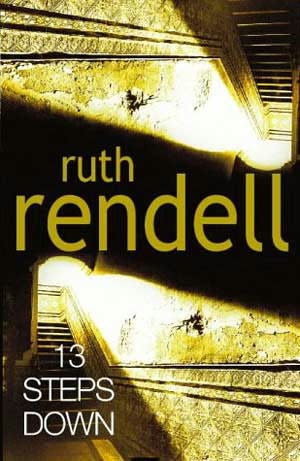
*** A Fatal Inversion, The Bridesmaid and Thirteen Steps Down are Rendell's best novels, in my opinion. If I weren't wary of making this list too long, I would add The Chimney Sweeper's Boy and No Night Is Too Long to the list of her best work. If you like the mystery genre but still have not read anything by Rendell, what are you waiting for? She is absolutely the best. 

**** I have tried to discuss the plots of these novels as little as possible here to avoid spoiling the pleasure of their future readers.

Wednesday, March 23, 2011

Ricardian: A Review of Elizabeth George's "I, Richard"


Elizabeth George's collection of short stories I, Richard hasn't been received very well even by her hardcore fans. The reason for what I believe is an unfair rejection of this collection is the disappointing first story titled "Exposure." If you decide to read I, Richard, I suggest you skip this story altogether and enjoy the rest of the collection.

Only the very last story, "I, Richard" belongs to the genre of Ricardian Apology. George wrote this story to make her Ricardian allegiances known to her fans. Of course, as a mystery writer, she couldn't fail to structure this story as a modern-day murder mystery that is inspired by one of the character's belief in Richard's innocence. 

George is different from many Ricardians in that she does not blame Henry Tudor for killing the young princes. This writer makes us question why we always assume that history was made by men. She allows a woman (of course, I will not spoil your reading pleasure by telling you her name) to become a protagonist of the story. Both the mystery of the princes' murder and the modern-day mystery that frames them are based on the idea that dismissing female protagonism is a big mistake. George reminds us that women make history as much as men do. Those men who try to treat women as objects with no will of their own always end up paying a very high price for this delusion.

Sunday, March 6, 2011

Ricardian: A Review of Josephine Tey's The Daughter of Time

Most of my readers didn't warm to my first Ricardian post. This is completely understandable since the subject of whether Richard III did, in fact, murder the princes Edward and Richard in the summer of 1483 is quite academic. I will keep indulging my love of Ricardian arcana from time to time, while you should feel free to skip posts tagged "Ricardian" if the subject bores you. 


Josephine Tey created several classical British mysteries that any lover of the genre would appreciate. Few people know, however, of her contribution to Ricardian Apology. In The Daughter of Time, Tey offers us her take on the provenance of the myth that blames Richard III, the last Plantagenet king of England, for the murder of his nephews (the Princes in the Tower.)

Inspector Alan Grant finds himself stuck in a hospital, bored and desperate to participate in some sort of an investigation. While he is in a hospital bed, he only has access to history textbooks. The story of Richard III catches his eye and as he begins to read accounts of Richard's "crimes", Grant realizes just how senseless and lacking in logic all accusations against Richard are.

I might have believed Grant's asseverations
that murderers don't look like this
had I never seen pictures of Ted Bundy,
a wholesome-looking serial killer
The Inspector's journey begins in a way that I didn't find very convincing. Grant looks at the famous portrait of Richard III and realizes that a man who looks this way could not have possibly been a cold-blooded murderer of two small boys. This, of course, is very naive and smacks of Lombrosianism that had been discredited long before Tey wrote The Daughter of Time.

This, however, is the only weak point of an otherwise logical and reasonable account of the numerous holes in the myth of Richard's guilt. Inspector Grant and a young researcher who helps him discover the truth soon realize that Richard III had absolutely no reason to kill his nephews. The boys had been declared illegitimate by an Act of Parliament and Richard III occupied the throne as a well-loved and legitimate King of England. Elizabeth Woodville, the boys' mother, was friendly with Richard III until his death. Would she had visited his court and allowed her daughter to do so had Richard III, indeed, murdered her small sons? That seems highly unlikely. Moreover, after Henry Tudor defeated Richard III in the Battle of Bosworth Field, he never declared publicly that Richard had killed the boys or even that the boys were dead. He did, however, imprison the boys' mother in a convent. 

In the view of these facts, Grant arrives at a conclusion that the first Tudor king, Henry VII, was the only person with means, motive and opportunity to kill the Princes. Having absolutely no claim to the throne, he needed to destroy the Plantagenets so that nobody would dispute his rise to power. I need to tell you right now that not every Ricardian shares Tey's belief in the culpability of Henry Tudor. There are many other suspects, and you can make up your own mind as to which one is the likeliest murderer. I will keep bringing you these accounts on a regular basis.

Tuesday, January 4, 2011

John Lescroart's Damage: A Review

In case you don't know, John Lescroart is the author of a great courtroom drama series set in San Francisco. Unlike Grisham, who also writes best-selling courtroom dramas, Lescroart actually knows how to write a good sentence in English. For those who love San Francisco (and how is it possible not to love this magical city?), Lescroart's novels will be especially interesting to read. Even if your vision of San Francisco is different from Lescroart's, you can't fail to find his admiration for the city to be infectious.

Lescroart became famous as the creator of the Hardy / Glitsky series featuring Dismas Hardy, a lawyer, and his best friend Abe Glitsky, a police officer. Both Hardy and Glitsky are complex, interesting characters who are often tortured and always far from perfect. A little while ago, Lescroart must have decided that the Hardy / Glitsky series had played itself out and came up with a new protagonist for a new series: Wyatt Hunt. The resulting The Hunt Club, Treasure Hunt (Wyatt Hunt), and A Plague of Secrets were so weak that they almost made me abandon this writer for good. With the Wyatt Hunt character, Lescroart committed what is a huge mistake for such an experienced author: he created a protagonist who is so perfect as to be completely disgusting. Wyatt Hunt is an athlete, a musician, an investigator and a know-it-all whose favorite things to do are to save damsels in distress and rescue abused children under dramatic circumstances. In order to make him even more attractive, Lescroart surrounded him with extremely pathetic characters whose goal was to present Hunt with even more opportunities to shine.

Tonight, however, Lescroart finally released a novel that lives up to his erstwhile standards. Damage finally abandons the inane goody-two-shoes of Wyatt Hunt and his coterie of helpless losers and focuses on Lescroart's trademark characters Abe Glitsky and the hippie lawyer turned District Attorney Wes Farrell. (Hardy's fans need to be forewarned that Hardy appears only briefly in Damage.)

I had pre-ordered this novel on Kindle several months ago. Yesterday, I stayed up until 2 am (the time when Amazon sends out pre-ordered new releases) because I couldn't keep waiting any longer to see how this novel would turn out. Then, I couldn't sleep because I just needed to read it. Today, I'm happy to report that the novel is definitely worth all that trouble. It's really good. There are great courtroom scenes which, however, are not excessive. There is a mystery that keeps you in suspense until the end (although, I have to confess that I guessed some of it. Still, that's not surprising given the extent of my familiarity with this author's books.) There are personal dramas, power struggles, corruption, and truly memorable characters. In short, this is one of Lescroart's best novels, and this is saying a lot with such a prolific and gifted author.

Saturday, December 4, 2010

Ruth Rendell's Tigerlily's Orchids

Life is hard for us, American-based fans of the incomparable mystery author Ruth Rendell. Every time her new book comes out, we either have to sit around waiting for over 18 months for an American edition to come out, or hunt around for a copy someone might have brought from Great Britain and might be willing to sell. Some people, of course, are lucky enough to have close friends in Great Britain and can pester them for a copy of Rendell's new book. I have not been blessed in this department, so I have to cast my lot with used books sites.

Ruth Rendell is admirable on several accounts. As an auto-didact, she has a range of vocabulary and the breadth of erudition that many of her Oxford-educated peers do not possess. She is 80 years old, but this prolific writer keeps releasing new books on a regular basis. The great changes that have taken place in our Western societies over the last 50 years and the incapacity of many people to adapt to said changes form one of Rendell's favorite topics. Still, this writer who was born in 1930 has an astonishing understanding of today's realities. In my favorite novel by Rendell ever, 13 Steps Down, she created a memorable character of Gwendolen Chawcer, an elderly bookish spinster who is terrified of "new-fangled" (her favorite word) devices such as computers and microwaves. Even though Rendell understands how terrifying modern reality can be to older people, she seems to have a perfect grasp of today's modes of existence.

Her most recent novel* Tigerlily's Orchids (Import Edition) Hardback is not Ruth Rendell's best work but it's still a joy to read. The book is light on mystery. You pretty much know exactly what's going to happen, and there is little (if any) suspense. The strength of Tigerlily's Orchids (as well as of this writer's entire corpus of work) lies in Rendell's gift of creating delightfully quirky characters who are weird in most endearing ways. I am usually horrible with characters' names (which, believe me, is a huge problem for a literary critic.) You can see me engrossed in a book and ask me what the names of the protagonists are, and more often than not I will not be able to say. Ruth Rendell, however, is so good at creating memorable characters that even my unreliable memory always retains their names.

What I like the most about Rendell's books is her skill in taking any minor quirk in a character's personality and demonstrate how this touch of strangeness can gradually develop into full blown insanity, taking this character along some very dangerous paths. I might be projecting here, but I believe that everybody has this little place within them that houses some uncanny oddity, some little spot of the bizarre, some minor obsession. We keep it under control - for the most part - but it's very pleasurable to imagine it unleashed, they way it is in Rendell's books. I have read interviews with Ruth Rendell and I have no idea where this proper and quite sheltered older lady** found her deep knowledge of the darker side of human psyche. Still, nobody writing today describes a gradual slippage into insanity better than Rendell.

If there is a Rendell fan among my readers, please make yourself known. I have tried foisting Rendell's books on everybody around me but, somehow, I can't find a true lover of Rendell's books among people I know.

* Rendell's The Vault is scheduled to appear in 2011 to the delight of her fans all over the world.

** Rendell is also a very kind human being. When I was a teenager in Ukraine, I wrote her a letter to express my admiration of her novels, and she responded with a long letter and a gift of books. It was next to impossible to find new Enlgish-language books in my country at that time, so this gift was priceless to me.

Wednesday, October 6, 2010

Laura Lippman's Hardly Knew Her: A Review

Female writers are often terrified of their own literary talent. They take refuge in writing mystery novels where they can vent their artistic frustrations through describing fictional mutilations, torture and dismemberments they inflict on their female characters. The most violent, gruesome descriptions of torture inflicted on women and children can be found exclusively in mysteries written by women. Tess Gerritsen and Lisa Gardner, for example, specialize in scenes of female torture and debasement that are almost too painful to read.

Many people have tried to figure out why this happens. Elizabeth George, for instance, recently wrote an article on the subject suggesting that this occurs simply because readers don't care enough about male victims. Describe the murder of a man in your novel, she says, and it is guaranteed not to sell. I feel, however, that female writers create mystery novels that are so much angrier than male mysteries because they experience a degree of frustration in their daily lives and creative endeavors that is unknown to their male colleagues.

Not all female mystery writers cultivate the excessively gruesome variation of the genre. The amazingly talented Tana French and Laura Lippman write really great fiction that masquerades as mystery through a half-hearted addition of a couple of dead bodies here and there. While Tana French seems to be moving to a stage in her writing where dead bodies become more perfunctory than ever with every new novel, Laura Lippman still isn't ready to quit pretending she is a lot less talented than she is. Hardly Knew Her is a collection of Laura Lippman's short stories that are so good they could almost be compared to Joyce Carol Oates's. There is some sort of a crime in each of them but this collection is so much more than that.

Lippman's stories explore various ways in which women sell sex for money. The stories are very different, they are narrated in very distinctive voices and are set in extremely different social surroundings. Still, each of them addresses the relationship between sex and money in a way that is always insightful and fresh. Cheap didacticism is alien to Lippman. Among her female characters who sell their bodies in a variety of inventive ways, the only one who has character and integrity is a career prostitute. She is, of course, despised by housewives who believe that selling themselves just to one man is somehow better. Lippman makes it very clear that her sympathies lie with the honest, resourceful prostitute and not with the spoiled housewives who go to great lengths to convince themselves of their non-existent superiority:
“Is there anyone who works harder than a stay-at-home mom?” Ditchdiggers, she thought. Janitresses and custodians. Gardeners. Meter readers. The girl who stands on her feet all day next to a fryer, all for the glory of minimum wage. Day laborers, men who line up on street corners and take whatever is offered. Hundreds of people you stare past every day, barely recognizing them as human. Prostitutes.
This kind of honesty is not easy to find in a genre that is addressed to an overwhelmingly female audience. The desire to keep the housewives happy and cater to their tastes has been the downfall of many an entertainer. Thankfully, Lippman is not one of them.

Laura Lippman lives in Baltimore, and most of her stories are set in this city. The few times that she ventures to other settings, her stories lose in quality. The only part of Hardly Knew Her: Stories that I didn't enjoy too much was a story set in New Orleans. On home turf, however, Lippman is brilliant. Her love of Baltimore and her profound understanding of its history make her stories fascinating to those of us who have an emotional attachment to this beautiful city.

Friday, July 30, 2010

Mystery Fiction of Summer 2010

As I mentioned before, I'm a huge fan of the mystery genre. This summer, several of my favorite mystery authors released their new books. In this post, I will share my impressions of these new mysteries.


1. Tess Gerritsen writes very hardcore detective mysteries. For some reason that I haven't yet been able to identfy, American female mystery authors write books filled with scenes of unimaginable cruelty, torture and all kinds of horrors in a way that no male writer has been able to equal. You often encounter the following type of sentence in Gerritsen's work:
Entrails glistened in her gaping abdomen, and her freshly thawed flesh dripped pink icemelt into the table drain.
Or the following:
THE MAN’S LEGS were splayed apart, exposing ruptured testicles and the seared skin of buttocks and perineum. The morgue photo had flashed onto the screen without any advance warning from the lecturer, yet no one sitting in the darkened hotel conference room gave so much as a murmur of dismay. This audience was inured to the sight of ruined and broken bodies.
If you are not bothered by these quotes and like really suspenseful mysteries about serial killers, check out Gerritsen's The Apprentice (Jane Rizzoli, Book 2)or The Keepsake: A Novel. This summer, Gerritsen released her new Ice Cold: A Rizzoli & Isles Novel. In my opinion, this is maybe her most suspenseful novel so far. The ending, however, is a bit disappointing. There is also a lot less gore in this novel, probably because of the new TV series based on Gerritsen's books.
2. Lisa Gardner is another mystery author who writes really hardcore stuff about serial killers,
child abusers, and scary stuff like that.

Her new Live to Tell: A Detective D. D. Warren Novel is probably her best novel so far. Many people say that they find the setting of this new novel (a pediatric psych ward for psychotic and sociopathic children) too disturbing. So beware: this book, as well as any book by Tess Gerritsen are not for the squeamish.

If you don't feel disturbed too easily, though, this is a great mystery that is suspenseful, engrossing, and makes you want to gulp it down in one sitting.


3. This is a new author I only just discovered. The Dark Vineyard: A mystery of the French countryside is only the 2nd novel in Martin Walker's mystery series featuring Bruno, a police officer from a small French village of St. Denis.

The Dark Vineyard: A mystery of the French countryside is as unlike the hardcore mysteries of Tess Gerritsen and Lisa Gardner as anything you can imagine. Even though it is a novel about a crome being investigated, it's a lot more centered on the very French joie de vivre (enjoyment of life). Characters in this novel share endless bottles of wine, engage in the wine-making and wine-selling process with glee, prepare delicious meals, and start numerous love affairs.

This is a really calm, relaxed and fun mystery novel that will make you desperate to travel to France as soon as possible.


4. I already wrote about the incomparable Tana French here and here. I'm still hoping that one day she will dare to abandon the pretense of writing mysteries and start writing novels.

In her most recent book Faithful Place: A Novel, she more or less does just that. Only the most innocent of readers will not be able to guess who the murderer is very early in the book. But the identity of the killer is completely secondary here. What mattters is the author's beautiful command of the English language and her talent for creating unique and engrossing characters. Tana French is masterful at creating a character who is a total jerk and making the readers cares what happens to him anyways.


5. Richard North Patterson became famous for writing really great courtroom dramas, such as Degree of Guilt, Eyes of a Child, Caroline Masters, The Outside Man, and others. Then, something happened  and he started writing incredibly boring and convoluted political thrillers. As

a result, he lost a huge chunk of his fan base (including me).

Now, Richard North Patterson is trying to return to the courtroom drama genre that made him famous. In the Name of Honor would be good if only it weren't so similar to a host of other books dealing with the same topic. Of course, if you never read another courtroom drama that has to do with soldiers who fought in Iraq, are suffering from PTSD, and are killing each other as a result, you might enjoy In the Name of Honor. However, after I read John Lescroart's much better Betrayal (Dismas Hardy), I was pretty bored with Patterson's book on the same topic.

Still, I'm glad this author is finally making his way back from the horrible political thrillers he kept writing for a while.

Wednesday, June 9, 2010

Stieg Larsson's Books: Why Do People Like Them?


I thought I was going to love Stieg Larsson's books. I love mystery novels to the degree where I have turned them into one of my research interests. I am also fascinated with the Scandinavian countries. I enjoy reading literature from Sweden and about Sweden. Alongside Norway, Sweden is a country where I would love to live.

For these reasons, I was sure I would really enjoy the Millenium Trilogy. In reality, though, I find it painfully hard to slog just through the first of the books. The characters are beyond boring, the story line is painfully lacking in any interest, the writing style is horrible (translation or not, you can still spot an uninspired style of this magnitude). The only parts of the book I enjoyed are the ones that describe the beautiful Swedish climate. In the midst of the scorching Midwest summer I'm bravely dealing with right now, reading about all the cold and snow is a welcome relief. Otherwise, the book seems simply endless and not in a good way.

What I find it hard to understand is why everybody else seems to love these novels so much. If any of my readers read these books and can tell me why people go crazy over Stieg Larsson's mysteries, I would be very grateful.

Friday, December 25, 2009

Tana French's The Likeness: A Review

I just fnished reading . What an absolutely delightful book, my friends! I enjoyed every one of its 480 pages profoundly. Tana French is a young Irish writer. The Likeness is one of those really good books that its female author tries to masquerade as a mystery novel. The mystery itself is not bad, especially if you manage to get over a few of the initial premises that border on the fantastic.

Cassie Maddox, a young Irish policewoman, goes undercover among a group of PhD students who live in an old house they are attempting to restore. This premise is, of course, highly unrealistic. Graduate students in literature have a certain way of talking and acting that cannot be faked. In reality, un undercover police officer would have blown her cover during the very first discussion on why Lacan is wrong about everything and Eagleton's new-found essentialism is annoying. Nobody can fake writing a doctoral dissertation convincingly. You have either lived through that process or not.

Having said that, however, I have to confess that French's writing is so good that soon enough you forget about these inconsistencies and even forget to care about the identity of the killer. The Likeness is a beautifully written story about today's Ireland. It offers incisive criticism of modern consumer society without falling into the trap of bemoaning the good old days:
Our entire society’s based on discontent: people wanting more and more and more, being constantly dissatisfied with their homes, their bodies, their decor, their clothes, everything. Taking it for granted that that’s the whole point of life, never to be satisfied. If you’re perfectly happy with what you’ve got—specially if what you’ve got isn’t even all that spectacular—then you’re dangerous. You’re breaking all the rules, you’re undermining the sacred economy, you’re challenging every assumption that society’s built on.
What makes this novel so enjoyable is that, in places, it reaches the level of insightfulness that is normally completely our of reach for the mystery genre writers. In The Likeness, the main conflict arises - and eventually leads to murder - because of a profound dissatisfaction that the characters of the novel feel with the very structure of society:
Part of the debtor mentality is a constant, frantically suppressed undercurrent of terror. We have one of the highest debt-to-income ratios in the world, and apparently most of us are two paychecks from the street. Those in power—governments, employers—exploit this, to great effect. Frightened people are obedient—not just physically, but intellectually and emotionally. If your employer tells you to work overtime, and you know that refusing could jeopardize everything you have, then not only do you work the overtime, but you convince yourself that you’re doing it voluntarily, out of loyalty to the company; because the alternative is to acknowledge that you are living in terror. Before you know it, you’ve persuaded yourself that you have a profound emotional attachment to some vast multinational corporation: you’ve indentured not just your working hours, but your entire thought process. The only people who are capable of either unfettered action or unfettered thought are those who—either because they’re heroically brave, or because they’re insane, or because they know themselves to be safe—are free from fear.
Just this one paragraph makes the novel absolutely worth reading for me.

The Likeness is only Tana French's second novel and an obvious improvement on her first one, In the Woods. I can't wait to see how far this growing author will go. Her talent is undeniable and her command of the language is unique. Maybe one day she will feel strong enough to stop hiding behind the protective screen of the mystery genre and will write actual literature. I have no doubt that French has enough talent to achieve that.

Sunday, December 20, 2009

The Horrors of Motherhood: Sophie Hannah's The Wrong Mother, A Review

The semester is over, the final grades are in, so now I can continue on my search for a relaxing reading list for the holiday season. Mystery novels are my favorite genre of mindless fun reading. I am always on a search for promising female writers, and for some reason, British female mystery writers (or even the writers who, like the talented Elizabeth George, pretend to be British) are always a lot better than female detective novel writers from anywhere else in the world.

My latest discovery is . As a mystery novel, Sophie Hannah's The Wrong Mother: A Novel is almost as good as it gets. (And don't worry there are absolutely NO SPOILERS in this review.) It is a breathtaking, fast-paced police procedural, which thankfully does not overdo the details of police procedure. This novel does exactly what a good detective novel is supposed to do and keeps you guessing until the very last pages. At the same time, it is not one of those annoying mysteries where the readers could not have possibly guessed at the identity of the killer/s simply because the  author did not provide them with some crucial information. Hannah provides enough clues for her readers to solve the riddle for themselves. Another thing that endeared Hannah to me is that she does not revel in gruesome details and does not scatter body parts over each page of the book.  There is also no arcane knowledge of crime scene analysis that is the hallmark of many boring mystery novels.
At the same time, Hannah has a lot to say about womanhood and motherhood, and this made her novel especially fun to read. The following statement, for example, echoes one of my recent posts:
[Women] shoulder burdens rather than dellegate them to their husbands or partners. Often they assume a man wouldn't be able to cope in the way that they can. Plus, they want to make everyone happy, even if it's at their own expense - you know, the martyr mentality. The 'have-the-men-had-enough?' mentality.
Hannah portrays convincingly the painful lot of women who have chosen to parent both their children and their husband, reduced to the role of an eternal teenager in need of mommy's constant mothering.

Hannah's vision of motherhood, which is the central topic of this novel, is beyond bleak. Many of the book's characters are women who used to be extremely happy as single women or in childless marriages. The moment they had children, however, their lives became profoundly and utterly miserable. I have no way
of judging whether Sophie Hannah's portrayal of motherhood is correct, but I have to say that it is extremely powerful.
There is a 'conspiracy of silence' about what motherhood is really like. No one tells you the truth
says one of the novel's characters. Hannah sets out to break this conspiracy of silence and tell her readers what motherhood is really like. The world of being a mother is not what cheesy Hallmark cards tell us, she says. It is constant, undiluted misery, capable of breaking even the strongest and most determined woman. Of course, Hannah recognizes that there are many women who truly enjoy motherhood. The only women who feel like this, however, are the ones who are only good at motherhood and completely incapable of achieving anything else in life. They excel at being mothers because they can't excel at any other pursuit. The following passage is powerful and hilarious and offers a perfect example of both Hannah's writing style and her ideology:
The mothers who immerse themselves in . . . 'the whole mummy thing', the ones who are only so good at mothering because they have to be, because they are afraid of setting foot outside their own front doors and they need the perfect excuse. Can't hack it in the real world? Have a baby, then, and let everyone praise you  for your commitment and devotion to your child above all else. Stand at the school gate twittering, 'All I ever wanted is to be a mum.' People without children can't get away with making an equivalent statement, can they? 'Excuse me, madam, but why do you sit at home all day doing sod all?' 'Oh, well, it's because I want to devote myself to being a niece. I've got an aunt, you see. That's why I've decided not to achieve anything ever. I really want to pour all my time and energy into my niecehood.'
This paragraph is definitely one of the funniest, most beautifully sarcastic things I have read in a while. It also demonstrates why the US mystery writers cannot possibly compete with writers from Great Britain. In order to sell your book as an American author, you have to engage in the Jodi Picoult type of lachrimose, stereotype-laden, Oprahesque writing that offers nothing but the most washed out trivialities.

Wednesday, June 17, 2009

Rendell

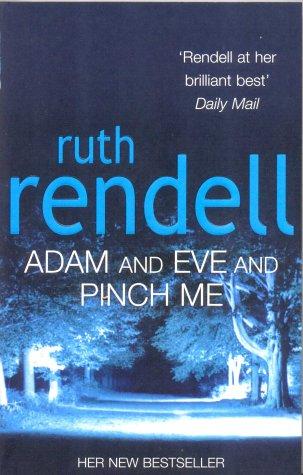
It's summer, so it's time to read for fun. I mean, if not now, when? For me, fun relaxing reading invariably means mystery novels. So I want to share my love for somebody who in my opinion is the best living mystery writer in the world: Ruth Rendell (she also sometimes writes as Barbara Vine.)

Rendell has a regular smart-detective-obtuse-sidekick series (Inspector Wexford Series). Those who like traditional mysteries with a murder, a police investigation, and a revelation at the end, would certainly enjoy them. I, however, prefer other books by Rendell.

Her main strength, in my view, is the way she writes about characters who are initially slightly eccentric but who gradually experience a descent into insanity. The writing is really good, the plots are gripping. She achieves that, however, not so much through action as through atteention to character development. Rendell doesn't write about car chases or the mafia. She doesn't pile on bodies or go for gory details. The tension in her novels mounts slowly but inexorably. The characters she creates are among the most memorable you will ever encounter. Rendell's books are not about shocking the readers, they are about showing us the horrors that often hide behind the mundane, the ordinary, the seemingly insignificant.
Here are some of my favorite novels by her: