Showing posts with label review. Show all posts

Monday, May 16, 2011

Ernesto Laclau's On Populist Reason: A Review

I have to confess that I'm extremely disappointed by Laclau's 2005 book On Populist Reason. One thing you need to figure out before you start writing is what your audience will be like. Are you trying to address the specialists in your field or do you want the book to be accessible to any reasonably educated person? Once you have decided who it is that you are writing for, then you need to make sure that both the ideas you express and the language you use to transmit them are on the same level.

In On Populist Reason, Laclau seems to have forgotten how important it is to know your audience. He uses extremely complex, jargon-ridden writing style to transmit ideas that are beyond basic. If I am to struggle through the author's convoluted sentences and displays of erudition, I expect his argument to lead me to something better than the kind of trivialities that Laclau offers in this book.

Laclau begins his study of populism with an overview of the existing definitions of this concept. He points out that  the perception of populism as something that is a priori negative is the only reason why such definitions only succeed in demonizing populism in terms that are as negative as they are vague. Instead of analyzing populism, political theorists attempt to demonstrate how much they condemn it and then allow this condemnation to taint every conclusion they make. Laclau attempts to move away from such facile definitions and offer a more profound analysis of populism. However, he fails at that task quite spectacularly.

More often than not, it felt to me that Laclau was talking to people he considers to be deeply unintelligent and unaware of the most basic tenets of political theory. He does it in the kind of language, though, that would prevent these ignoramuses from following his line of reasoning. Here is one of the many examples:
The complexes which we call 'discursive or hegemonic formations', which articulate differential and equivalential logics, would be unintelligible without the affective component. . . We can conclude that any social whole results froman indissociable articulation between signifying and affective dimensions.
This statement concludes over 100 pages of a very convoluted discussion and does nothing more than announce in this extremely technical language that communities are bound together not just by reason but also by emotions. Well, duh. This idea has been studied, discussed and argued ad nauseam for over 100 years now. There is hardly any need to convince those of us who are capable of reading Laclau's texts of something so banal.

In a similar way, Laclau offers a very plodding discussion that is supposed to lead his readers to the earth-shattering conclusion that - believe it or not - populist movements can exist both on the Left and on the Right of the political spectrum. I am sure that there are people who are unaware of this fact but these are not the same people who can get through 40 pages on floating signifiers.

I have also discovered from On Populist Reason that in the US populism has been hijacked by the Right that, against all reason, managed to convince farmers and blue-collar workers that the Republicans represent the interests of the regular folks as opposed to the Democrats who supposedly only defend the rights of the long-haired East Coast elites. I know that you must have already yawned twice as you have been reading this paragraph. We all know this, we have all heard this said a gazillion times. Why Laclau believes that it needs to be pointed out yet again is beyond me.

The book is filled to the brim with inanities of the most disturbing kind. On page 177 (close to the end of the book), we find out that in order for the populist appeal to be effective, there have to exist some problems in society. A society where institutional stability is complete, will not respond to populism. But, of course, perfect societies do not exist, so this situation is completely hypothetic. "Surprise, surprise!" I wrote on the margins when I read this. For the most part, this was my reaction to the entire book.

Coco Louco Restaurant in St. Louis: A Review

Now that I have discovered N. Euclid Ave in St. Louis, I can't stop going there. It even reminds me of Montreal a little in spite of being as empty as the rest of the city. And that's the highest compliment I can pay to a city. So yesterday we went to a Brazilian restaurant called Coco Louco. In the reviews I read before going there, people almost unanimously agreed that the food there was fantastic while the service was abysmal. In my experience, however, the food at Coco Louco could be a lot better while service was impeccable. (It's not like I'm doing this on purpose, people, but I never manage to agree with the popular opinion on anything.)
As you can see, the restaurant was pretty empty.
It was a Sunday, of course, but I
find it impossible to believe that there are
people in this city any day of the week
Our waiter's name was Benya and he turned out to be a Russian-speaker. That's one of the things I love about this country. You go to a Brazilian restaurant in the Midwest and get served by a Russian-speaking waiter. How cool is that?

As for the food, one thing that I can recommend highly is the appetizer plate for $14. Here it is:


The appetizer plate contains these great meat and cheese filled pastries that are called "pastel." The best kind is the beef pastel. It as so good that we ordered several extra ones to take home with us. As for the main courses, I wouldn't say that the ones we tried are really worth the price. I had the red snapper that you can see on the picture here:


It is quite good but it really didn't feel like it was worth the $27 the restaurant charges for it. 

Then, there was espeto mixto wihich is different kinds of meat grilled on a skewer. Brazilian cuisine is almost as famous for its meat as the Argentinean, but this meat was quite a disappointment. It was simply mediocre and unworthy of the famed name of Brazilian meat. You can see the skewer with some remnants of the espeto mixto on the picture here:


The dessert was really good. It's a mango mousse and we got it on the house. Here it is:


Overall, we had a splendid time because we always enjoy discovering new restaurants. The food, however, didn't really do justice to the great Brazilian cuisine. If the weather is nice next weekend, we will probably go back to St. Louis, and I will share with you a review of an Indian restaurant they have on N. Euclid.

Saturday, May 14, 2011

Jo Nesbø’s The Snowman: A Review


The inexplicable success of Stieg Larsson’s mysteries is the best thing that has happened to Scandinavian writers since Selma Lagerlöf. Larsson’s untimely death left a void that publishers are trying to fill desperately. Scandinavian names, long descriptions of cold weather and depictions of carnage in Sweden, Norway and Denmark are suddenly in vogue. Since many Americans are a bit confused on where Sweden is actually located, all European mystery authors are experiencing a surge of interest in their books.  


As you can see from the cover of Jo Nesbø’s The Snowman, this author’s publishers are doing all they can to milk Stieg Larsson’s fame for all it is worth. This, however, is something that, in my opinion, this author doesn’t need. This book is very good. Its only defect is that it is too drawn out. In his zeal to create as many twists to the plot as humanly possible, Jo Nesbø goes a bit too far and creates a 100 or so pages somewhere in the middle of this long book that feel quite redundant.

If I had to compare Jo Nesbø’s style of mystery writing to another author’s, I would say he bears no similarity to the weirdly boring Stieg Larsson. Rather, Jo Nesbø is the Norwegian version of Michael Connelly. (Connelly apparently agrees and has published rave reviews of this writer’s work.) Nesbø’s protagonist called Harry (sic!) Hole is a police officer on a mission. He is also a lonely drunk and a die-hard romantic who gets treated badly by the woman he loves. Nesbø isn’t nearly as good as Connelly in creating a complex and richly-layered protagonist. His Harry looks a little cartoonish at times. He is much better than Connelly, however, in writing the ending to his mystery. Connelly’s endings tend to be much too abrupt. This gifted writer doesn’t seem to realize that you cannot announce the culprit’s name on the last page and just be done with it. The laws of the genre require that after the culmination there should be a winding-down period where the readers are offered an explanation of either what drove the murderer to commit the crimes or a description of the deductive process of the detective that resulted in solving the mystery. Nesbø’s ending is absolutely perfect.

The Snowman is a serial killer mystery. In the novel, Norwegians seem quite frustrated with the fact that they alone, of the three Scandinavian countries, have failed to produce a serial killer of their own. There are other cute moments in the book that have a very specific Norwegian flavor. See, for instance, the following passage that would have Ayn Rand die all over again were she around to read it:
'It's a very small shop. We don't have many customers. Almost none until the Christmas sales, to be honest.''How. . .?''NORAD. They support shops and our suppliers as part of the government's trade programme with Third World countries. The message it sends is more important than money and short-sighted gain, isn't it.'
This is, of course, a very dangerous game that the third richest country in the world (after Luxembourg and Qatar) is playing. Oil comes and goes while people who have been corrupted by such ridiculous handouts remain.

There are some sparks of wisdom in this novel that I wanted to share with you. One of the characters says, for example:
Our generation has turned itself into servants and secretaries of our children. . . There are so many appointments and birthdays and favorite foods and football sessions that it drives me insane.
Anybody who has observed the frantic scrambling of the Western parents to organize endless play dates and activities for their children will have to agree with this observation. 

I enjoyed this book quite a bit and recommend it highly. Of course, it didn't hurt that snow was mentioned pretty much on every single page making this summer heat somewhat more bearable.

Monday, May 9, 2011

Eduardo Mendoza's Riña de gatos. Madrid 1936: A Review

There has been a veritable flurry of very long novels about the Civil War published by the leading Spanish writers in the past couple of years. Almudena Grandes is even planning an entire series of such novels. She has already published two, El corazón helado (very good) and Inés y la alegría (a review will appear on this blog shortly). Also of note is Antonio Muñoz Molina's La noche de los tiempos, which is as long as it is enjoyable. 

The reason why so many authors in Spain still write about the Civil War at great length is that the trauma of the war was never fully healed. Decades of a fascist dictatorship followed the defeat of the Republicans in the war. After Franco's death, one of the characteristics of Spain's transition to democracy was (as usually happens with countries that emerge from long and repressive authoritarian regimes) to try to forget the war. No persecution and punishment of war criminals took place. People who fought against each other, the victims and the executioners were expected to start living peacefully side by side pretending that no Civil War and no dictatorship had ever taken place. This approach was obviously doomed to failure. Spanish writers today are trying to heal the trauma of the Civil War by talking about all of its aspects at length. This is something that Spanish society definitely needs. Great novels come out as a result, which is an added bonus.

Eduardo Mendoza decided to participate in this trend with his recent novel Riña de gatos. Madrid 1936. Mendoza's approach to exorcising the ghosts of the Civil War is different from that of many other writers. Riña de gatos turns the tragic months preceding the beginning of the war in the summer of 1936 into a burlesque. Laughter has the power to heal trauma and bridge even the most profound differences. Mendoza brings to the pages of his new novel José Antonio Primo de Rivera (the leader of the Spanish fascists), generals Francisco Franco and Queipo de Llano  (who are plotting a  military uprising against the Republic, an uprising we all know will be successful and cause untold horrors to the country), Niceto Alcalá Zamora (the first president of the Second Spanish Republic) and Manuel Azaña (who will become the last president of the Republic.) All of these historic figures are placed in situations that make them look homey, non-threatening and slightly ridiculous.

The plot of the novel revolves around Anthony Whitelands, a British art critic, who comes to Spain to authenticate a painting that was supposedly created by Velázquez. As the hapless Brit boozes and whores his way through the Madrid of the spring of 1936, his activities attract the attention of competing political factions that would like to get their hands on the painting. A genuine Velázquez could pay for a lot of weapons and help the group that manages to lay its hands on the painting win the approaching war. Soon, Anthony Whitelands finds himself being torn between offers of friendship from the charming fascist José Antonio Primo de Rivera, sexual advances of sex-crazed countesses, demands of an underage prostitute, manipulations of British and German spies and threats from a Soviet conspirator named Kolia.

When I first started reading the novel, I opened it in a suitably somber mood that I believed was appropriate when reading about events as painful as those of the pre-war months in Spain. By the end of the novel, however, I was beating my head against the desk in laughter. I've read several reviews of Riña de gatos. Madrid 1936 and realized that many of the readers didn't manage to escape from the weight of gravitas that usually accompanies the discussions of the Spanish Civil War. If one were to let go completely of the doom and gloom attitude to the war, one would realize that Mendoza's novel is extremely funny. This writer is known for subverting the readers' expectations and this is exactly what he does in his new novel.

Saturday, May 7, 2011

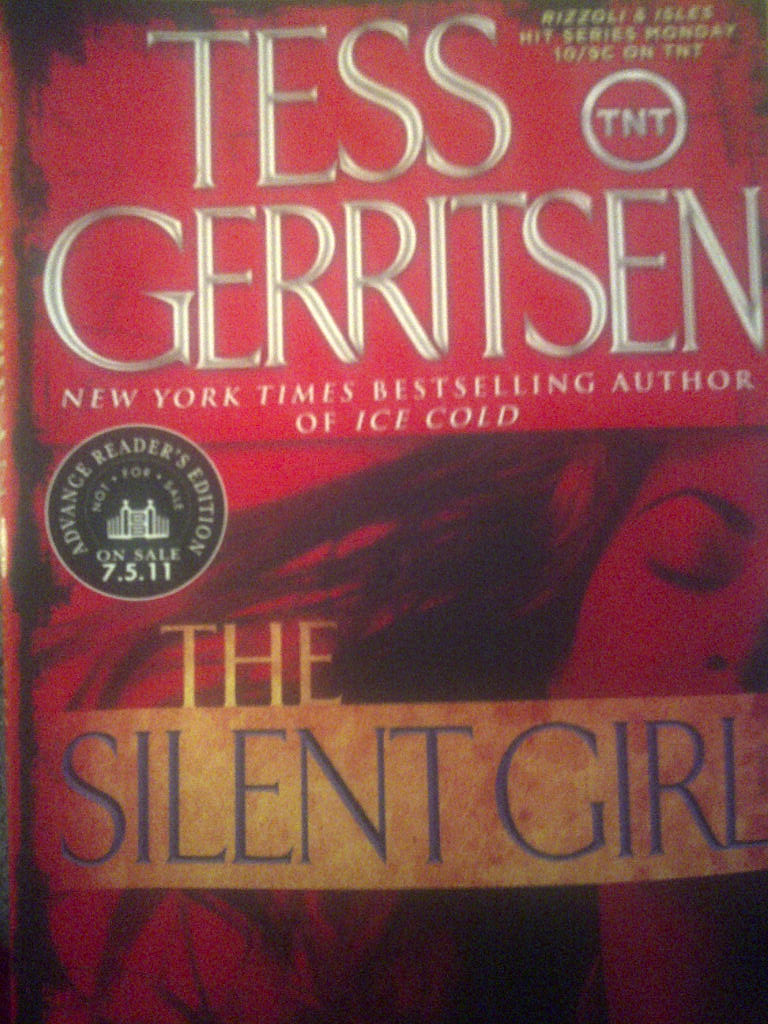
Tess Gerritsen's The Silent Girl: A Review

Tess Gerritsen used to be a very unique mystery writer. Her Rizzolli and Isles series featured a police officer, Jane Rizzolli, and a medical examiner, Maura Isles, whose unconventional personal lives and intense personalities made the series especially interesting to follow. Gerritsen was a writer who did blood and gore especially well. If you are into the mystery novels filled with descriptions of human entrails glistening against the snow, torture and detailed autopsies, Gerritsen was the writer for you. She never shied away from explicit scenes and, as a result, managed to create some of the most memorable serial killer novels around.

And then television happened. A very stupid show started being filmed based on Gerritsen's novels. The Silent Girl is the first novel by Gerritsen that came out since Rizzoli & Isles hit TNT. It isn't a bad book at all, mind you. The mystery is good, the culprit is difficult to identify, the plot has quite a few twists and turns, the book reads very easily. The problem with The Silent Girl is that it isn't a Gerritsen novel. It's another installment of a very mediocre TV series. Rizzoli and Isles have been transformed into good girls whose personal lives are boring enough to be suitable for prime time. To give an example, Maura Isles isn't engaged in her long-standing affair with a priest any more. She has now turned from a cold and harsh person into a weepy, miserable creature who is all of a sudden dedicated to wannabe mothering of a teenager more than to her career. Gory scenes have been substituted with descriptions that would look good on TV: Chinatown, martial artists, an obligatory scene with a mafioso, a grieving parent or two, mythical creatures leaping from roof to roof, etc. 

I used to look forward to Gerritsen's new novels coming out. Now, however, she is no different than hundreds of other authors who produce sanitized, conventional mysteries that aim to be filmed rather than read. Until Rizzoli & Isles gets cancelled, it hardly makes any sense to read another Gerritsen mystery.

The Silent Girl will come out on July 5. 

Monday, April 25, 2011

Zygmunt Bauman's Liquid Modernity: A Review, Part II

I want to dedicate the second part of my review of Liquid Modernity to those of its parts that I found to be objectionable. My problem with the entirety of Bauman's work is that whenever he talks of people, humanity, or mankind at large, he always ends up making statements that are only true for a certain part of humanity, namely, white heterosexual males. Let's take, for example, the following statement, in which the erasure of women is so complete as to be shocking:
'Work' so understood was the activity in which humanity as a whole was supposed to be engaged by its fate and nature, rather than by choice, when making its history. And 'work' so defined was a collective effort of which every single member of humankind had to partake. All the rest was but a consequence: casting work as the 'natural condition' of human beings, and being out of work as an abnormality; blaming departure from that condition for extant poverty and misery, deprivation and depravity. (137)
These statements are, of course, completely true if by "humanity as a whole" and "every single member of humankind" we refer exclusively to men. For women, the situation was and still is the exact opposite. Working mothers are routinely blamed for causing "extant poverty and misery, deprivation and depravity" of their poor, abandoned children. Women are constantly exhorted to "opt out" of the workplace and demonized for not doing so. Working conditions are geared towards making the life of working women as inhospitable as possible. If we keep this in mind, Bauman's references to "humanity as a whole" become egregiously offensive.

In a similar vein, Bauman bemoans the disintegration of the patriarchal family, which brought about the liberation of all those pesky females he loves to erase. He becomes as preachy as any fundamentalist when he begins to lament the evils of divorce, especially when people who dare to abandon loveless marriages are not rich:
There is little doubt that when 'trickled down' to the poor and powerless, the new-style partnership with its fragility of marital contract and the 'purification' of the union of all but the 'mutual satisfaction' function spawns much misery, agony and human suffering and an ever-growing volume of broken, loveless and prospectless lives. (90)
How dare you, poor and powerless folks, look for satisfaction outside of the confines of the patriarchal family? You need to sit tight, patently bearing your miserable, loveless marriages.

What Bauman prefers to overlook in his anti-divorce rants is that, in the absolute majority of cases in the developed countries, it is women who seek the divorce (in 2010 in the US it was 72% of divorces petitioned for by women to 28% by men). The situation is even more clear-cut among college-educated couples where, according to the data provided by American Law and Economics Review, women file for divorce in about 90% of cases. This is not at all surprising since marriage is still a losing proposition for women even in the most developed countries. Women are still stuck with more housework, the greatest burden of child-rearing and very little gains coming out of being married other than some dubious prestige the TV shows try to convince us exists for women who get married. Married women live shorter lives than single women, while married men live longer than single men. For this reason, in real life (as opposed to what we are being told by television and newspapers) men are a lot more interested in marriage than women. The disintegration of the patriarchal family that bothers Bauman so much is, indeed, robbing men of power. At the same time, it liberates women. Women, however, are not a group that Bauman ever notices. 

It is often difficult for me to distinguish whether on this topic Bauman is being purposefully obtuse or if he genuinely, sincerely does not realize how biased his statements are. This is one of the foremost thinkers of our times. Is it possible that the whole history of women has passed him by? Look, for instance, at the following statement:
It is no longer the task of both partners to 'make the relationship work' - to see it work through thick and thin., 'for richer for poorer', in sickness and in health, to help each other through good and bad patches, to trim if need be one's own preferences, to compromise and make sacrifices for the sake of a lasting union. (164)
Can Bauman really not know that to suffer in silence, practice resignation, trim one's own preferences, compromise and make sacrifices was only and exclusively the task of a woman in patriarchal family structures? Can he possibly have missed the entire history of manuals for married women that proliferated from the Middle Ages until today and that exhorted (and still do) women to sacrifice themselves for the good of the family in the very terms that Bauman employs here? Is he being disingenuous with full knowledge of what he is doing, or is he truly this blind to the situation of an entire half of humanity? Note also the slippage into the Christian rhetoric that is quite unexpected in a Communist and a Jew. Apparently, Bauman's need to push women back into the confines of the patriarchal family structure is so overwhelming that he forgets even the Marxist dogma that religion is the opium of the people.

Sunday, April 24, 2011

Zygmunt Bauman's Liquid Modernity: A Review, Part I

Liquid Modernity (2000) is probably Zygmunt Bauman's most important work. This is where the philosopher introduces concepts that will inform his Liquid Love: On the Frailty of Human Bonds (2003), Liquid Life (2005), Liquid Fear (2006), Liquid Times: Living in an Age of Uncertainty (2006), etc. Since Bauman is one of my favorite contemporary philosophers (probably the second favorite after Žižek), I hope eventually to post reviews of all these books on my blog. As usual, I will dedicate the first part of my review to going over some of the ideas from Liquid Modernity that I found to be useful. Later, I will publish the second part of the review that will discuss what I consider to be flawed parts of Bauman's argument.

The main idea that Bauman advances in this book is that it is a mistake to see modernity as a monolithic period that stretches more or less unchanged from the late XIXth century until today. Bauman distinguishes between two stages of modernity:

1. The first stage of modernity, according to Bauman, is the "solid" stage. This is the moment in history of our Western civilization where solid certainties of pre-modern times had disintegrated to such an extent that the only thing to do was to sweep these rotten underpinnings of pre-modern societies out of the way completely. The goal of this first stage of modernity was to erect its own solid certainties in the place of the ones that were going to be swept away by change. If we think about the trajectory of the Soviet approach to modernity, we will see that it fits Bauman's argument perfectly. The transformative push of the first few years of the revolution led to an impenetrable fortress of a repressive Communist regime.

Bauman points out that the main fear of this first stage of modernity was that totalitarianism would emerge from its push to create a new set of certainties on the wasteland of the old society that had been destroyed by the advent of modernity. Orwell's 1984, says Bauman, is a perfect example of what this solid stage of modernity saw as its worst-case scenario. As we know all too well today, totalitarian regimes did, in fact, flourish during this first stage of modernity.

2. Bauman refers to the second stage of modernity as "liquid." At this stage, there is no more effort to replace a set of old rules, certainties and identities with a new one. The freedom to switch identities as often as we want, move around, transform ourselves is now seen as an end in itself and the most prized characteristic of our existence. Bauman's goal in Liquid Modernity is to analyze the main concepts that inform this liquid stage of modernity and to point out the limitations of this freedom.

One of the main struggles of individuals in pre-modern societies consisted of defending their private sphere from the encroachment of the public sphere. People belonged to their families, their clans, guilds, social classes. Their identities that were assigned to them at birth were inexorable and inescapable. If you were born a woman, for example, this very fact implied a set of roles, behaviors and life strategies that was pre-ordained and that you could try to escape at your own peril. If you look at the history of art, you will see that it isn't until the birth of the Romantic movement in late XVIII century that individual emotions and minute shades of personal feelings start being discussed as something valuable. It is only at the end of the XIXth century that we begin to see a slow process of liberation from identities one is assigned at birth.

Today, however, Bauman maintains, it is the public sphere that needs to be salvaged from the constant encroachment of the private sphere. According to the philosopher, our public sphere has been eroded by a constant parade of exhibitionist private issues that there isn't any public sphere left to speak of. Think about the following statement by Bauman in terms of what we are witnessing in today's politics:
What are commonly and ever more often perceived as 'public issues' are private problems of public figures. . . Not one among the 'great and mighty', let alone the offended 'public opinion', proposed the impeachment of Bill Clinton for abolishing welfare as a 'federal issue'. (70-1)
We can see that this tendency has become even more pronounced today, 11 years after the publication of Bauman's Liquid Modernity. To give just one example, there is a huge group of people whose political activism is limited to a painstaking investigation of whether Sarah Palin's child is truly hers (I blogged about these folks here), as if her motherhood had anything whatsoever to do with whether she will make a good presidential candidate. We get regaled with endless stories about Michelle Obama's personality, President Obama's shoes, George W. Bush's daughters, Donald Trump's ex-wives. In the meanwhile, a discussion of what it is they are doing as politicians gets relegated to the realm of the inconsequential. 

While we are concentrated on discussing the private issues of others and exhibiting our own private sphere to the world (blogging and Facebook are a perfect example of this), we fail to notice that the very nature of power has changed. Formerly, those who possessed the greatest masses of land were the most powerful. Power was bogged down by the enormous apparatus of hardware and people needed to maintain it. Today, says Bauman, power has become liquid:
We are witnessing the revenge of nomadism over the principle of territoriality and settlement. In the fluid stage of modernity, the settled majority is ruled by the nomadic and exterritorial elite. Keeping the roads free for nomadic traffic and phasing out the remaining check-points has now become the meta-purpose of politics. (13)
The power today is hard to pinpoint in every sense of the word. As everything else, it has become mobile and uprooted.

(To be continued. . .)

Friday, April 1, 2011

El sueño del celta / The Dream of the Celt by Mario Vargas Llosa: A Review


In case you found Joseph Conrad's Heart of Darkness and José Eustasio Rivera's La vorágine difficult to understand, here is Mario Vargas Llosa's latest novel El sueño del celta to explain to you exactly what happened in those novels. Roger Casement, the novel's protagonist, was a British consul who traveled to Congo and the Amazon and wrote scandalous reports about the horrible treatment of the natives of Africa and South America by the colonial forces. Later on, he joined the Irish nationalist movement and militated for the cause of Ireland's independence.

This is not a novel that offers much - or any, I would say - space for the reader to analyze, interpret, imagine, or look for his or her own answers. Everything is spelled out with painstaking attention to detail. As a result, some parts of the novel sound like they were copy-pasted from an encyclopedia. Sources of historical data, short biographical sketches of real-life people who appear in the novel, dates and gigures populate the pages of El sueño del celtaVargas Llosa seems to have lost his capacity to relinquish control over his text and allow the readers to interact with it on their own. For those who managed to remain unfamiliar with the civilization versus barbarity conflict, Vargas Llosa makes absolutely sure that you will be sick to death of both terms by the end of the novel. And for those who didn't get the message that imperialism is wrong, it will be hammered in on every other page.

Everything I have written so far has probably made you think that I hated the novel. This, however, is not true. El sueño del celta doesn't offer much for analysis but it is surely informative and very well-written. I now know everything I ever wanted to know (and a lot, lot more) about Roger Casement, his travels, struggles, ailments, friends, foes, hopes and dreams. This novel is anything but boring. Vargas Llosa is a great narrator who can turn anything into a great story. I have no doubt that this novel will be quite successful if only for the fact that it is very easy to read.

The enumeration of sufferings inflicted by the colonial forces on the natives of African Congo and the indigenous people of the Amazon becomes painful to read at a certain point. This, of course, is a story that needs to be told and repeated as many times as possible lest we forget that imperialism can never be excused. I have to warn you, however, that an honest piece of writing about colonialism (such as this one) will be so disturbing as to prevent you from sleeping at night.

There are people who insist that Vargas Llosa is a Libertarian. It is a statement that is as silly as claiming that Juan Goytisolo is a Communist. Writers have a tendency to try on political discourses without really knowing what those discourses are about. They don't, however, allow their political triflings influence what and how they write in any way. It's been a while since I have read an indictment of the horrors that free market and wild capitalism inevitably bring along that would be as passionate and convincing as El sueño del celta. Anybody who believes that it would be a good idea to let market forces act freely, without any restraints from the government, should read this novel and hopefully just shut up already. In El sueño del celta,Vargas Llosa condemns the horrifying greed of free market capitalists better than any writer I have read in a while.

Wednesday, March 30, 2011

Stephenie Meyer's Twilight: A Fantasy of Helplessness

This is the promised review of Twilight, everybody. I did all I could to suffer through it. Now I'm due for some good reading because I feel like my brain has been polluted by the horrible writing in this book.

The genre of female coming-of-age stories, to which Meyer's Twilight obviously belongs, underwent a profound transformation in the recent decades. Since the inception of the genre in the 18th century, the central idea of female novels of growth and development was a conflict between the female protagonist and the repressive patriarchal society that strives to stunt her growth and infantilize her. The heroine struggles valiantly against the patriarchal authority that prevents her from developing into a fully grown individual in every sense of the word. Often, however, she loses in this struggle and either dies or consents to being transformed into a perennial child at the mercy of a husband, a father, a family member, etc.

When the women's liberation movement made huge advances in its feminist struggle, everybody expected female coming-of-age stories to reflect the changes in the position of women in society. Finally, we were to read female Bildungsromane where the protagonist takes on the world, grows, develops, and uses her newfound freedom to become a complete and fulfilled adult who does not permit others to stunt her growth. Finally.

These expectations, however, were not fulfilled by the works of literature created by female writers who live in this new, liberated reality. I initially observed this phenomenon in the contemporary Spanish literature but Twilight demonstrates that this tendency also exists in other countries that have made important feminist advances. The tendency I'm talking about consists of the appearance of a huge number of female coming-of-age stories where the female protagonist goes to incredible lengths to infantilize herself. No oppressive patriarchal society persecutes these heroines trying to stunt their growth. Just the opposite, the female characters of contemporary female Bildungsromane often have a lot more freedom than most actual women of that age.

Take Bella Swan, for example. She finds herself in a situation where her divorced parents remove themselves almost completely from the task of supervising her. Bella could use this freedom to explore different facets of growing up, experiment, develop in a variety of directions. However, just like so many female protagonists of such novels she chooses to hand the authority over her life to a male protector/savior and his clan. Bella infantilizes herself in a society where nobody demands that from her. She goes to extreme lengths to become a perennial child coddled and protected by the Cullens.

In this sense, Bella does not stray far from her mother whom she describes as lost and useless without male protection. This is how Bella talks about her mother:
I felt a spasm of panic as I stared at her wide, childlike eyes. How could I leave my loving, erratic, harebrained mother to fend for herself? Of course she had Phil now, so the bills would probably get paid, there would be food in the refrigerator, gas in her car, and someone to call when she got lost, but still . . .
However, those protagonists of today's female Bildungsromane whose mothers are passionately feminist are as likely as Bella to stunt their own growth and infantilize themselves. Much has been said about the nature of Bella's relationship with Edward Cullen. While I was reading the novel, however, I couldn't help noticing how much their relationship resemble that between a very small child and her parent. She pesters him with questions (and if you have ever spent any time in the company of a three year old, you can't fail to see the resemblance), he watches over her as she sleeps, he is always there to protect her from the big, menacing world she does not comprehend.

Twilight is a particularly badly written representative of a powerful trend within the genre of female coming-of-age stories of our feminist era. Women are now in a position where they have to confront things that their mothers, grandmothers and great-grandmothers never had to. Fantasies of helplessness, such as the Twilight Saga, allow female readers to imagine a world where they do not have to shoulder these new responsibilities. They can imagine themselves as eternal children supervised, protected and watched over by supernaturally strong and powerful men.

Now I have a few questions for my readers. The ideas I explore here are the ones that I developed in my doctoral dissertation. I want to spend this summer reworking it into a book. Did you find this post interesting? Easy to understand? Would you like to hear more on this subject? Any feedback will be welcome. Harsh criticisms will also be useful. 

Friday, March 11, 2011

The Motorcycle Diaries: A Review

The Free Dictionary offers the following definition of the word "hagiography":
1. Biography of saints.2. A worshipful or idealizing biography
Both these definitions fit Walter Salles's film The Motorcycle Diaries (2004) perfectly. I can only imagine how much Che Guevara would have hated this cheesy, saccharine movie that presents him as a Christian saint / eunuch. 

Gael Garcia Bernal who plays the young Ernesto Guevara is an extremely talented actor. However, he is the last person in the world who should have been cast as Che. Garcia Bernal has a non-macho masculinity that helped him give the performance of his life as a gay teenager in Y tu mama tambien. The first word that comes to my mind whenever I see Garcia Bernal is "sensitive." He is simply unsuited to play a super macho Che Guevara who raved in his diaries about the joys of never washing himself and developing a strong, manly stench.

Of course, like any good saint, Ernesto Guevara of The Motorcycle Diaries resists temptations and performs miracles. He guards his virtue fiercely, even though his best friend, played by the amazing Rodrigo de la Serna, tries to undermine his companion's chastity by offering an example of free and exuberant sexuality. Ernesto also walks on water and cures lepers with his touch in a scene whose Biblical motifs are so strong as to render the whole film unpalatable. The efforts of the creators of this movie to present Ernesto Guevara as an unblemished, sensitive, romantic character end up producing a cardboard figure without a shred of humanity. 

In many ways, Che Guevara is a terrifying figure. A middle-class guy with a good education, he could have practiced medicine and lived comfortably in Argentina. Instead, he chose to become a guerrillero. This man, who'd been trained to cure people, enjoyed participating in executions of those who were branded as counter-revolutionaries. He was fascinated with filth in the most literal sense. Even when his revolution won in Cuba, Che demonstrated that he was one of those revolutionaries who were only happy fighting and destroying. His attempts to inscribe himself into the peaceful process of post-revolutionary rebuilding was a failure.

Movies like The Motorcycle Diaries and books like the one I blogged about earlier today serve the goal of taming the image of the incomprehensible and terrifying revolutionary, transforming him from a figure that threatens the society of consumers into a convenient object of consumption.

Monday, March 7, 2011

The Adjustment Bureau: A Review

For some reason I never realized that The Adjustment Bureau was supposed to be a romantic comedy. I never watch romantic comedies because the whole genre is too saccharine and cliché-ridden for my taste. I thought that The Adjustment Bureau was more along the lines of Inception so I went to see it.

Contrary to what one expects from the genre, the movie is not half bad. None of the actors is particularly annoying or talentless, which is a rare occurrence for a Hollywood movie. There are some really funny jokes at the expense of politicians, and who doesn't like to have a good laugh over the politicians' hypocrisy and ugliness?

One thing, however, left a bad aftertaste. The female lead dumps her fiancé right in the courtroom where they are supposed to get married and runs away with a guy whom she met casually a long time ago but who is the true love of her life. Don't get me wrong, I'm not saying that you can't meet a person and realize within minutes that this is the most important person in your life and that you will love them forever. Of course, you can. What bothers me, however, is this idea that a person you shared years of your life with can be discarded in a matter of seconds. Even if the relationship sucked, even if you were sick and tired of the person, it still is never easy to leave behind all of the memories, the shared experiences, the traditions, the private jokes that can't fail to accumulate over the years.

I'm not suggesting that people shouldn't dump partners who bore them or whom they don't really love for the sake of a suddenly awakened passion towards somebody else. I think they most definitely should. A loveless life is a life wasted, in my opinion. However, I can't imagine what kind of an emotionally undeveloped monster could dump the previous partner for a virtual stranger without a single pang. 

What's curious, though, is that there are hundreds of movies that insist on presenting precisely this scenario as the recipe for true passion. If this sells, that should mean people are buying it. Probably, so many people are deeply miserable in their personal lives that the fantasy of running away without a second thought proves cathartic.

P.S. I'm really hoping that nobody will leave comments of the "Relationships are hard work" bent. They are not supposed to be, and I'm definitely not trying to elicit this platitude by criticizing another one.

Sunday, March 6, 2011

Ricardian: A Review of Josephine Tey's The Daughter of Time

Most of my readers didn't warm to my first Ricardian post. This is completely understandable since the subject of whether Richard III did, in fact, murder the princes Edward and Richard in the summer of 1483 is quite academic. I will keep indulging my love of Ricardian arcana from time to time, while you should feel free to skip posts tagged "Ricardian" if the subject bores you. 


Josephine Tey created several classical British mysteries that any lover of the genre would appreciate. Few people know, however, of her contribution to Ricardian Apology. In The Daughter of Time, Tey offers us her take on the provenance of the myth that blames Richard III, the last Plantagenet king of England, for the murder of his nephews (the Princes in the Tower.)

Inspector Alan Grant finds himself stuck in a hospital, bored and desperate to participate in some sort of an investigation. While he is in a hospital bed, he only has access to history textbooks. The story of Richard III catches his eye and as he begins to read accounts of Richard's "crimes", Grant realizes just how senseless and lacking in logic all accusations against Richard are.

I might have believed Grant's asseverations
that murderers don't look like this
had I never seen pictures of Ted Bundy,
a wholesome-looking serial killer
The Inspector's journey begins in a way that I didn't find very convincing. Grant looks at the famous portrait of Richard III and realizes that a man who looks this way could not have possibly been a cold-blooded murderer of two small boys. This, of course, is very naive and smacks of Lombrosianism that had been discredited long before Tey wrote The Daughter of Time.

This, however, is the only weak point of an otherwise logical and reasonable account of the numerous holes in the myth of Richard's guilt. Inspector Grant and a young researcher who helps him discover the truth soon realize that Richard III had absolutely no reason to kill his nephews. The boys had been declared illegitimate by an Act of Parliament and Richard III occupied the throne as a well-loved and legitimate King of England. Elizabeth Woodville, the boys' mother, was friendly with Richard III until his death. Would she had visited his court and allowed her daughter to do so had Richard III, indeed, murdered her small sons? That seems highly unlikely. Moreover, after Henry Tudor defeated Richard III in the Battle of Bosworth Field, he never declared publicly that Richard had killed the boys or even that the boys were dead. He did, however, imprison the boys' mother in a convent. 

In the view of these facts, Grant arrives at a conclusion that the first Tudor king, Henry VII, was the only person with means, motive and opportunity to kill the Princes. Having absolutely no claim to the throne, he needed to destroy the Plantagenets so that nobody would dispute his rise to power. I need to tell you right now that not every Ricardian shares Tey's belief in the culpability of Henry Tudor. There are many other suspects, and you can make up your own mind as to which one is the likeliest murderer. I will keep bringing you these accounts on a regular basis.

Tuesday, January 25, 2011

Book Reviewing Policies

People are writing in more and more often, asking if I'd be willing to read and review their books. I'm not at all averse to doing that. If you are considering sending me a book for review, here are some things to keep in mind:

1. Send your proposal to clarissasblog@hotmail.com. Don't forget to mention your book's title, genre, and page length. Also, provide a brief summary.

2. I reserve the right to express my honest opinion about the book. If I don't like it, the review will reflect that.

3. Hard copies of books are preferred. I read too much off a computer screen as it is, and it hurts my eyes. Of course, if the book sounds really interesting, I'll accept it anyway in the .pdf format.

4. Don't send any books until I explicitly agree to review them.

5. I will not review any of the following:

* romance novels;
* anything to do with zombies or vampires;
* fantasy;
* sci-fi;
* books on mafia and organized crime;
* books where the main character is the President of the US;
* books that contain more than one car chase;
* books where martial arts are important;
* books about the CIA;
* books where somebody is dying of cancer for over 15% of the entire length of the book.

No offense, people, I just don't get this kind of books, so it makes no sense to expect me to write intelligent reviews.

6. I'd be willing to accept for review books in the following languages:

* English;
* Spanish;
* Russian;
* Ukrainian;
* French;
* Portuguese.

Sent via BlackBerry by AT&T

Saturday, January 22, 2011

Politically Correct Bedtime Stories: A Review

A fellow blogger Izgad brought to my attention James Finn Garner's Politically Correct Bedtime Stories. I bought this great book on Kindle yesterday and laughed until I almost howled. I know the book was published quite a while ago and I'm really late to any discussion of it. So I'm just going to share some of my favorite quotes from this hilarious little collection.

Here is the beginning of the very first story in the collection. If you don't think this is hysterically funny, I have no idea how that's possible:

There once was a young person named Red Riding Hood who lived with her mother on the edge of a large wood. One day her mother asked her to take a basket of fresh fruit and mineral water to her grandmother's house--not because this was womyn's work, mind you, but because the deed was generous and helped engender a feeling of community. Furthermore, her grandmother was not sick, but rather was in full physical and mental health and was fully capable of taking care of herself as a mature adult.


Unfortunately, there are some hapless academics who pontificate to their students in this manner, which is sad and deadening to any critical capacities the students might possess. I have written before about the pseudo-liberals' attempts at castrating language, so I won't repeat myself.
I have also been guilty of writing in a way similar to the one that is being parodied in the following priceless retelling of the story of Three Little Pigs:
"At the house of sticks, the wolf again banged on the door and shouted, "Little, pigs, little pigs, let me in!" The pigs shouted back, "Go to hell, you carnivorous, imperialistic oppressor!"
Just compare it with a quote from this very heavy-handed review I wrote:

At the beginning of the series set in 1915, we see Maria, an illiterate day laborer who is a lover of a rich mill-owner and a mother of his illegitimate child. One day, the mill-owner and his buddies are making fun of Maria because of her marginalized social status.
At least, I caught myself in the process of adopting this weird, pseudo-progressive language and stopped in time. Many people, however, do it completely in earnest, which makes their writing sound extremely comical. What's even worse, they try to censor everybody who doesn't share their terror of language. As the example of my clumsy review demonstrates, such things might happen to all of us. Still, there are those who don't have the requisite sense of humor to understand the extreme silliness of any attempts to purge the language of half its vocabulary and literature from all of its "offensive" masterpieces.

The author ridicules not only the pseudo-liberal language purges but also the efforts to rewrite famous fairy-tales that have become even more common since the book was first published. This is how the tale of the three little pigs ends in this politically correct version:

Their next step was to liberate their homeland. They gathered together a band of other pigs who had been forced off their lands. This new brigade of porcinistas attacked the resort complex with machine guns and rocket launchers and slaughtered the cruel wolf oppressors, sending a clear signal to the rest of the hemisphere not to meddle in their internal affairs. Then the pigs set up a model socialist democracy with free education, universal health care and affordable housing for everyone.
It was especially disturbing to read Garner's retelling of the fairy-tale of Rapunzel. Last year, Disney released Tangled, a very weird retelling of the famous German tale. The fairy-tale enjoyed great popularity for centuries until Disney decided that it could be improved by injecting modern sensibilities into it. The result was considerably inferior to Garner's hilarious parody. Even then, there were pseudo-progressive bloggers who claimed the story was racist because the protagonist is blond. The arguments that this German story was created by German people many of whom are, indeed, blond were also rejected as racist. At the end of the discussion, I started feeling like my own blond hair was some kind of a racial slur.

Even though Garner's book was published a while ago, it still merits attention as a reminder of how far pseudo-liberals would go in order to distract our attention from the sad reality of how decidedly unprogressive their views actually are.

P.S. Last night my husband and I were discussing Politically Correct Bedtime Stories and laughing at the funny quotes. He reminded me of the review I quoted above and that was written in the same silly style and of how funny it was.

"But you still like my blog more than anybody else's?" I asked in jest. 

"Of course, I do," he said. "I'm completely monogamous even though all other lifestyle choices are perfectly acceptable, valid and worthy of respect and it would never occur to me to claim that my way of being is in any way or manner preferable to anybody else's and should be deemed superior to anybody's because that would be offensive, condescending and wrong."

Wednesday, January 19, 2011

Neil McKenna's The Secret Life of Oscar Wilde: A Review

After the disappointment of Selina Hastings's biography of Somerset Maugham, I didn't expect much from Neil McKenna's The Secret Life of Oscar Wilde, a book that has served as an inspiration to Hastings. Still, I was too sick to process anything more complex than a biography, so I decided to give it a try. To my surprise, I really liked it.

For one, McKenna doesn't take on a task that would be excessively hard for him to carry out and never promises anything he will not be able to deliver. He makes it very clear from the start that this book is dedicated exclusively to Wilde's sexual biography and nothing else. Unlike Hastings, he doesn't attempt to cover every aspect of his subject's life or offer inane pronouncements on the subject of his literary work. Wilde's artistic production is discussed only in terms of its connection to his sexuality.

It is obvious that McKenna has done an incredible amount of research. However, he is different from Hastings in that he doesn't expose the readers to a barrage of irrelevant minute details of Wilde's existence. Every new personage he introduces is relevant to the culminating moment of the book: Wilde's trial. McKenna never forgets to attract the readers' attention to the information that will become crucial much later in the book. Every fact that the author mentions serves to advance the story, so it's easy to follow the narrative without getting distracted from the story-line. McKenna makes every effort to remain objective and, unlike Hastings, never tries to offer inane judgements where none are needed. This is quite a feat for a biographer of somebody as controversial as Wilde.

In spite of McKenna's objectivity, Wilde comes off like a very disgusting individual who bullied underage boys into having sex with him and might have been on the verge of pimping his 9-year-old son to Lord Albert Douglas on the very eve of the scandal that eventually put him in jail. One of the reasons I rarely read writers' biographies is that I'm fearful of being so disappointed in them that it will prevent me from enjoying their work ever again. Of course, there are artists of such stature that you can forgive them anything. Francisco de Quevedo was an anti-Semite and a hater of women. Dostoyevsky was also a rabid anti-Semite who treated his wife horribly. Juan Goytisolo is a passionate misogynist. Still, they created works of art of such magnitude as to be enough to redeem our entire civilization with all its faults. In my view, Wilde is nowhere near that category.

Biographies are often boring, especially if they discuss people whose life journey has been written about and filmed many times. This is not the case with The Secret Life of Oscar Wilde. McKenna offers some very interesting findings. I used to think that my knowledge of the circumstances surrounding Wilde's trial and incarceration was quite good. This book, however, proved me wrong. After reading it, I realized that the case was a lot more complex than I thought. The book really reads like a mystery novel. 

Of course, I wouldn't be myself if I didn't find anything in this biography to make fun of. McKenna sometimes creates phrases that are quite heavy-handed. I will give you a few of my favorite examples:
  1. Certain events were enough "to send him rushing towards the bacteriological sanctity and safety of marriage." You have to agree that the bacteriological safety of marriage sounds perfectly hilarious. Coupled with the general tone of the book that often borders on pompous, this turn of phrase is priceless.
  2. "Oscar performed his husbandly duties manfully and to good effect. Just four months after her marriage, Constance found herself pregnant." It is highly debatable whether the appearance of children in such a loveless and miserable marriage was such a good effect, of course.
  3. "The love of Oscar for Constance, and of Constance for Oscar, was a strangely arbitrary, ill-considered, precipitate sort of love." This sounds like there is love that isn't arbitrary or precipitate, which is hardly possible. A calculated and well-pondered sort of love is no love at all.
  4. "The locus of Oscar's sexual interest in Constance lay in her virginity, and in robbing her of that virginity." I don't know how it's possible to "rob" anyone of their virginity, as if it were an actual object and not a social construct. It is especially difficult to do so within a fully consensual relationship.
  5. "Pierre Louis is usually regarded as a red-blooded heterosexual." This, of course, immediately made me wonder what other kinds of blood heterosexuals might possess.
  6. "The letters were from Oscar, Lucas D'Oyly Carte and others, and were indeed compromising. Wood knew that they were worth their weight in-gold." Given that letters don't weigh all that much (and here we are talking about pretty short letters, too), one is left to wonder whether their weight in gold was really that big of an amount. 
  7. "Charlie even accepted a preserved cherry from Oscar's own mouth. `My brother took it into his, and this trick was repeated three or four times.' It was quite clear to everybody that Oscar wanted Charlie to take more than just a preserved cherry into his mouth." We cannot possibly know what was clear to everybody who was in the room at that time or what Oscar wanted Charlie to take into his mouth. Thankfully, such heavy-handed attempts at guessing are very few in the book.
McKenna is, however, perfectly capable of creating a very powerful, pithy, incisive sentence. Consider this one, for example: "In the eyes of the Victorians, there was only one thing worse than a sodomite, and that was a proselytising sodomite." In spite of some minor slips, The Secret Life of Oscar Wilde is a very good book that I enjoyed a lot.

Saturday, January 8, 2011

Why I Don't Like the Movie The Lives of Others

I know that most people adore The Lives of Others and find this movie very touching. I, however, could never get into it because of how wrong it gets many of the most basic details of the characters' daily existence. I don't like Cold War rhetoric and imagery because of how reductive and unintelligent they are. It's always the good versus the evil, and it doesn't matter which side of the Iron Curtain you are on. The verbiage is the same and the desire to reduce complex realities to a bunch of cheesy stereotypes is omnipresent. Both sides judge each other according to their own, very limited ideology, without ever trying to understand that things might be a little bit more complex.

During the Soviet times, my father always listened to the BBC (secretly, of course) at night. "They are fools, all Westerners are fools," he would fume in the morning. "Last night they said that there were human rights abuses in the USSR which consisted of people not being allowed to travel freely abroad. They have no idea about who we are and how we live. I have a PhD in linguistics and I have to leave aside my research and spend the entire next week sorting rotten cabbage. But, sure, not being able to travel abroad is my main concern."

I was reminded of this reductive Cold War mentality as I was watching The Lives of Others. The filmmakers so obviously made their film with the goal of selling it to Americans that it was painful to watch. Take, for example, that scene where the character who works for the Stasi comes to his BARE apartment, where he lives ALONE, eates a plate of spaghetti with KETCHUP and invites a PROSTITUTE over to his apartment. I mean, how much more ridiculous than that can you get? And, of course, if a movie is so careless with the minor details, how can you expect it to deliver anything more reliable in terms of the big picture? The result is this unbearably cheesy Americanized fantasy about what life behind the Berlin Wall was like. A fantasy that has nothing to do with reality.

Friday, January 7, 2011

Black Swan: A Review

The saddest thing is that this could have been a really good movie. The story, the directing, the photography, the supporting cast were very impressive. The beautiful music obviously didn't hurt. This could have been a powerful work that pondered issues of artistic awakening and the nature of creativity, a Künstlerroman in the true meaning of the word. This could have really worked. Could have - if it weren't for the imponderable decision to cast the Queen of Vapid, a.k.a. Natalie Portman, in the leading role.
For some incomprehensible reason, Portman is in vogue right now. Every other movie out there is rendered horrible by her insipid presence and annoying lisp. Portman has two facial expressions in her arsenal: blank face with her mouth closed and blank face with her mouth half-open. Every single emotion is conveyed by either mouth closed or mouth half-open. I don't know how she manages to keep her facial muscles in such a rigid state at all times: Botox? facial paralysis? natural vacuousness? Whatever it is, this peculiarity incapacitates her completely as an actress. She looks down, sees a shard of glass sticking out of her belly, mouth half-opens, a blank stare: what on Earth is she thinking? Good? Bad? Fun? Painful? Something? Anything?

The entire experience of watching Black Swan is poisoned by the need to guess what emotions Portman's character is supposed to be conveying. Trying to deduce anything from her frozen face and vapid stare is beyond painful. The scenes where Portman appears against Mila Kunis make her look even more pathetic. Kunis is no actress of the century but at least there is some acting capacity there (Ukrainians rule!). Kunis simply kills Portman in every single scene.

An alternative reading of the film is that Portman's character is supposed to be so overworked and exhausted by starvation and endless purging that she has no energy to experience, let alone express, any emotion. I wish I had been informed of this interpretation before I watched the movie. Then, I might have avoided the constant and fatiguing attempts to guess the character's feelings and intentions. I still believe, however, that the truth here is that Portman is simply devoid of any acting talent whatsoever.

Tuesday, January 4, 2011

John Lescroart's Damage: A Review

In case you don't know, John Lescroart is the author of a great courtroom drama series set in San Francisco. Unlike Grisham, who also writes best-selling courtroom dramas, Lescroart actually knows how to write a good sentence in English. For those who love San Francisco (and how is it possible not to love this magical city?), Lescroart's novels will be especially interesting to read. Even if your vision of San Francisco is different from Lescroart's, you can't fail to find his admiration for the city to be infectious.

Lescroart became famous as the creator of the Hardy / Glitsky series featuring Dismas Hardy, a lawyer, and his best friend Abe Glitsky, a police officer. Both Hardy and Glitsky are complex, interesting characters who are often tortured and always far from perfect. A little while ago, Lescroart must have decided that the Hardy / Glitsky series had played itself out and came up with a new protagonist for a new series: Wyatt Hunt. The resulting The Hunt Club, Treasure Hunt (Wyatt Hunt), and A Plague of Secrets were so weak that they almost made me abandon this writer for good. With the Wyatt Hunt character, Lescroart committed what is a huge mistake for such an experienced author: he created a protagonist who is so perfect as to be completely disgusting. Wyatt Hunt is an athlete, a musician, an investigator and a know-it-all whose favorite things to do are to save damsels in distress and rescue abused children under dramatic circumstances. In order to make him even more attractive, Lescroart surrounded him with extremely pathetic characters whose goal was to present Hunt with even more opportunities to shine.

Tonight, however, Lescroart finally released a novel that lives up to his erstwhile standards. Damage finally abandons the inane goody-two-shoes of Wyatt Hunt and his coterie of helpless losers and focuses on Lescroart's trademark characters Abe Glitsky and the hippie lawyer turned District Attorney Wes Farrell. (Hardy's fans need to be forewarned that Hardy appears only briefly in Damage.)

I had pre-ordered this novel on Kindle several months ago. Yesterday, I stayed up until 2 am (the time when Amazon sends out pre-ordered new releases) because I couldn't keep waiting any longer to see how this novel would turn out. Then, I couldn't sleep because I just needed to read it. Today, I'm happy to report that the novel is definitely worth all that trouble. It's really good. There are great courtroom scenes which, however, are not excessive. There is a mystery that keeps you in suspense until the end (although, I have to confess that I guessed some of it. Still, that's not surprising given the extent of my familiarity with this author's books.) There are personal dramas, power struggles, corruption, and truly memorable characters. In short, this is one of Lescroart's best novels, and this is saying a lot with such a prolific and gifted author.