Showing posts with label internet. Show all posts

Tuesday, May 10, 2011

Europe Is Going to the Dogs. Are We That Far Behind?

The idea of censoring the Internet, the last bastion of freedom in our over-controlled world, looks more and more attractive to governments everywhere. Here is what the European Union is hoping to do to the freedom Europeans now have of using the Internet:
The Presidency of the LEWP [Law Enforcement Working Party] presented its intention to propose concrete measures towards creating a single secure European cyberspace with a certain "virtual Schengen border" and "virtual access points" whereby the Internet Service Providers (ISP) would block illicit contents on the basis of the EU "black-list".
Of course, we will be told that the black-list will only be used to prevent pedophiles and other criminals from posting their stuff online, which is patently false. Driving human traffickers and pedophiles underground will make it harder to apprehend them. So if this proposed Internet censorship has nothing to do with catching criminals, why introduce it? The answer is obvious:
 In 20 years the government-corporate nexus of power will be able to control nearly completely what that average person experiences in the media again.
Unless we start opposing these and similar measures today, our Internet will be stolen from us. The space where we all can say whatever we want, argue, discuss, find information, organize and plan for political activism can very easily be transformed into a place that offers nothing but political propaganda by those in power and inane advertisement. Look at television. Do you really go there for news and opinion? Or do you rely on the Internet where a multitude of voices is far more likely to tell you how things really stand and offer original thoughts and opinions instead of boring, chewed-over party line?

No matter where you live, when you hear about such measures being proposed, protest, organize, do anything you can to stop it. Don't buy the stupid propaganda about how good, benevolent, paternalistic governments need to protect silly little you from scary pornographers, pirates, and identity thieves. Pornographers, pedophiles and thieves have existed forever. Unfortunately, they will find ways to keep existing after the Internet is castrated. The free Internet has existed for a very short time and needs our protection.

Tuesday, February 22, 2011

Putin Against Google

You know that a country is not on a good path when its leaders criticize that nasty, mean Internet for spreading the news of popular unrest and political protests. The authoritarian government of Vladimir Putin and his puppet Dmitri Medvedev has decried the role that the Internet played in the recent events in Egypt:
Prime Minister Vladimir Putin's deputy blamed Google Inc in an interview published on Tuesday for stirring up trouble in the revolution that ousted Egyptian leader Hosni Mubarak. "Look what they have done in Egypt, those highly-placed managers of Google, what manipulations of the energy of the people took place there,"Russian Deputy Prime Minister Igor Sechin told the Wall Street Journal. Such strong comment from one of Putin's most trusted deputies is a clear signal of growing concern among Russian hardliners about the role of the Internet in the unrest which has swept across the Arab world. . . In contrast to state television, Russia's Internet is remarkably free and the home to often scathing criticism of Putin, President Dmitry Medvedev and the entire Russian elite. Russia has so far resisted placing restrictions on the Internet, but analysts say there are a group of hardliners close to Putin who would like to impose controls similar to China's.
Putin, who made his career in the KGB during the Soviet times persecuting dissidents and working as a spy, cannot fail to hate the freedom to exchange information that the Internet offers. His attacks on Google are easy to understand for anybody familiar with how the majority of the people in Russia use the Internet. The greatest and most popular Russian search engine, www.yandex.ru, doesn't index websites in the same way that Google does (based on their usefulness and degree of popularity.)  Yandex is controlled by certain political and financial groups that make sure, for example, that during elections an independent politician doesn't get his or her name listed in any searches.

One of Putin's main fears is that the Russian people will tire of Yandex's manipulation of information and will switch to Google. For now, this hasn't been happening because the Yandex format is still more familiar to the Russian people. Soon, however, they might start waking up to the idea that a search engine that restricts your access to information isn't worth using.

I'm just afraid that when the Russians finally awaken to Google, we will have already lost the last shreds of net neutrality, and Google will become exactly what Yandex is today: a convenient tool for corrupt politicians and the oligarchs who bought them.

Wednesday, February 9, 2011

Why Did We Elect Him, Again?

I want to be oblivious, people, I truly do. I want to zombify myself into a nirvana of not knowing, not doubting, not seeming the obvious. I keep telling myself, "No, Obama is good, he will deliver on his campaign promises - eventually. Or at least he'll give a very nice speech explaining why he couldn't. And no, he is not in favor of strengthening governmental restrictions to the point where our every breath is regulated, and by "our" I mean that of the regular folks, not the banks, never that." But you can only be oblivious for that long before you can't disregard evidence any longer. Take this beautiful piece of news, for example:
The Obama administration has drafted new proposals to curb Internet piracy and other forms of intellectual property infringement that it says it will send to the U.S. Congress "in the very near future."
It's also applauding a controversial copyright treaty known as the Anti-Counterfeiting Trade Agreement, or ACTA, saying it will "aid right-holders and the U.S. government to combat infringement" once it enters into effect. Those disclosures came from a report released today by Victoria Espinel, whom President Obama selected as the first intellectual property enforcement coordinator and was confirmed by the Senate in December 2009. There's no detail about what the proposed law would include, except that it will be based on a white paper of "legislative proposals to improve intellectual property enforcement," and it's expected to encompass online piracy. The 92-page report (PDF) reads a lot like a report that could have been prepared by lobbyists for the recording or movie industry: it boasts the combined number of FBI and Homeland Security infringement investigations jumped by a remarkable 40 percent from 2009 to 2010.
Nowhere does the right to make fair use of copyrighted material appear to be mentioned, although in an aside on one page Espinel mentions that the administration wants to protect "legitimate uses of the Internet and... principles of free speech and fair process."
It would have been nice, of course, if during his election campaign Obama had told all those bloggers and Facebook/Twitter users who were doing so much to put him in office, "Prepare, folks! In return for all your Internet activism on my behalf, I will slap you with a list of regulations, rules, FBI and Homeland Security investigations so long that the most anti-libertarian amongst you will secretly start collecting Ayn Rand's books. I will make you realize that what movie and recording industry have achieved with their lobbying for copyright restrictions is nothing compared to what will be done to your free and unimpeded use of the Internet. We will now supervise every breath you take online, and isn't that amazing? Yes, we can do this to you, Internet users. Yes, we can, indeed!"

What's so frustrating is that while the economy continues to tank, both major political parties are only interested in finding new and inventive ways of policing us into the ground. The Republicans want to police our bodies with their tightening of anti-abortion regulations, while the Democrats want to police our thinking and free expression.

I know that I have now angered both the Democratic and the Republican readers of my blog but I don't care. Unless we all snap out of our partisan oblivion as soon as possible, nothing is going to get better.

Thanks for the link, Mike!

Monday, February 7, 2011

The Importance of Having a Webpage

Mike at www.michaelalanmiller.com writes:

If you run a small business and you do not have any sort of web presence, you are an idiot. There is just no other way to put it. If people can’t find your hours, your menu if you are a restaurant, if they can’t engage with you and find out a little about you, you are just screwing yourself over.
I couldn't agree more. When I’m selecting a restaurant, I usually use the information as to whether they have a website and how convenient to use it is as a way to determine whether this restaurant deserves being patronized. Every single time in my experience an absence of a website (or a really crappy, outdated one) is mirrored in the cooking, decor and service. People who are clueless as to the importance of a web-presence for their business are usually just as clueless about the fact that their business is in need of serious updating.

When I was looking for an academic position, I researched prospective employers in the same way. If the Department of Spanish has a sad-looking uninformative webpage that hasn’t been updated in a decade while the Business School has a webpage with every gadget imaginable, this is a great predictor of how the university administration feels about the relative importance of these two departments. 

Monday, January 31, 2011

Things That Suck in Canada

I love Canada, but there are three things that suck something fierce in my country (no, this post will not talk about taxes): banks, cell phone connections, and the Internet. These three areas are monopolized, which is never good because when there is a monopoly, competition dies. And when there is no competition, there is no incentive to provide goods and services that are even marginally decent.

Canadian banks charge you for every breath you take. Depositing, withdrawing, having an account - everything carries a fee. They mess up, steal your money, and charge you for this transaction. (This actually happened to me. National Bank of Canada stole $1,000 from me, and I could do nothing to get it back. They even recognized they messed up, but that money has never been recovered. By me, that is.) 

They also have this weird policy of "freezing" any money you deposit. I deposit some money in cash, and can't have access to it for days. If you deposit a check, it's frozen at least for a week. If the check is American, your money is frozen for 30 days. I once deposited a check from the Treasury of the US in the amount of $250. And then I had to wait for 30 days for it to clear. I mean, I know the US Treasury is not in great shape, but you can reasonably expect it to be able to clear a $250 check, right? After I moved to the US, I kept bugging bank tellers, unable to believe how easy banking was in the US: "So you are saying that I can deposit this check and have access to my money immediately? Like, right now? Like, this very moment? For real?" 

Canadian Internet banking is a story that I'll keep for another day because it's too bizarre. And if you dare to lose your bank card, woe betide you. You will be tortured and abused by the condescending bank tellers to the degree where you will start considering how great life was before the banking system came into existence.

The cell phone services in Canada are equally nasty. The quality of the connection sucks. Canadians know that there are specific places in their houses, apartments, offices, streets, where cell phone connection just dies. Every conversation I have with my sister who lives in Montreal is punctured by her saying "OK, I'm gonna get disconnected now. OK, the connection is about to drop again. Don't hang up if the sound disappears, it might get back up in a minute." And the cost of having a cell phone has always been sky-high. When I moved back to Canada for a year in 2007-8, I could never understand my cell phone bill. I kept thinking that somebody put the wrong number of zeros on the amount I owed. My happy-go-lucky American habit of blabbing on the cell phone all day long had to be abandoned.

The Internet connection is also expensive, slow and bad. In the US, you can always catch some free Wi-Fi somewhere, but in Canada it’s all password protected. Even in Starbucks, you can’t get free Wi-Fi. Every time I go back to Canada, I prepare to struggle with the Internet connection. As a blogger in the US, I'm used to being able to blog from pretty much anywhere. In Canada, though, I always feel disconnected from the world. Every trip to Canada is spent in a frantic search for a connection. And even if you are fortunate enough to find one, prepare for it to drop for no apparent reason at the worst moment possible.

As if things weren't bad enough as it is, Canadian monopolists are now trying to make the Internet connection even harder to get and even more expensive:
The CRTC has decided to allow Bell and other big telecom companies to change the way Canadians are billed for Internet access. Metering, or usage-based billing (UBB), will mean that service providers can charge per byte in addition to their basic access charges. The move is sure to stifle digital creativity in Canada while the rest of the world looks on and snickers.
 This is so wrong, people.

Sunday, October 24, 2010

When Was the First Time You Used the Internet and the Cell Phone?

The very first time I accessed the Internet was in 1995. Obviously, I used a dial-up connection, which was excruciatingly slow. It never took less than 15 minutes to get connected and the connection had a tendency to get interrupted whenever somebody tried to make a phone call to my phone number. Or even the neighbors' phone number. (The way telephones in Ukraine worked was by connecting neighbors' phones with each other. Whenever you picked up the receiver, your neighbors' phone got disconnected and they couldn't make or receive phone calls.) The web offered very little content at that time. Still, I was really impressed that, while sitting in my apartment in Ukraine, I could have a conversation with people across the world. It felt like something magical. Every time when I was waiting for the dial-up to connect me, I kept wondering what it would feel like if the connections were faster and only took about 5 minutes or so. I also liked imagining what the web would look if anybody could place any kind of information they wanted there.

As for the cell phones, I resisted them for a very long time. The idea that people would be able to locate me at any given moment made me feel extremely uncomfortable. It also felt like such an incredible drag to have to figure out what all the buttons meant and how all the cell phone's functions worked. Finally, in 2000 I let my sister give me the most basic cell phone in existence as a gift. Today, if somebody were to deprive me of my Internet access and my BlackBerry for three days, I would start experiencing severe withdrawal symptoms.

What are you first memories of using the Internet and the cell phone?

Friday, August 6, 2010

Petition for Net Neutrality: Urgent Action Needed!

Make sure you sign Al Franken's petition for net neutrality here.

I hope I don't need to explain why a merger between Comcast and NBC will be a disaster for the freedom of information everywhere. If you want to preserve the Internet the way it is now, if you are terrified of the possibility that Fox will control how fast progressive sites are loading as opposed to conservative sites, you need to join us in taking action NOW.

The corporate takeover of the Internet needs to be stopped. Otherwise, five years from now the kind of Internet activism and progressive blogging that is being done right now will not exist any more.

Sunday, May 9, 2010

Google Gone Nuts

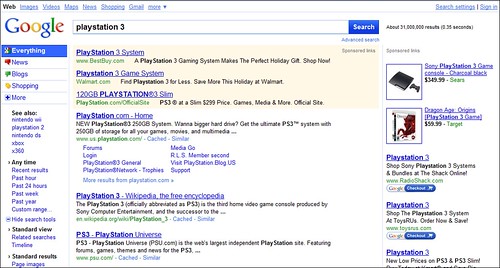
I'm sure that everybody has noticed the most unwelcome change to Google that took place recently. You can see the new excessively busy and annoyingly Bing-like design on the right.

I have no idea what prompted Google to mess with the simple and uncluttered design that made them the search engine par excellence all over the world. Why they would want to imitate the not nearly as popular Bing.com is completely beyond me.

Google is my homepage at every single one of my computers. I use Google at least a dozen times a day. So imagine my annoyance when instead of a simple and straightforward search results page I got to stare at this confusing mess. What are these people thinking? If I were into the Bing look, I would simply go to Bing and avoid Google altogether.

Thanks to michaelalanmiller.com, I have discovered a way to go to the normal Google homepage. You can find it here. Now, I have to change the homepage option on all my computers, which will finally save me from having to see the mess created of my beloved Google.

Tuesday, May 12, 2009

Wikipedia: A Professor's Curse

For years, I have been begging my students to stop relying on Wikipedia for all of their research needs. And they still do it. I appeal to their reason trying to explain how easy it is for anybody to add completely spurious data to any Wikipedia article. But they never listen to me and keep quoting Wikipedia with annoying regularity.

Now that the story about a student who duped tons of people around the world through lying on Wikipedia came out, I will have to make copies of this article at the beginning of each semester and hand it out to students.