Showing posts with label technology. Show all posts

Thursday, April 7, 2011

Which Scientific Advances Are You Looking Forward to the Most?

As for me, I'm eagerly awaiting the advent of two major scientific advances:

1. Teleportation. It will allow people to cover huge distances in matter of minutes. Imagine what that will do for all those people who are separated from their loved ones because they work in different places. I could work here but live in Philadelphia, for example. That would be pretty fantastic. Of course, teleportation will never be free or uncontrollable. I'm sure there will be terminals where you'll have to pass through document checks and customs and pay a fee, but the mere possibility of this kind of travel will be amazing.

2. Human cloning. This will be an invention which will finally bring about a decisive victory for feminism and gay rights. Women will no longer have to go through the trauma and danger of pregnancy and childbirth. Men will be able to have their own children without being at the mercy of whether a woman wants to carry their child to term. Gay couples will be able to have kids easily. No wonder that conservatives are so terrified of cloning. 

Which scientific advances are you looking forward to the most and why?

Friday, March 4, 2011

Can You Guess What This Is?

Try to guess what these white thingies are without looking them up online. I will reveal the answer later today.


Thank you, KT, for sending this to me!

P.S. And the prize goes to Jonathan who guessed on the first try. It's a cell-phone! The following article suggests it's creepy but I kind of like the way it looks:

This terrifying creature is the Elfoid, or Erufoido, a creepy, blob-shaped cellphone which I would never even touch, much less hold up close to my ear.
Astonishingly, the Elfoid is meant to make people less scared of their phones, not more. It simplifies complex technology by using hidden buttons and voice-recognition to control it, but that’s just the beginning of the weirdness.
The Elfoid will somehow communicate the “presence” of the person on the line using sound and cameras, and the doughy urethane cover mimics the feel of human skin. This will, researchers at Osaka University hope, make people feel closer to each other.

Saturday, February 5, 2011

Technology as a Cause of Academic Divide

Academic electronic publications overflow with articles on the evils of using technology in the classroom. A significant percentage of academics who, irrespective of their age, are stuck in the mentality of the past are deeply opposed to the use of new technologies in teaching. They fill article after article with disquisitions on how students hate classes that rely on technology, how they suffer because of PowerPoint presentations, cell phones, IPads, Kindles, laptops that seemingly distract them from actual learning. Educators who use technology in the classroom are branded as lazy creatures who want gadgets to do their job for them.

I am one of those "lazy" educators. In my literature and culture courses, I use PowerPoints on a regular basis. I first started doing them last year, and the students liked them so much that I decided not to stop. I keep begging the students to tell me if they dislike PowerPoints, after which I will be happy to discontinue them. The students, however, are adamant in their insistence that they love my PowerPoints. I find them to be very useful, too. To give an example, on Thursday we were discussing Lazarillo de Tormes, a Spanish Picaresque novel of the XVIth century. When we got to the passage in which Lazarillo leaves Salamanca, I had photos of this city, of its great university, of the Cathedral of Salamanca up on the PowerPoint. Many of my students haven't had a chance to travel to Spain, and seeing what Salamanca actually looks like made them appreciate the reading in an entirely new way. After class, two of the students came up to me to say that they were now considering going to Salamanca as part of the Study Abroad program because the city sounded fascinating. 

Another thing that I like to do in literature courses, is to put up passages we are analyzing and questions students are supposed to be answering in groups up on a PowerPoint. This is saves a lot of time that previously used to be occupied with endless questions of "What are we doing right now? What were the questions? What page is it? Do you have an extra copy of the book? Where are we right now? What did you want us to do?" Maybe all of this makes me a lazy educator, but I'd much rather spend valuable class time on actual discussions than on repeating what the question was a dozen times in a row.

For some reason, when people talk about using Power Points in class, they imagine a professor who fills the slides with bullet points and then reads them out loud in a droning monotone. Most of us don't do anything like that, though. My PowerPoints mostly provide visual materials to illustrate the points I'm making. It really makes no sense trying to explain the ideological implications of the tango when you can't show the students a video of an actual tango dancing.

In language classes, I allow students to use cell phones to look up words in electronic dictionaries. Many of the students take several languages, and it makes no sense for them to lug a Spanish, a French and a Chinese dictionary around at all times. Why not use the available technology to makes everybody's life easier?

I have a sneaking suspicion that academics who are so virulently opposed to use of technology in the classroom (and who also scoff when they see their colleagues read books on a Kindle) are simply intimidated by technology because they have no idea how to use it. Instead of confessing their technological incompetence and asking for help, they try to marginalize those of us who are comfortable with technology and use it on a regular basis. Of course, technological advances cannot be stopped. We have to prepare ourselves for the advent of even more sophisticated inventions. I, for one, feel very excited about that prospect.

Wednesday, November 17, 2010

Technological Prowess

I'm very proud of myself because today I installed a computer (instead of the endlessly crashing one in my office) and I did it completely on my own. Then, it turned out that it doesn't have Microsoft Office installed, so I downloaded OpenOffice, which I always heard was in no way worse than Microsoft Office. And now I'm very happy because only a person whose computer kept crashing in every possible way for a year can fully appreciate the joy of having a normally functioning computer.

The only problem is that after two days of using a touchscreen cell phone, I keep poking every computer monitor I see with my finger, expecting something good to happen. But the only thing that happens is that people keep looking at me like I'm weird. Our brains learn to adapt to new technology really fast. When I was six, my father took me to his job and showed me the first computer I'd ever seen. It was a huge machine that occupied an entire room, made a humming noise, and had to be fed perforated cards. I'm going to utter a platitude now but I feel I earned it as somebody who just single-handedly installed her very first computer: it's scary to imagine what new technological advances await us in a couple of years and especially in a couple of decades.

Saturday, October 9, 2010

Gender Stereotypes and Technology

Have you heard of this stereotype about men being so much better with technology than women? Well, just like all other gender stereotypes, this one is complete rubbish. I just finished grading the first oral exam in my Advanced Spanish Conversation course. Every single female student managed to open the files with the exam, record the responses and get them to me without any problem whatsoever. Male students, though, failed at this fairly simple task miserably. Only one male student managed to get the exam to me and that happened after a lot of prompting on my part. The rest are a complete disaster. They recorded several tracks on top of each other, sent me the files in a wrong format, or submitted empty files.

Now I have no idea what to do with a group where all male students failed the exam and all female students did extremely well. And all because the men in the group can't use even some very basic technology.

Thursday, October 7, 2010

What's Up with Our IT People?

What I dislike about the IT department at my university is that it never takes care of things that don't work but instead messes with stuff that does work, destroying it in the process. I haven't been able to get them to make sure I have a working computer for the third semester in a row. An IT person comes to my office, looks at the computer, says "Huh. . ." in a pensive manner and then disappears for a month.

One thing that always worked great was our university e-mail system. Until, that is, the IT people decided to change the interface because obviously they have nothing better to do with their time. Since then, I can only access university e-mail about 7 times out of 10. The interface is clunky, overbusy and hard to manage compared to the one we had before. It also takes forever to load.

I also discovered today that I don't receive all of my e-mail. Which is very annoying news for somebody who is awaiting decision on 3 articles she submitted for publication. There is this journal that promised to have an answer for me before July 4. And probably they did but I never got their e-mail. This is beyond annoying.

Wednesday, September 22, 2010

I Figured Out Why the IT Guy Hates Me!

Thanks to one of my favorite blogs, I now know why my IT guy hates me. This is exactly how I do my Google searches. I have noticed that the IT guy would make these choking noises while observing me do stuff on my office computer. So this is the reason, huh? Interesting. . .

I will try the new system tomorrow, though, and see how it works. Maybe I will invite the IT guy over to watch my newfound computer prowess.


If the cartoon is too small and you can't see it, click on it or go here and zoom in.

Friday, February 5, 2010

Struggling with Computers

Technology doesn't like me. Back at Cornell, I once managed to destroy both of our departmental copiers. And I did it twice. And it all happened in the space of an hour. So I was not very surprised to discover that over the winter holidays the hard drive of my work computer had "melted" (according to our IT specialist) for no apparent reason. I requested a new computer (which I am owed as per the conditions of my employment). The IT person reformatted the part of the hard drive that hadn't melted, instead. Needless to say, it took the computer less than a week to stop functioning.

After I reported this disaster, it took the IT person until the day before yesterday to walk to my office with a new computer. Everybody knows that IT people have a tendency to get distracted very easily. Still, he did install a new, out-of-the-box computer on Wednesday. The next day (which ws yesterday) I came to work 2 hours early in order to prepare my classes for next week. My goal was to get all the work out of the way and have an uninterrupted 4-day-long weekend. When I came to work, however, I discovered that my "new" computer was dead.

Not only was I annoyed, I was also very bored. There is really nothing to do on campus at 7:30 in the morning if you have no computer.

When the IT person finally showed up, he started reinstalling (or whatever, I'm not good with the terminology) the computer. When I came to my office after teaching all my classes, I discovered that the computer was, indeed, working. The only problem was that something happened to the screen resolution and after five minutes of working on the computer I was on the verge of going insane. It turns out that the IT person connected a wrong monitor to this computer. How he thought I would be able to work on it is beyond me. We all know, however, that IT people have very weird ways of thinking about things.

Now he tells me that when I come back to work on Tuesday the computer will be in a working condition. Yeah, right. I'm so not going to work without bringing my own computer.

P.S. My home laptop also started acting up. But I think I managed to repair it. I won't go into the endless story of how long and painful the process was but it kind of seems like it worked. I feel very proud of myself. Maybe now I should take the job of installing my office computer into my own hands.

Wednesday, August 5, 2009

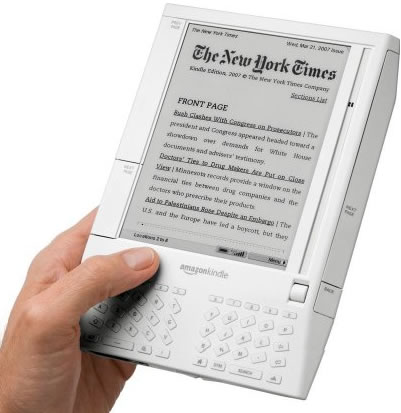
Anti-Kindlers

I have no idea why today I keep encountering Kindle-related articles wherever I turn. I guess this testifies to the ever-growing popularity of the Kindle that makes Kindle-haters foam at the mouth. One of them is Nicholson Baker whose article "A New Page: Can the Kindle really improve on the book?" has been published in The New Yorker.

Anti-Kindlers tend to come up with the weirdest criticisms of the device. Their strange arguments are aimed at hiding their fear of technology and their lack of affinity with today's world. They can't keep up, it's as simple as that, so they try to conceal this self-evident truth behind endless anti-technology rants.

So what are Baker's objection to the Kindle? First of all, it's not pretty enough. The e-paper isn't as white as the journalist hoped it would be and the font isn't very attractive, which somehow detracts from the value of the texts one reads on the Kindle: "Monotype Caecilia was grim and Calvinist; it had a way of reducing everything to arbitrary heaps of words. " I personally happen to believe that nothing could reduce, say, Cervantes Don Quijote to an arbitrary heap of words but I guess it's just me.

The next reason to hate the Kindle is that there are many stupid books available in the Kindle format. The fact that these same books are also available at every major bookstore means nothing to Baker. It's all the Kindle's fault.

Another complaint is that "photographs, charts, diagrams, foreign characters, and tables" are often mangled or simply absent on the Kindle. It doesn't interest Baker that now there is Kindle DX, made specifically for the kinds of texts that have lot of tables, charts, and diagrams. When this journalist finds out about this version of the Kindle, I'm sure he will complain that the Kindle doesn't do the dishes or cook dinner.

The next objection: the Kindle doesn't preserve colored illustrations. That's true, it doesn't. As an avid reader, however, I haven't missed colored illustrations in the books I read ever since I turned 6. Yes, the Kindle is not for looking at pictures. It's for reading texts. Since when isn't it enough to just read a book without being distracted by illustrations? Has Baker never read a print book that had no pictures? How many articles did he published complaining about that experience?

Another horrible thing about the Kindle is that its books are encoded in a format that protects the rights of the writers. So all you get on the Kindle is "a grouping of words in front of your eyes for your private use." Baker is undaunted by the faact that a print book offers you the exact same thing. If it's electronic it must be bad.

Baker's last objection to the Kindle is the weirdest. This bad device, he says, turns the page when you press the next button. So if you press it before finishing the page, you will find yourself at the next page. So the buttons do what they are supposed to do? What a horrible little machine!

Is the Publishing Industry Headed for Disaster?


The New York Times informs that Sony is daunted by the success of Amazon's Kindle and has decided to bring down prices for its new releases.
As every Kindle owner knows, one of the most attractive features of the Kindle is Amazon's guarantee that all new releases will be priced at under $10. For those of us who would never consider buying a hardcover because of its impossible price and have to wait for a paperback edition to come out, this is great news.
It turns out, however, that e-book companies do this at a loss since the publishers refuse to acknowledge the new reality of electronic reading devices and demand the same amount of money for a Kindle version than for a hardcover: "Book publishers will still retain their traditional cut of every e-book sale — about half the hardcover retail list price. But they are concerned that as online retailers like Amazon and Sony gain market power, they will eventually tire of losing money on e-book sales and ask publishers for lower wholesale prices, a move that would cut into their profit margins. “We all know that these companies are taking a loss and that’s not going to continue forever,” said Jonathan Karp, publisher and editor in chief at Twelve, an imprint of the Hachette Book Group." The publishers' insistence on getting the same amount of money for a hardcover book as for an e-book makes no sense whatsoever. A digital version requires no investment into paper and printing. If the book publishers were at least marginally environmentally minded, they would see how great the proliferation of e-readers would be for the environment.
This brainlessly greedy attitude on the part of publishing houses will inevitably result in the same disaster as that experienced by the music industry. If the publishers fails to recognize that the times when you could sell a hardcover for about $30 are almost over, they risk alienating their customers altogether. People will turn to more accessible and cheaper ways of gaining information. The invention of the Kindle makes it possible to get people to read a lot more. Instead of using this great opportunity, however, the publishers are hopelessly stuck in the past, trying to preserve a practice that fails to meet today's expectations of the readers.
There are quite a few writers who have seen the amazing potential of Amazon's Kindle. Often, a writer would offer a new book for free in order to get potential interests acquanted with and possibly interested in buying the rest of her books. These smart writers understand that the Kindle can bring them a greater visibility and, ultimately, bigger profits. I wish the publishing houses would finally wake up to the idea that they can't use the same outdated business practices and hope to survive in the new millenium.