Showing posts with label cooking. Show all posts

Tuesday, May 17, 2011

Clarissa's Frog Legs Soup: A Recipe

I love making soups because you can be as inventive as you want and use up all the stuff you have floating around the refrigerator. Today, I decided to make a soup of frog legs and fish. Once again, a Google search didn't offer any interesting recipes, so I decided to improvise. It turned out so good that I have already devoured two big bowls.

Here is what you will need:

3-4 pairs of frog legs
3-4 fish of any kind you like. The fish should be skinless but it is very important not to remove either the backbone or the tail. They are needed to make the broth less watery.
3 potatoes
2-3 carrots
salt, herbs, spices
some fresh sage

Here are the frog legs and the fish all ready for cooking. Separate frog leg pairs in two so that you have to separate legs. There is no need to chop them up onto smaller pieces.


You can use either fish stock or simply water if you have no stock handy. Place the chopped carrots and the frog legs into the broth (or water) and place the pan on high. You will need to bring it to the boiling point and then reduce the heat immediately.


Add a bay leaf, salt and pepper, and any herbs and spices you like. I added dry oregano, cumin seeds, several cloves, mustard seeds, and when the soup was almost ready, some fresh sage. Peel, cube and add potatoes to the soup. After 10 minutes or so, cut the fish into chunks of the same size and add them to the pot. Let the soup simmer on slow until the potatoes taste ready but not mushy. Here is how the soup ended up looking:


If you let it stand for a few hours after making it, the soup will taste even better.

Sunday, April 3, 2011

The Best Hobby Ever


I have no idea why but I recently remembered this cottage cheese cake with raisins that I loved when I was a child. So I made my own cottage cheese and then baked the cake. It's really light because it only has three tablespoons of flour. And it's really delicious.

Weekends are great because I have the time and energy to make interesting recipes.

Sent via BlackBerry by AT&T

Thursday, January 13, 2011

Clarissa's Chupe de mariscos from Peru (Peruvian Seafood Soup)

We have Peruvians in the family, so Peru's wonderful cuisine is very appreciated. Today I will share with you my version of my favorite Peruvian dish - Chupe de mariscos, or a seafood soup. Peruvian food is not only delicious and healthy. It is also aesthetically pleasing, which this particular chupe showcases beautifully.

Ingredients for the
chupe de mariscos The fruit obviously are not
part of the dish. They are just there
because it's their place
 1. First of all, I have to warn you that there are quite a few ingredients in this soup. You can see them gathered in this picture. I am cooking this in a small Midwestern town, so some of the ingredients are not available to me and I have to improvise. It is still absolutely delicious, though. So this is what I will use:

-bouillon (if you don't have it, just use water);
-raw shrimp;
-a couple of fillets of white swai and cod (you can take the fillet of any fish you like as long as it's white);
-a small turnip,
-a couple of potatoes;
-frozen green peas (fresh peas are best, if you can get them);
-4-6 eggs;
-a little can of tomato paste;
-1-2 cans of evaporated milk (you decide how much you want to use);
-fresh cilantro and oregano;
-garlic;
-a couple of medium or one big carrot;
-hot yellow peppers;
-unsalted butter;
-some rice (you can skip this ingredient if you like);
-and, of course, salt and pepper.

2. Heat up 8-10 cans of bouillon or water in a big pan. Make sure you add salt to taste. In the meanwhile, mince garlic and hot yellow peppers. The quantity of these ingredients is up to you. We prefer more garlic and very little peppers, but some people do the opposite. Take a small frying pan, melt 1/4 of a stick of unsalted butter in it, and fry garlic and peppers on medium heat for under a minute. The garlic should not be allowed to get dark.

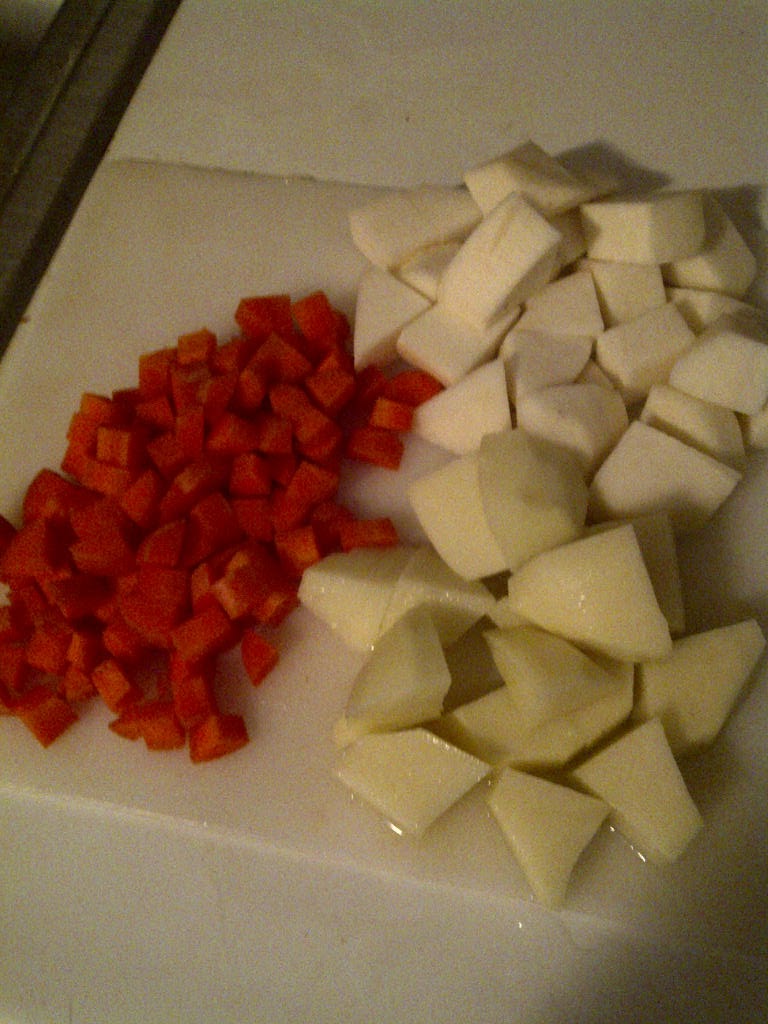
3. Peal and cube the carrot, the potatoes and the turnip. Carrot cubes should be smaller than potatoes and turnips. Add the vegetables and garlic + peppers to the boiling bouillon.

Here you can see comparative sizes of
cubed vegetables. Potatoes
are in the front and the turnip is in
the back. Feel free to use any variety of sweet potato.
4. Then add 2 table spoons of tomato paste to the bouillon. Add 1/2 tea spoon of oregano. If you will be using rice, add a handful now. Don't add too much rice, or it will absorb all the delicious liquid, and you will end up with a stew instead of a soup. 

5. When the vegetables are done to the desired degree of softness, add fish fillets cut into pieces and raw, peeled shrimp. Again, it's up to you to decide how much fish and shrimp respectively you want to add. It's also a great idea to add fresh calamaris at this point, but I don't have any today.
Make sure you don't get the precooked shrimp.
You need raw shrimp, or it won't be the same at all.
Raw shrimp need to be peeled and deveined.
This can be done for you at the store.
6. When the fish ans shrimp are halfway done, start adding the evaporated milk. Stop adding the milk when the soup reaches a pleasing color. Feel free to add more or less evaporated milk, according to your preferences. Some people use as much as 2 cans, while I normally use just one.

7. Now is the time to add a cup of peas and 4-6 eggs. At the very end, chop some cilantro and add it to the soup. When the eggs are cooked, turn off the heat. Let the soup stand for 10 minutes. And now try it and tell me if it isn't absolutely delicious.
It even looks beautiful!
 ¡Buen provecho, amigos! Enjoy!

Friday, December 24, 2010

Clarissa's Split Pea Soup with Bacon: A Recipe

Recently, I have been sharing with people more and more often that cooking is my hobby.  Here and here I explained why I'm wary of confessing that I cook. This is not a hobby to feel good about when one receives e-mails from our university administration, saying: "It will be nice if female faculty members cook something for our Christmas party." Today, however, at the request of reader sarcozona, I am sharing my recipe for Canadian split pea soup with bacon (for lack of ham.) For me, cooking is a creative process and I change every recipe every single time because it's more fun that way.

1. Take one cup of yellow split peas and one cup of green split peas. Of course, you can take just one kind, but the soup looks a lot better and somehow more festive if two kinds are used.

2. Place the peas in 8-10 cups (according to how thick you like your soup) of bouillon. Lacking that, you can always use water (salted to taste). Using water instead of bouillon means you can be more generous with herbs and spices. Bring the peas in bouillon to a gentle boil, and let them simmer. They will stay simmering for 3-3,5 hours, so you will have time to prep all the other ingredients (and blog in the meanwhile) at leisure.

3. Take several rashers of bacon. Put them on a plate between two paper towels, and leave in the microwave for 4 minutes. Some people prefer to fry their bacon, but that leaves too much fat, whcih overpowers the taste of soup.
How come photos at professional cooking sites always
look so much better than the ones I make? Well,
at least I tried hard. :-)
Break up the cooked rashers into small pieces and add them to the simmering soup.

4. An hour into the whole process, it's time to think about herbs and spices. This is the place where experimenting and discovering new shades of taste is the most fun. Here are the spices I chose this time:

This is a hearty dish, meant to be eaten in winter. This is why I always choose sturdier herbs and spices to go with it. Feel free to experiment as much as you want, however. Peas and bacon are very strong, taste-wise, so there is quite a bit of freedom in how many herbs one uses in this recipe.I always keep tasting the soup and adding more herbs and spices as the time goes by.

5. Somewhere at the end of the second hour, is the time to add vegetables. Here are the ones I chose this time:
I dice the carrots first, then the turnip, and after that the potato, and add them to the cooking pot in that order. Vegetable can be cut in pretty large pieces, but all chunks should be of uniform size because otherwise
the texture will be too inconsistent.

6. As a huge lover of ginger and garlic, I then prepare a ginger garlic paste. It can be bought in a store but I don't really trust it because God knows what weird substances have been added to it. Making a ginger garlic paste is beyond easy. You just take equal amounts of gignger and garlic, add a little bit of olive oil, and throw it all into a blender. Blend until you are satisfied with the texture of the paste.
Cooking and blogging at the same time
is fun! I wonder why I never did it before.
If you are a vegetarian who left out bacon, I suggest you really consider adding ginger. Unless you hate it, of course. If making a paste is too much of a drag, it's perfectly OK to cut the gignger into tiny pieces and adding it to the soup.

7. It's up to you to decide when the soup has reached the desired consistency. If you like it chunkier, 2,5 hours will suffice. If you wish it smoother, leave it simmering for up to 3,5 hours. Some people, puree the soup after it's done, but I never do that. I lke experiencing the textures of all the ingredients, but that, of course, is a matter of personal taste.

8. I serve the soup with a salad because in winter I serve everything with a salad:

Some people add sour cream to the split pea soup but I find it a bit too much. Feel free to try it, though.

Here is a close up of the end result:

It could have been less chunky if I'd let it simmer a little longer.
But I was starving and couldn't wait to eat any longer.
I just tried it and it tastes delicious. ¡Buen provecho!

Wednesday, August 11, 2010

Why Are Shows on Cooking and Design So Popular?

Project Runway, Top Chef, Top Chef Masters, Kitchen Nightmares, Masterchef, Anthony Bourdain: No Reservations, Bizarre Foods with Andrew Zimmern  -  the list of shows where people make exquisite food and beautiful clothes can go on forever. Why are people in this country willing to sit there for hours staring mesmerized at food they can't taste and clothes they can't wear?

The answer is simple. Existence in the United States is bereft of what one would call "the finer things in life." Many people can't afford to eat anywhere other than the horrible McDonald's or Taco Bell and buy their clothes anywhere other than Walmart. If you are lucky enough to belong to the dwindling middle class, then maybe you can afford to visit The Olive Garden every other week and wear the horrible concoctions sold at Gap. Buying exclusively fresh produce and meats is likely to bankrupt pretty much any family with a regular income.

The most paradoxical thing about life in the US is that people strongly believe that they live in the richest country in the world while eating the kind of rubbish that a European person wouldn't feed to their dog and wearing clothes only fit to wash the floor.

What's curious, though, is that this is not entirely a class thing. Throughout my Ivy League experiences, I met many very wealthy people. And still, they mostly ate junk and wore rubbish. Granted, their junk and rubbish were expensive but the fact that they paid a lot for it changed nothing.

The reason people choose (when it is a choice and not a matter of limited means) to eat and wear stuff that tastes and looks horrible is what they call "convenience." Buying pre-processed foods at the deli is more "convenient" than making something yourself from fresh ingredients. Wearing jeans, T-shirts and sneakers everywhere you go is more "convenient" than assembling outfits and accessories that will reflect your own style and your state of mind every day.

At a first glance, this explanation seems to make sense. Cooking from scratch, assembling outfits. Who's got the time for all that stuff? But if yout think about it, isn't there something really disturbing about not having time for such things? Almost since the day they are born, people in this country are told that they have to be productive at all costs all the time. Engaging in things that are not directly related to productivity is seen as frivolous and dispensable. People have neither time nor energy to savor and enjoy the finer things in life. Having time to themselves makes them feel so guilty that they hang out at work long after it's perfectly OK to go home, invent useless activities at work, sign up for endless duties that leave them exhausted at the end of the day.

As a result, they are left with jeans, hamburgers, television, and very little less. Besides work, work, work, of course.

Sunday, August 2, 2009

Cooking and Chauvinism

Michael Pollan's "Out of the Kitchen, Onto the Couch" New York Times article is one of those annoying thinly veiled attempts to bemoan the ways in which modern women have abandoned their housewifely duties. I have written before about my love for cooking and my struggle to keep this hobby secret because of the chauvinistic connotations attached to it. Pollan's article is a perfect example of how a chauvinistic culture attaches all kinds of ideologically manipulative beliefs to cooking.

People seem to love cooking shows (Top Chef, Hell's Kitchen, Gordon Ramsay's Kitchen Nightmares), Pollan says, but this fascination with TV programs doesn't make them want to cook on their own: "Here’s what I don’t get: How is it that we are so eager to watch other people browning beef cubes on screen but so much less eager to brown them ourselves?" For some Reason, Pollan doesn't ask himself why all the people who watch "So You Think You Can Dance?"and "American Idol" don't rush to take dancing and singing lessons, why all the fans of Law & Order don't seek careers in law enforcement, or why everybody who watches 24 doesn't engage in torturing people on a regular basis. "A great many Americans are spending considerably more time watching images of cooking on television than they are cooking themselves", says Pollan, but forgets to add that there is a score of activities that we love observing on television even though we never engage in them in real life.

Pollan doesn't stop at lamenting the lack of popularity homecooking enjoys. He goes on to look for people to blame. The answer is easy for this journalist: blame the feminists. Big, mean and nasty feminists, it turns out, duped poor innocent American women into believing that housewifely chores might be boring, repetitive and unfulfilling: "The year Julia Child went on the air — 1963 — was the same year Betty Friedan published “The Feminine Mystique,” the book that taught millions of American women to regard housework, cooking included, as drudgery, indeed as a form of oppression." According to this male chauvinist, women loved dedicating their entire existence to cooking, cleaning, and doing the laundry. Then Betty Friedan came and magically convinced them they were miserable. Since women are inherently brainless, one book is more than enough to convince them that they hate activities that they, in fact, enjoy. It's surprising that these utterly stupid creatures even managed to read and understand the book in question, but this is yet another contradiction in this quasi-journalist's idiotic argument.

This kind of antifeminist reasoning inevitably leads Pollan into a breathless description of happy prelapsarian (that is, before cooking was "thoughtlessly trampled" by nasty feminists "in their rush to get women out of the kitchen") moment when women cooked and men sat around and observed their efforts: "Even when “everyone” still cooked, there were plenty of us who mainly watched: men, for the most part, and children. Most of us have happy memories of watching our mothers in the kitchen, performing feats that sometimes looked very much like sorcery and typically resulted in something tasty to eat." It doesn't matter to Pollan if the women he is dying to see back in the kitchen are interested in providing him not only with homecooked food but also with entertainment. The journalist then proceeds to enumerate his mother's cooking miracles in a tone of a whiny 5-year-old who wants mean feminists to give him back his mommy.

This kind of attitude is precisely why I don't tell people I cook. Chauvinists of Pollan's ilk are incapable of seeing cooking simply as a hobby, they need to attach ideological meaning to it.

Monday, April 20, 2009

Ciltural Differences


One of the best ways to observe cultural differences is through comparing the different versions of the same show produced in different countries. Take Kitchen Nightmares, for example. This show is not only fun, it is also a perfect way to gauge just how unlike the British and the Americans are. Or, rather, how unlike the viewers' expectations are in the two countries.

The traditional structure of the British episode had to be changed to suit the US audience. In Britain, chef Ramsay always has to overcome the initial distrust and sarcasm on the part of the restaurant owners he is trying to help. They make snide remarks, refuse to follow his advice, and even try to get rid of him.

The American participants of the show are almost often extremely grateful for any help. They thank chef Ramsay for any suggestion he is willing to offer. They cry and say how much he changed their lives (I have never seen anything approaching tears of gratitude in the British version of the show. At most, some restaurateurs might emit some semi-grateful grunts.)

Another difference is the ubiquitous makeover that seems to be indispensable to any American TV program. Ramsay's team transforms the restaurant overnight. In one of the episodes, Ramsay even sends the restaurant owner to a spa for a personal makeover. This tradition is absent from the British version of Kitchen Nightmares. If any work needs to be done on the restaurant's appearance and decor, the employees of the restaurant do it on their own. There is no "team" to perform a miracle and change the restaurant in a few hours.

All in all, I prefer the British version. The American show is too predictable: tears of sadness, a miracle, happy gasps, tears of joy.

Friday, April 17, 2009

Cooking

I love to cook. It's my hobby. I collect recipes, watch cooking shows, and love exploring new cuisines. For years, I have felt that I needed to conceal this hobby from people around me. I would go to the supermarket and constantly look over my shoulder to make sure nobody saw me buy the ingredients I needed. I would only bring store-bought stuff to potluck dinners. I would start yawning in a very affected manner any time people would discuss cooking. In short, I behaved like a CIA agent on a dangerous spy mission. As a result, everyone who knows me is convinced that I can't even boil water.

The root of this neurotic behavior lies in an experience I had when I first started grad school. One day, my colleagues and I stayed at the office after classes. We ordered food, had some drinks, and spent several hours talking about our teaching, our research, and our intellectual pursuits. When the party was over, every single woman (except me) immediately got up and started cleaning. Every single man (and me) stayed put and continued talking about the meaning of life. To me, it was a profoundly disturbing experience. Here we are, discussing intellectual topics and ostensibly feeling like equals in every possible way. Then, in a second, half of the group gets up and starts acting as if they were the servants of the other half.

Another upsetting thing that I noticed was the kind of contribution than men and women would make in class. Men would speak a lot (even if they had nothing of value to say) and very loudly, they would have no problem interrupting women, they would dominate the discussions. Women, on the other hand, would make their comments in a tentative little voice (even when their ideas were way stronger than anything their male colleagues could ever hope to contribute). When challenged by men during the discussions, they would immediately withdraw their opinions in an apologetic way.

But these women cooked. All the time. They would bring baked goodies almost to every class. This was very upsetting to watch. It was as if they felt that they needed to buy their acceptance to these intellectual discussions and placate the men in the course by feeding them. It was as if they had accepted that nobody would ever expect them to contribute anything of value to the course. Anything other than what their traditional roles dictate, that is.

I decided then and there that I will never give my colleagues an opportunity to see me as a cooking and cleaning machine whose only purpose in life is to make their existence more comfortable. If they sit in a room surrounded by dirty dishes and wait for somebody to clean up for them, so will I. If they expect somebody to feed them, so will I. If they interrupt their colleagues and disrespect their opinion, I will interrupt and disrespect them.

I have been told that this attitude on my part is anti-feminist because I allow gender expectations to define my behavior. I have been told that the chauvinists win if I have to modify my way of being in order to prove something to them. In my view, however, this is a specious argument. When subaltern subjects engage in mimicry in order to confuse the colonizers, they upset the existing balance of power. When I behave like the biggest macho in the group, my conduct represents a sort of a mirror where chauvinists can see themselves in an exaggerated way.