Showing posts with label pharmaceuticals. Show all posts

Saturday, February 12, 2011

Drug Insanity Spreads to Canada

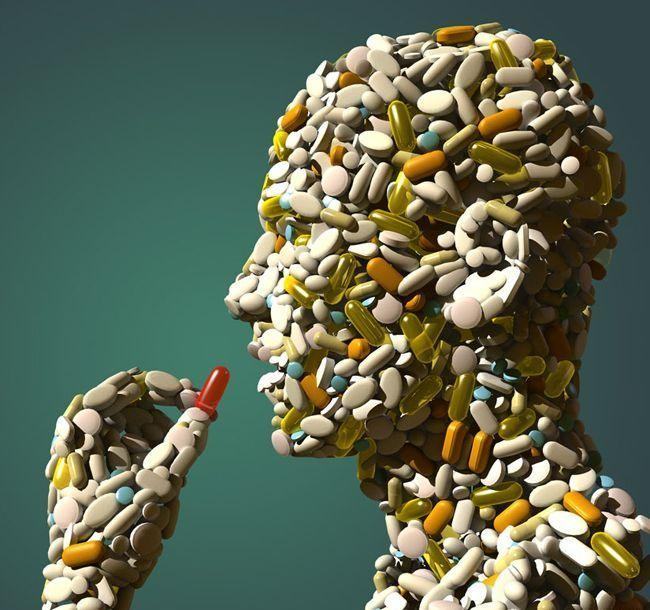
One of the scariest things in the US is the cavalier attitude that people have towards drugs. There is this wide-spread conviction that guzzling pills is an acceptable response to pretty much everything. Free samples of pain-killers are distributed in coffee shops, TV commercials exhort people to "ask their doctor" about a new pill that will cure them of everything, "the purple pill" is advertised as an aesthetic object that should be desirable regardless of whether you have the disease it is supposed to cure, personal qualities such as shyness are declared "syndromes" that require medication, doctors are genuinely shocked to discover that a 34-year-old patient doesn't take any prescription or over-the-counter medication, people think it is weird not to have a medicine cabinet in one's house, medication that hasn't gone through a rigorous safety testing regularly appears on the market and causes harm to innumerable pill-lovers.

Canadians have been looking at this pill-popping insanity, and have decided that they want something like that, too. Well, not all Canadians, of course. Just the ones at Health Canada who have been working hard to dismantle the system of safety measures that should prevent untested, dangerous medication from flooding the market:
Health Canada is holding its third and final “technical consultation” on proposals to “modernize” regulations governing prescription drugs and medical devices. The closed-door meetings will take place this week in Ottawa (Jan. 19-21). The Canadian public is largely unaware of the proposed changes, let alone their profound implications. Health Canada is working behind the scenes with the drug industry and drug industry funded groups to lower the drug safety standards and speed new drugs to market, thereby increasing the likelihood that Canadians will be exposed to dangerous new drugs. The proposed technical changes to drug regulation are part of a broader plan to introduce new legislation based on risk management and a lower standard of safety which will replace the current Food and Drug Act, which has as its central aim the protection of public health. The precautionary principle will be scrapped and the burden of proof will be shifted. So, instead of the drug industry having to demonstrate their product is safe, new drugs will be presumed safe and harm will have to be proven.
If that weren't bad enough, there is also a concerted effort on the part of pharmaceutical companies to legalize the advertisement of prescription drugs to consumers. According to Arthur Schafer, the director of the Centre for Professional and Applied Ethics at the University of Manitoba, there is a strong push to allow in Canada the same kind of irresponsible advertisement for drugs that we see in the US:
Big Pharma is also lobbying hard for the abolition of current Canadian regulations prohibiting direct-to-consumer advertising of prescription drugs. Experience from the United States and New Zealand -- so far the only two countries to permit DTC advertising -- demonstrates these ads are a highly successful tool for the industry to persuade people to "ask your doctor" for the latest and most expensive products. Tens or even hundreds of millions of dollars are spent on campaigns for drugs. Industry calls this "public education" but it's an education which invariably exaggerates benefits and downplays harms. If/when DTC drug advertising is approved in Canada, the costs to our health-care system will escalate dramatically. At the same time, deaths from prescription pharmaceuticals will become even more common, as will a range of serious side effects. 
We have all seen how ridiculously low the standards for such advertisement are in the US. A drug appears on the market, we are flooded with commercials promising all kinds of benefits and mumbling over the side effects. Then another commercial appears, qualifying what was said in the first commercial. After a while, we hear that the drug has been pulled off the market and we can join a class-action suit against its makers. Now this mess is coming to Canada. 

What a shame.

Tuesday, October 26, 2010

Ob-Gyns and Beauty

As if visits to an ob-gyn weren't traumatic enough, the doctors seem to go out of their way to make them even more unpleasant. Today, for example, I discovered that before a woman can be admitted to see the gynecologist, she has to fill out the following questionnaire:

"1. Are you trying to lose weight? Are you interested in taking weight-loss medication prescribed by this office?
2. Would you like to be given Botox injections to improve your appearance?
3. Are you interested in Latisse, a lash-growing prescription medication? **
4. Would you be interested in laser treatments that will remove your wrinkles and crow's feet?"

It seems that some doctors first want to make you sick by filling you up with all this junk and then treat you for the ensuing problems with your health. Of course, I refused and betook my fat, wrinkly self with inadequate lashes to the doctor's office for the annual check-up. When the doctor evinced surprise at how healthy I was, I had half a mind to tell her that I was healthy precisely because I never allowed anybody to convince me to try any of this prescription rubbish, but it didn't seem worth the trouble.

**How anybody can respect a doctor willing to prescribe this junk to people is beyond me.

Wednesday, January 6, 2010

Anti-depressants Don't Work. Is Anybody Really Surprised?

A new study by Professor Robert J. DeRubeis of the University of Pennsylvania has demonstrated that
Antidepressant medications likely provide little or no benefit to people with mild or moderate depression. . . Rather, the mere act of seeing a doctor, discussing symptoms and learning about depression probably triggers the improvements many patients experience while on medication.

Really? There actually needed to be a study demonstrating this? Even the relentless pharmaceutical companies have recognized that anti-depressants are useless. These powerful drug-pushing concerns have been brainwashing the public for decades with their mantra of "depression is a chemical imbalance in

your brain which we will cure by a prescription medication. Or two. Or three, if you are stupid enough to buy into our advertisement of an anti-depressant on top of another anti-depressant taking care of the residual symptoms of yet another anti-depressant."
 
If you read the entire article I quoted, you will see how apologetic Dr. DeRubeis sounds about his findings. All he is saying is that if you feel depressed, it makes sense to discuss this with somebody instead of guzzling crippling chemicals. To the public zombified by the endless ati-depressant commercials the scientist's message might come as a huge surprise. Still, I'm glad that finally somebody dared to publish findings that are likely to cut into the huge profits by the nasty pharmaceutical companies.

Tuesday, October 13, 2009

Stupid Advertisement

There is this commercial for Abilify that seems extremely weird to me. It says something like this: "About two thirds of people who are treated for depression still experience depression-related symptoms." If this is true, then the only logical conclusion would be that anti-depressants don't work. People should look for other ways of dealing with depression. The makers and pushers of Abilify, however, do not agree. Their suggestion is that people who suffer from depression should add another pill on top of the pills they are already taking.

Of course, after taking all those anti-depressant pills (which even this commercial admits do not work), the poor patients will have to take another ton of pills to deal with the side-effects of all this anti-depressant junk. Actually, the list of side-effects for Abilify runs for several pages. Initially, I wanted to post them here but there is seriously not enough space in this blog for that. It seems like a more apt name for Abilify would be Disabilify since nobody is likely to come out of ingesting this garbage (on top of other anti-depressants, no less) unharmed.

What are people thinking when they agree to put several anti-depressants plus this garbage into their bodies? How is it possible that these drug-dealers are allowed to advertise their junk as if it were candy?

Saturday, August 29, 2009

Psychoanalysis in the US

I was very glad to see today's article in the New York Times on the rise of psychoanalysis in the US.In "Freud’s Adirondack Vacation," Leon Hoffman tells of Freud's visit to the US, the people he met, and the influence he exercised over the mental health profession in this country. In the past few decades, Freud's name has become something of an insult in American psychology. The pharmaceutical lobby is one of the strongest in the US. It is, of course, deeply opposed to a method that deals with mental issues sans medication. As everybody knows, Freud's "talking cure" arose specifically in response to the proliferation of barbaric methods of treating mental patients practised by psychiatrists in the XIXth century.

Today, our understanding of mental health revolves around the mindless popping of prescription pills at worst and the senseless quasi-scientific blabber offered by Dr. Phil. The latter, of course, often leads to the former. Folowing the cue of pharmaceutical companies, Dr. Phil's first pronouncement on most psychological problems is that the problem might be caused by an imbalance of something in the brain, which requires taking prescription medication.

In a country where it has become normal and acceptable to diagnose 2-year-olds with schizophrenia and bipolar disorder (medication!), where schools label students as "hyperactive" (more medication!), where people often get prescribed 2 anti-depressants at once plus medication to deal with the side effects of the 2 anti-depressants, where psychotropic meds get peddled right from the TV screen, it would be a great idea to remember Dr. Freud and his American follower Dr. Putnam.

It's obvious that people have a vague desire for something different than prescription medication in the field of psychology. Dr. Phil's talk show originally gave some hope of presenting the "talking cure" in a more positive light. As we all know, the show soon degenerated into recommendation of prescription meds and a collection of unprofessional platitudes aimed at placating the bored suburban housewives who make up the bulk of Dr. Phil's audience.

Gradually, people begin to believe that medication and Dr. Phil's idiotic proclamations are all that psychology has to offer. As a  result, the popular trust for the fieldd at large becomes eroded even further.

Tuesday, July 28, 2009

Need to Swallow Medication? Take More Medication!


For some reason, today is turning out to be a day that I discover weird medical advances. First, it was a lash-growing prescription medication. Then I went to a store and saw a spray that helps you swallow pills. It's called "Pill Glide Swallowing Aid" and it comes in a variety of fruity flavors.
According to the company's press release, this spray helps children to swallow "those tiny little tablets kids need to stay healthy." This statement seems very confusing. If the children in question are healthy, why do they need to take pills to stay healthy? How is it going to help them preserve their health to swallow this weird concoction?
Here are the ingredients for the bubble gum flavor of this spray: Purified water, glycerin, sorbitol, xanthan gum, neotame, natural & artificial flavors. Buffered with: sodium citrate & citric acid. Preserved with potassium sorbate & sodium benzoate, propylene glycol, alcohol & tocopherols. Can anybody please tell me how it can be a good thing for a child or an adult to put these chemicals into their bodies just to be able to put even more chemicals into their bodies after that? Where does this stop? Now there is a pre-medication medication, maybe somebody will come up with a pill we need to take while medicating ourselves, after we have medicated ourselves, and between doses of medication to make our bodies more receptive to even more drugs.

Is There a Prescription for Stupidity?

When I first saw a commercial for Latisse I thought it was a joke. Who could have thought that having short or, to quote their promotional website, "inadequate" eyelashes was a medical condition that needed prescription medication. The name of this condition is "hypotrichosis", which according to Latisses's website is "another name for having inadequate or not enough eyelashes." Inadequate for what? I want to ask. Not enough for whom?

To make matters worse, the makers of the product have no idea how (or even if) this quasi-scientific goop works: "LATISSE® is believed to affect the growth (anagen) phase of the eyelash hair cycle in two ways: first, it increases the length of this phase; and second, it increases the number of hairs in this growth phase. The exact way it works is unknown." Notice the "Latisse is believed" part. Believed by whom? The crooks trying to sell this junk as medication? The women who are duped into thinking that having "not enough" lashes is a disease?

Since there are still honest doctors who will be unwilling to prescribe this junk to their patients, Latisse's website offers a Find-a-Doctor tool that gives you an address of a doctor who will prescribe this "medication" to you.

The website gives you advice on "how to make the most of your treatment" (treatment again, reinforcing the idea that women with short lashes are not only "inadequate" but also sick). Part of the advice goes as follows: "When you start using LATISSE® solution, be sure to mark your calendar and take pictures throughout weeks (0, 4, 8, 12, 16), so you can have your own "Before & After Gallery." And then do what with the gallery, I wonder? Put it up on your wall and show it off to guests? Carry it around with you in your wallet? Post it on a website as a monument to how you allowed another dishonest pharmaceutical company to dupe you into thinking that looking the way you do is a disease that needs yet another prescription?

Saturday, July 18, 2009

Biederman's ADHD Scam

I've been waiting for this for a long time. Paul Solomon reports that "Harvard child psychiatrist Joseph Biederman, whose work has helped fuel an explosion in the use of powerful antipsychotic drugs in children, has been caught up in controversy since a Congressional inquiry by Senator Charles Grassley (R-Iowa) in 2008." I was horrified when I first heard this con artist spouting off about how perfectly normal it is to prescribe antipsychotic drugs for children as young as 2 and diagnose Attention Deficit Hyperactivity Disorder (a completely spurious diagnosis that is making a fortune for quacks like Biederman and pharmaceutical companies) and bipolar disorder (imagine diagnosing that in a 2-year-old) in such tiny kids.

According to Paul Solomon, at the hearing aimed to investigate the bribes that Biederman received from pharmaceutical companies to present these vile ideas as scientifically valid, the following exchange took place:

Biederman appeared at a deposition on February 26, 2009, and was questioned by several lawyers for the states, who were claiming that makers of antipsychotic drugs defrauded state Medicaid programs by marketing their medicines improperly. At the deposition, Biederman was asked what rank he held at Harvard.

"Full professor," he answered.
"What's after that?" asked Fletch Trammell, one of the attorneys.

"God," Biederman responded.

"Did you say God?" Trammell asked.

"Yeah," said Biederman, after which there was a moment of stunned silence.

You can read the rest of Paul Solomon's great article here.

Of course, the man who is capable of giving antipsychotic meds to toddlers couldn't have said anything other than what he did. Biederman and people like him have been playing god for decades. At the behest of pharmaceutical companies, they come up with nonexistent diagnoses to feed people more and more needless and dangerous pills.

The idea that people who find social situations difficult must have some disorder and need to be medicated is offensive in the extreme. The idea that if you have trouble concentrating on what you do you also have a disorder and need to pop pills for the rest of your life is equally idiotic. The attempt to diagnose 2 and 5-year-olds with bipolar disorder are so cynical that they defy belief. I saw an investigative report program about a 5-year-old who was diagnosed with schizophrenia because he dressed up as a superhero and went to church dressed like that (A 5-year-old pretending he's a superhero, wow, that is so unhealthy).

People like Biederman are not as much to blame here, in my opinion, as the parents of these poor kids. Biederman is just out to make himself a fortune by poisoning kids he doesn't even know. As for the parents, however, it's terrifying that they would prefer to have any kind of a wild diagnosis attached to their kids instead of working on bringing them up. They zombify their kids with Ritalin and other poisons instead of talking to them and spending time with them. It's easy to blame all of the child's problems on some fictitious "disorder". Taking responsibility for your child's actions would be much more difficult and painful. Who needs that? Let's pump 'em full of chemicals and make Biederman a fortune in the process.