Showing posts with label publishing. Show all posts

Sunday, March 13, 2011

Is Blind Review Dead and Gone?

I'm still stuck on the response that I got from a very prestigious journal in my field this week. The reviewer was kind and respectful, said many complimentary things about the article, and had obviously read it very carefully and provided a detailed analysis. However, several things bothered me.

For one, blind review seems to be a thing of the past. My article was reviewed by somebody who initially received the article and knew who I was. The practice of assigning several reviewers to an article is also dead and gone. I published in this journal several years ago when they still had blind review and three different independent reviewers. Now, nobody is even trying to pretend that the process is in any way objective.

The person who reviewed my article is an esteemed scholar, and I found his feedback useful. However, this is not what academic publishing should be like. It shouldn't be up to a single person who is familiar with the author's name and credentials to decide whether the article is accepted for publication. It shouldn't be about whether that single reviewer agrees with the author. If the only people who get published are the ones this sole reviewer agrees with, the discipline's future looks drab.

Nothing is more discouraging to me than to observe this rapid erosion of scholarly standards. 

Wednesday, March 9, 2011

An Elusive Journal in My Field

I requested a fairly recent article (it was published in 2001) on the subject I'm working on right now through our university's Interlibrary Loan. Our library is pretty sucky but our library services (including ILL) are outstanding. They always deliver everything I request extremely fast. This article, however, they have not been able to locate in any of the collaborating libraries. They say they are "unable to find any libraries owning this journal that participate in Worldcat Resource Sharing."

I wrote to the article's author to see if he'd be willing to send me the text of the article. Its title sounds very interesting, and I don't want to submit my own article without consulting this previous study. Now my question is: does the difficulty in locating this journal mean the journal is not good? I was actually planning to submit my own article there but now I'm wondering whether it makes any sense to publish in a journal that nobody can find or consult later on.

Friday, December 24, 2010

Unpublishable Research

One of the reasons why I dislike the current format of academic publishing is that peer review often prevents truly innovative, original research from geting published. Anonymous reviewers cannot help judging the article on the basis of what they believe to be right. A piece that departs too dramatically from their preconceived notions, is judged by them as unfit for publication. As a result, the easiest kind of research to publish is the one that is based on a collection of accepted platitudes that are in vogue in the academic discipline in question at each given moment.

As of now, I have been able to identify three main blunders that an academic can make, rendering their research unpublishable. I have no doubt that, as time passes, I will keep discovering more of such areas.

1. There is a list of critical "authorities" in my field, whose work one should avoid contradicting in any way. Obviously, these are older, well-established academics who have supervised many graduate students. As a result, almost every peer review panel contains a former student, a friend, or a family member of such academic. It is weary work trying to figure out whose "words of wisdom" should not be disputed under any circumstances. There is also the danger of getting precisely the academic with whose ideas you argue to review your article. One might believe that an academic should be ecstatic that another scholar has read their work and has found it significant enough to merit a response. That, however, is not the case.
"This is a very well-researched and well-written article that makes an important contribution to the study of novel X," one reviewer wrote to me recently. "Nevertheless, I do not recommend it for publication because the author attempts to refute findings of scholar Y. Dr. Y is THE LEADING scholar in this field. It is UNACCEPTABLE that ANY ONE should question his scholarship." 
It went on like that for close to a page, but I will not bore you with the entire thing. Well, when a reviewer starts capitalizing words like a giddy teenager in his first chatroom, one can't help realizing that there is something deeply personal at stake here.

2. It is my contention that identity works like ideology. It can only exist if it's very existence is never questioned. It operates through constant reiterations of meaningless statements ("he needs to search for his identity," "her loos of her identity," etc.) that obscure the fact that this concept is completely without substance. Any weakening of the ideological edifice of identity produces a deep-seated anxiety in those who have come to accept it as a reality that always has been and always will be. Every time I see a reviewer begin to babble incoherently, I know that I must have stepped on their identity fixation.
"I don't understand what the author is trying to suggest. It cannot be that identity is unnecessary. Surely, no one will go as far as stating that. Then what is the point the author is trying to make? This entire piece leads us to question the very underpinnings of identity. Is that the author's goal? I'd like to believe it isn't," wrote another reviewer.
Sometimes, one can just feel the reviewer being genuinely upset over one's questioning of identity to the degree where one would like to ask the poor, tortured reviewer to pause and breathe.

3. Feminism is even worse than identity in terms of trying to publish research on this subject. There are two accepted truisms in feminist criticism that nobody whould dare question, no matter how much textual evidence you might accumulate contradicting these precious platitudes.

a) Platitude one holds that the massive gains of women's liberation movements in Western countries that took place in the 1970ies will result in transformation of literature written by women into "a celebration of womanhood" (whatever that is.) We have lived with these predictions of the imminent appearance of the celebratory genre for almost 40 years now, and they have proven to be false. Female literature en masse does not "celebrate" anything. (I'm sure a couple of novels here and there does, but it's absolutely not an overwhelming trend of any kind.) If anything, female writing in English and in Spanish (I don't follow anything else as closely) has become darker than ever. Mentioning that, however, (or worse still, trying to analyze the reasons why there is so much darkness in female wiritng nowadays) will render your researche pretty much unpublishable.

b) Platitude two maintains that feminism has lost its relevance for the younger generations because it failed to provide enough racial, ethnic, and class variety. This is one of the most wide-spread and insistent myths out there. Go to a feminist conference, and you will hear one scholar after another repeat this unintelligent statement with a glassy-eyed fervor that accepts no questioning. You can bring mountains of textual evidence (it isn't just a manner of speaking. I can, indeed, bring mountains of textual evidence) suggesting that time has come to move beyond this tired, meaningless platitude. However, whenever I send out an article suggesting that there are other venues to explore, I don't even get a review in response. I receive sheets of paper that say only (without as much as a greeting):
"We will not publish this." Or "we will not be able to publish this."
Why academic feminism got so stuck on an uninspired idea some unintelligent critic generated somewhere in the 80ies is a mystery to me. All I know is that there is now an unbridgeable gap between feminist criticism and actual literature that is being produced and read. Writers keep writing, readers keep reading, while the feminist critics keep ignoring all evidence that the tired pieties of the 70ies and the 80ies do not really work. And, of course, they keep holding back those scholars who are trying to move beyond this deadlock.

Friday, December 17, 2010

Academic Publishing

I have recently caught myself in a sacrilegous thought that I like blogging more than academic publishing. I'm one of those academics who live to publish. As much as I love teaching, for me it simply cannot compete with the delights of doing research. I'm not criticizing those of my colleagues who favor teaching, of course. They have a right to their different priorities. I, however, privilege research over teaching every single time. So discovering that there is an activity I like more than publishing my research is very novel to me.

There are several reasons blogging is better than academic publishing. One thing is immediacy. You don't have to wait for a year for the article to be evaluated and then for another year for it to come out. Often, by the time the article appears in print, it has lost its relevance because you have done many new things since then. Another reason why I prefer blogging is the feedback. I get to share my ideas with intelligent, well-informed people who respond, argue and point out deficiencies in my arguments. With academic publishing, you never know if anybody even read your article, and if they did, what their response was. Academic publishing often feels like talking to yourself, which doesn't make the process very attractive.

There is also the whole peer review thing which is supposed to guarantee the high quality of publications. Unfortunately, peer review often fails to ensure that low quality articles are rejected while good pieces of research are published. The so-called blind review is never truly blind. Frequently, peer review only serves to weed out articles that are saying something genuinely new as opposed to those pieces that rehash accepted platitudes.

I believe that the whole process of academic publishing should be transformed. Our professional association (the MLA) could, for example, create a website where academics who are members of the association could publish their articles freely. There would be a comment section where people could begin a dialogue about the publication. This would make it easy to follow one's favorite academics and see what is happening in one's area of research right now (as opposed to 2 years ago when the article was actually written.) Some people say that this kind of open publishing will produce a lot of inferior research. My question to them is: so what? There is a lot of crappy stuff being published every day. It is our jobs as specialists in our field to know whether a piece is good or not. Besides, I believe that this way of disseminating research will be so transparent that people will think twice before submitting a shitty article to a professional academic website. Today, one can always send in a low-quality article to an obscure print journal and hope that nobody sees it. With open publishing, though, one's colleagues and one's students will be able to find every unfortunate word one has ever published as soon as it comes out.

My non-academic readers might ask why a system that sounds so great doesn't exist already. The only reason why academics go through the boring and useless peer review process only to place their article somewhere where no one will ever see it is that this is the only way to have a publication that will "count." We all have our tenure, retention review, and merit review requirements. These requirements are either created or very closely monitored by corporate ignoramuses posing as college administrators. Such people only understand numbers, rules, restrictions, etc. Anything that is free and open (such as the academic publishing process I'm advocating here) terrifies them. As a result, the only publications of mine that will count toward my requirements are the ones that are strictly codified by these unintelligent people.

Of course, I'd much rather share the fruits of my research in an open access format. This would allow me to receive massive, intelligent feedback. Unfortunately, I can't do that. I have to abide by the silly rules maintained by backward, conservative people who are governed by numbers instead of ideas.

When will we start taking the academia back from these ignoramuses and making it more convenient for us?

Monday, October 25, 2010

Dealing With Academic Rejection

I have written about the hardships of academic rejection before. All of us come up with our own ways of dealing with yet another article or grant proposal being rejected in painfully offensive terms. So I came up with a way to provide myself with a psychological safety net for dealing with academic rejection, which is backfiring in a very curious way.

Now, when I submit an article for publication to a prestigious journal (especially, if the article deals with a controversial issue such as, for example, collective identity), I immediately follow it up by submitting another article to a much less prestigious journal. The idea here is to have something to fall back on psychologically when the article gets rejected by the more prestigious publication. Weird, I know, but how much rejection can a person take and not lose all faith in themselves?

Strangely, however, this system has been producing the opposite results. I would get an article accepted by the prestigious journal and have a similar article refused by the non-prestigious one. The most recent pair of articles dealt with collective identity in the contemporary Spanish novel. One of them was accepted by a very respectable journal, which only requested some minor changes. The other article was rejected by a place that (as I learned to my horror after submitting the article to them) has published some people who are complete and utter ignoramuses and quacks. The reason for the rejection was (and I quote) that "the theme of the novel is clear and does not warrant an extensive analysis." This third-grade level terminology in a discussion of literary criticism makes it painfully obvious how low the journal's standards are.

It looks like the time has come for me to revise my publication strategies.

Monday, October 18, 2010

Publishers Refuse to Enter the XXI Century

When the Kindle first appeared on the market, Amazon guaranteed that all new releases will cost $9.99 or less. Then, publishers realized that digital sales were cutting into their profits from over-priced hardcover editions and started raising Kindle book prices. First it was eleven dollars, then 12, then 14. Recently, they have gone completely nuts and started charging more for a digital copy (which, mind you, you can't share with your family and friends) than you will pay for a hard copy.

On the left you can see Ken Follett's Fall of Giants (The Century Trilogy). I've been dying to read it because part of it is set in my country during the time of the revolution. So much garbage is written by English-speaking writers about that period in my country's history that I couldn't wait to see how Follett (famous for his absolutely hilarious books on medieval Europe) would approach the topic. And then I realized that the publishers were charging $19.99 for the Kindle version of the book. This, of course, is pure insanity. Kindle owners have been boycotting the book and posting one-star reviews of it on Amazon to attract the publishers' attention to the sheer idiocy of charging so much for a digital copy of the book.
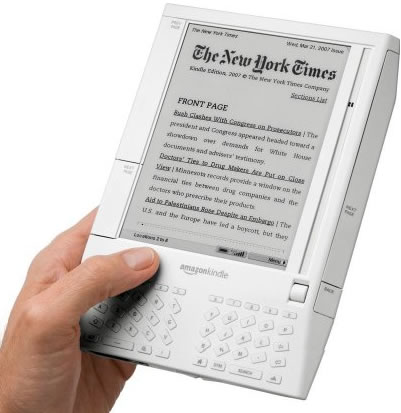
Today, the price of Follett's book was lowered from $19.99 to $19.39. Obviously, the price will eventually go down a lot more. I have no doubt that in a couple of years I will be able to buy the Kindle version of the novel for as little as $7. If I am still interested, that is. It is very disheartening to observe how recalcitrant publishers are when it comes to giving up on outdated practices and embracing new technologies. One has to be completely clueless not to understand that the future of publishing lies with digital technologies. Early adopters of electronic reading devices are trend-setters in an area that will eventually overtake publishing altogether. Alienating today's Kindle owners and prospective buyers of digital books is a stupidity that, I hope, will cost these publishers dearly. Publishing houses who learn to ride this new wave of technology will end up creating customer loyalty and selling more books in all formats. Those who fail to realize that $30+ hardcovers are a thing of the past will end up going out of business. Good riddance, too.

P.S. None of this, of course, dampened my enthusiasm for my Kindle. If the publishers are idiots, the Kindle is not to blame. In the end, it will come out winning no matter what because it is that good.

Wednesday, October 13, 2010

Now Accepting Congratulations

If you are an academic, then you are very familiar with this feeling of seeing yourself as a completely worthless, useless, unintelligent screw-up that you get when you haven't published anything for over a year. You slink in an out of the department, trying to make people notice you as little as possible because their questions of "Still no news on those articles?" are painful to hear. You don't speak up during meetings with colleagues because why should they listen to somebody who can't get herself published? You feel like an impostor grading your students' essays because what right has somebody who hasn't been published in so long to evaluate anybody's work? You can't do any research because it seems like everything you write will be rejected anyways. You start asking your partner obsessively if they will leave you if you never publish anything again. You persecute your friends and relatives with endless queries of "You don't think I'm a loser, do you?" In short, this is a very special kind of insanity that everybody in academia experiences on a regular basis.

So today I finally - FINALLY - got an article accepted for publication. It is the most heavily theoretical piece I have ever written (hello, Mr. Pippin!) and one that I never really hoped to get published because of its very strong ideological content. You see, I'm not really interested in doing the kind of literary criticism that counts the numbers of metaphors in a work of literature or that comes up with critical editions of texts. This is an important part of literary criticism, but it isn't something I want to be doing. For me, works of literature that I analyze are a pretext to discuss things I find important politically and ideologically. This statement is often greeted with gasps of terror among my colleagues. I, however, believe that discussing exclusively the formal aspects of literary works would be a huge waste of time.

Saturday, July 24, 2010

Publishers Fight Tooth and Nail for Their Right to Rip Off Readers

Andrew Wiley, a literary agent, got sick and tired of fighting with the huge publishing houses over the insanely high percentage of profits they insist on getting from the electronic editions of their titles. So he brokered a direct deal with Amazon to publish these titles at more affordable prices. Of course, the publishers immediately went nuts because their greatest fear right now is that readers will refuse to pay the crazy prices they are trying to charge for digital content. Random House, in particular, went total apeshit on Wiley, alleging (but failing to offer any proof) that the independent literary agent infringed on copyright restrictions:
' Random House responded with sheer thuggery, blacklisting Wylie in a clear attempt to scare other authors and their reps from trying the same thing. Other publishers also expressed outrage in different ways, like Macmillan CEO John Sargent, who railed about how Wylie’s exclusive deals excluded other e-devices like the Sony Reader (like Macmillan really cares about anything other than its own fortunes). What neither of these houses addressed is the $64,000 question: do they control e-book rights in contracts signed before anyone imagined that e-books might surpass print titles? Many feel the answer is no. '
The gall of these huge publishing houses is breath-taking. They have no proof whatsoever that they own the rights to these books but are fighting to death everybody who dares to publish them at less crazy prices. They got used to the inordinately high prices of hardcovers and want to cling to them at any cost. Since Amazon announced last week that its electronic books now outsell hardcovers, they are doing all they can to impose the same insane prices on digital content. That, of course, is daylight robbery.

Saturday, April 3, 2010

Scholarship


All day today I have been writing a schlarly article while watching a marathon of "America's Next Top Model." I have no idea why this happens but this show always inspires me to write like crazy. I have already written 8 pages today, which is a record for me. Normally, I do 3 pages a day (or five at most, if I feel especially hardworking). I hope there is another marathon of this show tomorrow because I need to finish this article.

Scholarly inspiration is a strange thing, indeed. You never know what will bring it out.

Sent via BlackBerry by AT&T

Sunday, March 28, 2010

Hispanic Studies Journals

Dear fellow Hispanists:

I just discovered this fantastic blog that lists all the academic journals in our field, collects comments on their publishing practices, and provides links to their web-sites. Here is this great blog. I'm so happy that I found it that I'm almost jumping for joy. No more sitting there, trying to figure out where to send an article.

The same person has a blog listing all Hispanic Studies presses.

Enjoy!

Saturday, January 30, 2010

Amazon vs Macmillan: How Much Should an E-book Cost?

Macmillan is one of those book publishers who are so shameless and disgusting in their greed that they believe hardcover prices should be charged for e-books. Never mind that with an e-book you save tons of money on production and distribution costs. Never mind that an e-book does not require extra printings and can be published ad infinitum, as long as people want to buy it.

Book publishers refuse to recognize that the world has changed. New technologies have made their favorite practices of charging exorbitant prices for hardcovers completely obsolete. Still, they are trying to hang on to these gouging techniques in hope that somehow the new technology will just go away.

As a result of Macmillan's greed, Amazon was forced to pull the Kindle editions of their books from the Kindle Store. I'm happy that Amazon is resisting Macmillans idiotic behavior. Good job, Amazon! Let's punish these losers for their stupidity by refusing to buy their overpriced books.

P.S. Sadly, Amazon has had to give in to the greedy bastards at Macmillan. Here is part of Amazon's statement:
'We have expressed our strong disagreement and the seriousness of our disagreement by temporarily ceasing the sale of all Macmillan titles.

We want you to know that ultimately, however, we will have to capitulate and accept Macmillan's terms because Macmillan has a monopoly over their own titles, and we will want to offer them to you even at prices we believe are needlessly high for e-books. Amazon customers will at that point decide for themselves whether they believe it's reasonable to pay $14.99 for a bestselling e-book...
Of course, I'm boycotting stupid Macmillan. Their representative is bound to show up in my office trying to peddle their books as textbooks for my students. Is s/he in for a nasty reception!

Wednesday, August 5, 2009

Is the Publishing Industry Headed for Disaster?


The New York Times informs that Sony is daunted by the success of Amazon's Kindle and has decided to bring down prices for its new releases.
As every Kindle owner knows, one of the most attractive features of the Kindle is Amazon's guarantee that all new releases will be priced at under $10. For those of us who would never consider buying a hardcover because of its impossible price and have to wait for a paperback edition to come out, this is great news.
It turns out, however, that e-book companies do this at a loss since the publishers refuse to acknowledge the new reality of electronic reading devices and demand the same amount of money for a Kindle version than for a hardcover: "Book publishers will still retain their traditional cut of every e-book sale — about half the hardcover retail list price. But they are concerned that as online retailers like Amazon and Sony gain market power, they will eventually tire of losing money on e-book sales and ask publishers for lower wholesale prices, a move that would cut into their profit margins. “We all know that these companies are taking a loss and that’s not going to continue forever,” said Jonathan Karp, publisher and editor in chief at Twelve, an imprint of the Hachette Book Group." The publishers' insistence on getting the same amount of money for a hardcover book as for an e-book makes no sense whatsoever. A digital version requires no investment into paper and printing. If the book publishers were at least marginally environmentally minded, they would see how great the proliferation of e-readers would be for the environment.
This brainlessly greedy attitude on the part of publishing houses will inevitably result in the same disaster as that experienced by the music industry. If the publishers fails to recognize that the times when you could sell a hardcover for about $30 are almost over, they risk alienating their customers altogether. People will turn to more accessible and cheaper ways of gaining information. The invention of the Kindle makes it possible to get people to read a lot more. Instead of using this great opportunity, however, the publishers are hopelessly stuck in the past, trying to preserve a practice that fails to meet today's expectations of the readers.
There are quite a few writers who have seen the amazing potential of Amazon's Kindle. Often, a writer would offer a new book for free in order to get potential interests acquanted with and possibly interested in buying the rest of her books. These smart writers understand that the Kindle can bring them a greater visibility and, ultimately, bigger profits. I wish the publishing houses would finally wake up to the idea that they can't use the same outdated business practices and hope to survive in the new millenium.

Friday, June 26, 2009

Good News


I've just received a publishing agreement for my book. This is all happening unexpectedly fast. I'm very happy, people!
I can't believe I might have a book of my own soon. It will have a color picture of me on the back cover (which is extremely important.)
Yay!

Monday, June 22, 2009

Norms of Publication


Can anybody tell me why every single academic journal (at least, in my discipline) comes up with a list of very peculiar norms of publication? We have our MLA Handbook, why can't we just follow the norms for quoting and bibliography that it suggests? We all know the MLA requirements very well and feel conmofrtable with them. But no, that would make our academic lives way too easy.

When you are used to quoting in a certain format, it's incredibly time-consuming to have to go through an article and redo it according to some weird and inexplicable requirements of a specific journal. And the most upsetting thing is that if they reject your article, you'll have to redo the entire bibliography and all of your quotes for another journal.

A journal where I submitted my most recent article (on Rosa Montero's Temblor as a Neo-Baroque Bildungsroman) wrote to say that it successfully passed the first round of evaluation (whatever that means) but now I have to change the bibliography according to their norms as soon as possible. Why couldn't they first decide whether they accept it and then ask me to do all this work changing it?

So, on this beautiful sunny day I have to be sitting here trying to grasp the intricacies of their unusual system of quoting. I hope it's not for nothing.