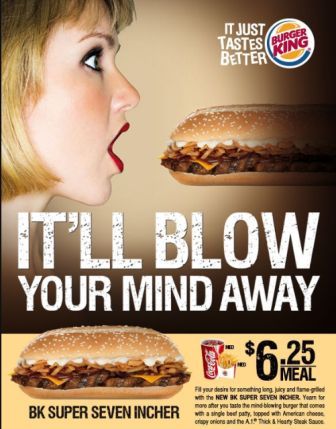
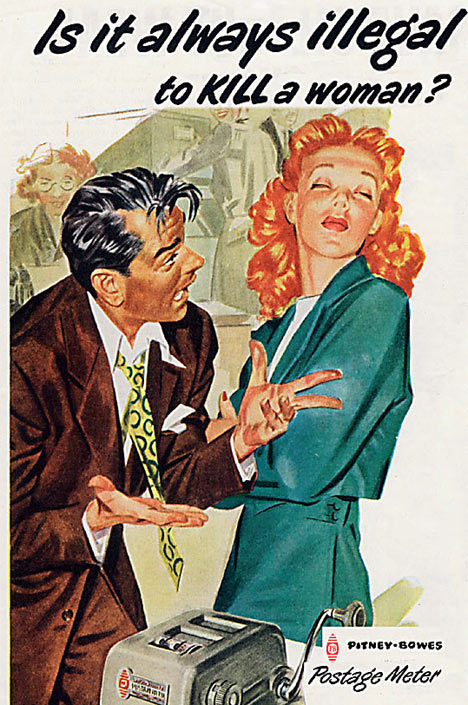
Reader el shared the following comment from one of online discussions about the bad, mean and scary advertisement industry:
I like how the ad messages evolved from WW2, “Be beautiful while you work in the factories and marry a sailor!” to post WW2 get-back-in-the-kitchen and marry a veteran. The social engineering is really remarkable–it went well beyond creating needs and selling products to shaping behavior in all walks of life. Advertisements still work that way, but I think they’ve gotten much more clever at being subtle. Insidious.
I can just imagine those subtle and insidious ad executives getting together and creating a world-wide conspiracy to shape people's behavior. Of course, it would make a lot more sense - and be a whole lot easier - simply to discover what people's basic needs and drives are and try to tap into those needs and drives. Is it possible that the old fogy Ockham was right and the simplest explanation is, indeed, the correct one?
I, for one, am sick to death of hearing how advertisement influences people to do things they don't want and buy stuff they don't need. As somebody who speaks to people for a living, I know very well that people have a tendency only to hear what they want to. You can repeat something a hundred times over, write it on a board, sing and dance it, put it in flashing lights and bright colors, and still people will hear the exact opposite of what you are saying because that's what they want to do.
A while ago, there was this theory that advertisers put subliminal messages into TV commercials to provoke people to want to buy things on a subconscious level. I don't know about other people, but I can't even say with certainty what company my favorite commercials represent. People of the TV generations have learned to tune out of commercials to the point where they couldn't tell you what was being advertised two seconds after the commercials aired. I do, however, watch attentively the advertisement for products that I want to buy.
People criticize advertisement for talking us into buying stuff we don't need and getting into massive debt as we keep consuming like crazy. I could buy into this argument had I not read Benito Perez Galdos's 1884 novel La de Bringas, whose protagonist, Rosalia Bringas, gets into debt through an unbridled consumption of useless objects. Her crazy spending gets so bad that she has to resort to prostitution to repay her debts. One could, of course, find much earlier examples of out-of-control purchases that left people destitute. So somehow people managed to overspend without watching TV commercials.
Advertisement promotes an impossible standard of beauty, people claim. In order to believe this you need to forget that for millenia people did all kinds of crazy, bizarre and dangerous things to their bodies to pursue an impossible standard of beauty. Foot binding, neck elongation, drinking of vinegar - all these practices existed long before anybody heard of advertisement.
In my opinion, all that advertisement does is give us exactly what we want anyways. The impossible standards of beauty and loads of useless junk are things that human beings always have and always will pursue. Beauty, by its nature, has to be impossible to attain, or it would be no beauty at all. If everybody is special, then nobody is. It is very easy and attractive to find some outside agency that we can happily blame for everything that goes wrong in our lives. It isn't my fault that I bought objects I couldn't afford. The bad, nasty commercials made me do it. I'm not to blame for eating junk and then torturing myself with stupid diets to lose weight. The greedy ad execs are at fault. I'm not a responsible individual. I'm just a weak, powerless object at the mercy of forces beyond my control.
Or am I?
People criticize advertisement for talking us into buying stuff we don't need and getting into massive debt as we keep consuming like crazy. I could buy into this argument had I not read Benito Perez Galdos's 1884 novel La de Bringas, whose protagonist, Rosalia Bringas, gets into debt through an unbridled consumption of useless objects. Her crazy spending gets so bad that she has to resort to prostitution to repay her debts. One could, of course, find much earlier examples of out-of-control purchases that left people destitute. So somehow people managed to overspend without watching TV commercials.
Advertisement promotes an impossible standard of beauty, people claim. In order to believe this you need to forget that for millenia people did all kinds of crazy, bizarre and dangerous things to their bodies to pursue an impossible standard of beauty. Foot binding, neck elongation, drinking of vinegar - all these practices existed long before anybody heard of advertisement.
In my opinion, all that advertisement does is give us exactly what we want anyways. The impossible standards of beauty and loads of useless junk are things that human beings always have and always will pursue. Beauty, by its nature, has to be impossible to attain, or it would be no beauty at all. If everybody is special, then nobody is. It is very easy and attractive to find some outside agency that we can happily blame for everything that goes wrong in our lives. It isn't my fault that I bought objects I couldn't afford. The bad, nasty commercials made me do it. I'm not to blame for eating junk and then torturing myself with stupid diets to lose weight. The greedy ad execs are at fault. I'm not a responsible individual. I'm just a weak, powerless object at the mercy of forces beyond my control.
Or am I?