Friday, February 12, 2010

Asperger's and Reading

A fellow Aspie blogger Izgad just wrote a brilliant post on Asperger's and reading fiction. The Simon Baron Cohen quiz, the most widely accepted test for non-neurological manifestations of Asperger's, is based on the assumption that people with Asperger's dislike reading fiction. I'm not a huge fan of this particular quiz as it is, and Izgad's intelligent objections make the quiz's shortcomings even more evident.

This is what Izgad says on this matter, and it resonates very deeply with me:
I would argue that my interest in reading is not despite my Asperger syndrome, but is one of the ways that I manifest Asperger behavior. Obviously I take to books much easier than people. Books are much better friends than people; they are easier to decode and you can open and close them as it suits you. Books do not misunderstand you and try to hurt you. Fiction provides precisely the sort of "human" relationship that I can deal with. The motivations of characters are written in words that I can decipher, as opposed to facial expressions.

As many of the readers of this blog already know, I am a literary critic and a professor of literature. I read and analyze fiction for a living. I also have "Severe to Extremely Severe" form of Asperger's. These things are not only not mutually exclusive. In my case - and evidently in Izgad's, too - they are closely interrelated. My love of classifying and categorizing is a huge help in my work as a literary critic.

What annoys me in most articles and books on autism written by people who do not have it is that they concentrate on everything autistics cannot do. They forget that there are many things that we can do precisely because of our autism that people who don't have it cannot. I call many of the manifestations of my Asperger's "my superpowers" because that is exactly how I perceive them.

It's Not a "Recession," Stupid!

It annoys me beyond what I can describe to hear people talk about the current economic crisis in the US as a "recession." For those who fail to see the importance of not using the wrong term to describe what is going on, here is a dictionary definition of the word "recession":

recession  /rɪˈsɛʃən/


–noun

1. the act of receding or withdrawing.


2. a receding part of a wall, building, etc.


3. a withdrawing procession, as at the end of a religious service.


4. Economics. a period of an economic contraction, sometimes limited in scope or duration.
Get it? LIMITED in scope or duration. If something recedes for a while, it has the capacity of going back. Like the tide that recedes and then comes back in. It withdraws and then comes back.

So if you talk about what is going on right now in this country's economy as a "recession", it means that you are clinging to the misguided belief that eventually things will go back to the way they were before the current economic meltdown. Come on, are you kidding me? It is never going to go back. We have to acknowledge that this is no temporary recession. This is a deep-seated systemic crisis of huge proportions that is going to transform the way we live, whether we want it or not.
 
Preferring to hide in illusion from unpleasant, uncomfortable reality is what got this society into the current crisis. Let's not compound our mistake by refusing to recognize what is going on.

Thursday, February 11, 2010

Campus Closed

Now our campus has officially been shut down and I can start my weeknd that will last until next Tuesday.

I have the best job in the world, people.

Sent via BlackBerry by AT&T

No Electricity

So I got up at 6 am today and came to work early in order to be very productive. But then the electricity went down campus-wide. The classrooms and offices are dark, the computers are out, even Starbucks is closed. The university administration doesn't want to make the decision on whether to dismiss the classes for the day, so professors and students have been wandering around like ghosts for the past 2 hours.

This is very boring.

Sent via BlackBerry by AT&T

Wednesday, February 10, 2010

Philip Roth's The Humbling: A Review

While Philip Roth's latest novel The Humbling is definitely not on the same level as his earlier masterpieces American Pastoral and The Human Stain, its is still pretty good. Written in Roth's luminous style, The Humbling tells a story of Simon Axler, an aging actor who loses his capacity to act and is plunged into a depression as a result. His wife leaves him, and Axler sees himself as condemned to loneliness for the rest of his days. Then, he starts an affair with Pegeen, a lesbian who is 25 years younger than he is. When Pegeen gets bored with their relationship and leaves, Axler is devastated.

This novel offers a profound critique of the male chauvinist way of thinking and of the problems it causes to the men who try to hold on to the obsolete macho ideology. Axler treats Pegeen as a voiceless, malleable doll, who needs to be transformed into a version of womanhood he considers to be acceptable: "All he was doing was helping Pegeen to be a woman he would want instead of a woman another woman would want." Understandably, his efforts to "cure" Pegeen from being a lesbian through fancy clothes and expensive jewelry fail.

In his efforts to analyze his relationship with an independent, self-sufficient, intellectual woman from the vantage point of outdated chauvinistic beliefs, Axler makes himself look utterly pathetic. he expects Pegeen's parents to be happy about their daughter's relationship with him because he is rich and can 'take care of her', whatever that means: "Here is this eminent man with a lot of money who's going to take care of her. After all, she's not getting any younger herself. She settles down with someone who's achieved something in life - what's so wrong with that?" Later on, Axler expresses a belief that Pegeen is involved with him because of his erstwhile fame as an actor.

Axler forgets that, unlike decades ago, an educated professional woman has no need to be with a person of any age or any gender because of money, the imaginary need "to settle down," or because she needs anybody to take care of her. What Axler fails to understand - and what costs him very dearly in the end - is that Pegeen's only reason to be with him (or with anybody else) is her desire. Gone are the times when women like Pegeen needed to attach themselves to an older man for prestige, money, or protection. Today, a woman who makes her own living can choose the sexual partner(s) she wants based on nothing but her own feelings and desires.

Pegeen is not the only woman Axler misjudges on the basis of his outdated sexist beliefs. Sybil, a woman he meets in a hospital, is for him "helpless, frail, and child-like." He misunderstands Sybil's inner strength and determination and ends up completely clueless about her.

In his long career as a writer, Roth often was criticized for the sexism of his novels. In my opinion, The Humbling is the writer's attempt to atone novelistically for that.

P.S. After I finished this review, I checked out some of the other reviews on this novel. I was shocked to realize that most people who have reviewed it consider the novel sexist. Apparently, for some people the mere fact of mentioning a relationship between an older man and a younger woman is in itself sexist. According to this weird logic, in order to avoid being sexist we have to pretend that such relationships do not exist.

Culture Shock

This post first appeared as a guest post on www.ktravula.com. Check it out and pay special attention to the nice things the author of the blog, my kind colleague Kola, says about me. :-)

When I was 22, I emigrated from Ukraine to Canada. I was fully prepared to experience a massive culture shock but none came. Sure, it took some time to get used to the idea of a credit card and a check-book, realize that a bus driver doesn’t give out change and there is no need to negotiate the price of a ride with the cab-driver before getting into the cab, and figure out why maple syrup can be poured on bacon and eggs. The process of learning these small things was really fun and caused me no shock whatsoever.

Five years later I decided to go to graduate school in the United States. Having lived in North America for a while, watching American TV and reading American books and newspapers, I expected even less of a culture shock on this change of residence. I was only moving to Connecticut, where the climate and the way of life were supposed to be pretty similar to what I had gotten used to in Canada.

Boy, was I ever wrong. A massive culture shock hit me immediately after crossing the US border and remained with me for years to come. It took time and effort to understand this new reality, learn to like, and eventually even love it.

I the US I discovered a deeply divided society. Glaring class inequalities, the likes of which I never saw back in Canada, racism, religious fanaticism, gender inequalities, economically devastated areas with the kind of poverty I never saw even back in Ukraine, crime, violence, inept governmental structures. All this was very different from the US I had seen in movies and TV shows.

But soon I also discovered that yet another US exists. The country of intellectuals, thinkers, artists. The country of hard-working, kind, generous people, who have not abandoned the struggle for the perfect society they inherited from their founders. The country of intellectually curious people. The country of people who hate injustice and inequality. The country that deserves better than the corrupt structures governing them.

When people read the very critical things I write about the US on my blog, they sometimes ask me, “Why do you live in this country if you dislike it so much?” But I ask, does hating injustice and inequality mean hating America? Or is it just the opposite?

Tuesday, February 9, 2010

Barking in a Foreign Language

This post is written by a guest blogger, Kola Tubosun whose great blog you can check out here.

Prompted by two related observations in my mind at the moment...


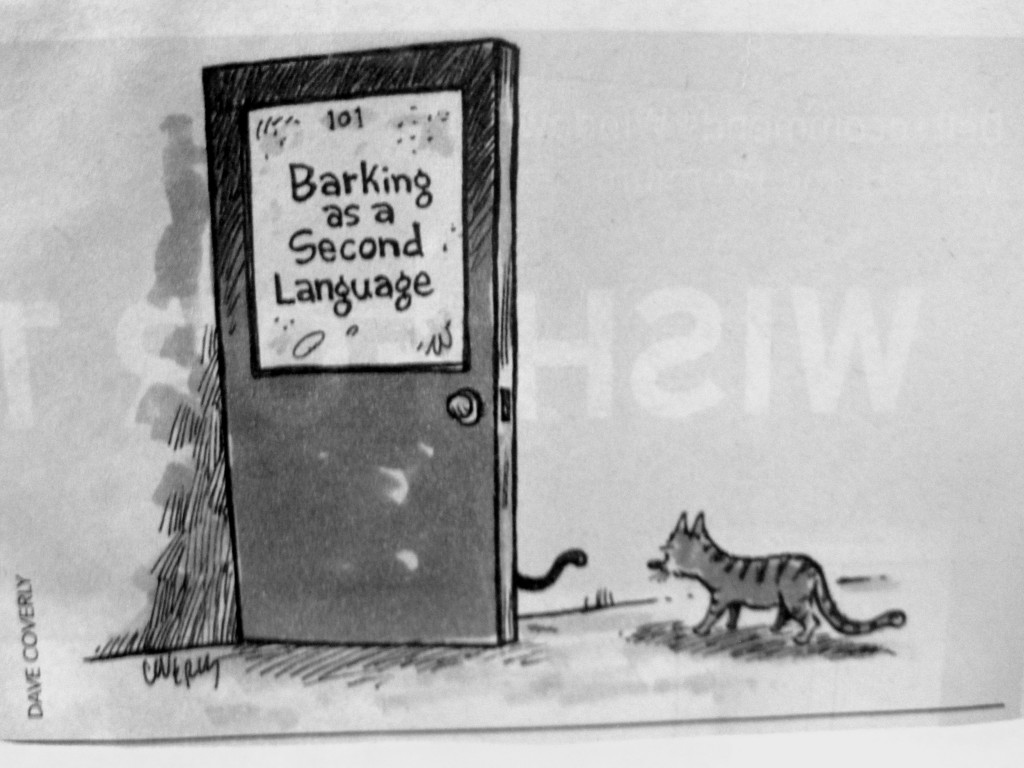
One was the search term in my blog statistics today. Some random person had apparently been directed to my blog by searching for the term "barking in a foreign language". This is not so strange when I realize that I had once made a blog post about the cartoon that I found on the glass entrance to my department.

The second was this very comprehensive article, and discussion, in the New York times about why, or whether Americans will really, learn Chinese. I enjoyed reading it and picked up a few nuggets, one of which was the fact that the interest of many Americans in learning foreign languages came from political and economic expediencies: They learnt Russian during the Cold War, Arabic after 9/11, Spanish because of their neighbours, and now Chinese in the wake of China's global economic uprising. Thus said the writers of the article. Not me, even though I have learnt also from a few interactions on the matter that many American students now study Chinese for the purpose of gaining leverage in the emerging economic world.

The article doesn't mention Yoruba, Swahili, or any of the other minority world languages being learnt in Universities all over America, but that is not the point - I guess. As much as this point in the article could be seen as a generalization of perhaps a genuine interest of students in expanding their worldviews, I believe that there's something interesting about the said American foreign language fad. For a fact, the govenment of the United States has shown more interest in languages spoken in parts of the world with some economic, political or cultural relevance to its own survival. At the Fulbright conference in December, I had made friends with a guy called Osama from Yemen, a Fulbrighter on a similar programme. That was before the Christmas Day bombing attempt, and its subsequent link to Yemen. After the terror attempt, I asked a friend if she thought that Yemen will now get a lesser slot in subsequent Fulbright programmes because of the terrorism incendent, and she said NO. Quite the opposite, she said. If this all rings true, then Hausa will also soon become another language of interest for Americans in the coming years, because of the failed bombing attempt of Christmas day. This creed can then be summarized somewhat thusly:
"If he has tried to kick your ass, kick his ass too, and then learn his language. You might understand him more, and thus prevent any further aggression."      
Whether this is true, or whether it ever works as planned in the long term, is of course subject to debate.

From Clarissa:

I highly recommend Kola's great blog, which is not only intelligent, humorous and exceptionally well-written but is also peppered with my insightful comments.                                                                                

Why I Dislike Third-Wave Feminism

People who have been around this blog for a while must already know that I dislike the so-called "third-wave feminism." Whenever I get to talk with one of the representatives of this movement, I get reminded of my dislike. So why does third-wave feminism bother me so much?

A fellow blogger tinceiri has left the following definition of third-wave feminism in the comment section of one of my recent posts:
Let me explain what third-wave feminism is about:


* Against Ableism
* Against Classism
* Against Ethnocentrism or Western-centrism
* Against Homo-/bi-/queerphobia or Heterosexism
* Against Racism
* Against Sexism or Misogyny
* Against Transphobia or CISsexism
* Against Religious Bashing
* Honoring Bodily Autonomy
* Supporting Sex Workers
* Anti-Biological Essentialism
Everything listed here, of course, sounds fantastic. What kind of a maniac could be opposed to these great things?

Unfortunately, the excellent intentions of third-wave feminists are completely undermined by the statement (from the same blogger I quoted before) that "third-wave feminism respects the choices of everyone." After a very short discussion, it always comes out that these feminists do not really support any kind of choice on the part of everybody. People who abuse others, racists, chauvinists, ableists, and xenophobes make all kinds of vile choices, and obviously third-wave feminists do not support those choices.

The question arises, then, if you do not in reality respect everybody's choices, why say you do? Why take up as your movement's motto something which is so patently untrue? My explanation is that when these feminists say they "respect the choices of everyone", what they are actually trying to say is that they do not want any of their choices to be questioned. Gaining rights always entails gaining responsibilities, and it is precisely the burden of extra responsibility that these feminists do not want. They want to exist in this comfortable reality where personal is not political, it is just a matter of choice. They want to preserve the right to live in a decidedly non-feminist way and still call themselves feminists. This discussion, for example, was one of the perfect examples of wanting to have your cake and eat it too.

Third-wave feminism is, in my opinion, a brand of feminism that has no future. Unless we accept that having the rights of a valid and complete human being implies having the responsibilities of a valid and complete human being, our struggle for equality is meaningless.

Monday, February 8, 2010

Literacy Tests

Everybody must have heard by now about the nasty remarks made by the former Republican Congressman Tom Tancredo about his desire to see the literacy tests for prospective voters brought back as a legal practice. You have to be an obtuse, illiterate racist in order to fail to realize that these vicious literacy tests were used as a tool of excluding black voters from expressing their political will.

However, I believe that something good can be rescued from this practice. Let's administer literacy tests to politicians aspiring to high elected offices. If somebody had thought of this before, a simple literacy test could have saved us eight horrible years with George W. Bush.

P.S. We were going over new vocabulary in my Spanish Intermediate II class. I don't allow students to speak English in class, so when they had to remember what the word "analfabeto" ("illiterate") means, many of them were stumped. One student came up with the following great definition of the word: "Es Presidente Bush!" ("It's president Bush!"). Immediately, everybody understood the meaning of the word.

A St. Valentine's Gift Suggestion from Amazon: A Fake Vagina

I've been browsing Amazon for suggestions for a St. Valentine's Day gift for my husband. One of the first two recommendations Amazon gave me was the curious product you see on the left. I have absolutely no idea what in my shopping history with Amazon could have given them the idea that this is a good recommendation to give to me.

Another question I have is how this is a good gift for St. Valentine's Day, of all possible festive occasions. If a man is getting a gift for St. Valentine's Day from his partner, this surely must mean that he has an access to . . . erm . . . the real thing. Even though the real thing is not a vibrating one. So why would he need a "Vibrating Deluxe Masturbator"? Maybe I'm not enlightened enough to get the point of this. Also, it's kind of annoying that when I checked out the "For Her" section of Valentine's gift recommendations, no women-friendly suggestion was made to me.

I wonder if any male is actually getting this pricey gift for St. Valentine's Day this year and what his reaction will be.

I sincerely hope my blog doesn't get tagged as pornographic again because of this post (as happened with this post.) My interest in this device is purely academic. It's bad enough that now I will not be able to blog while administering an exam in one of my classes tomorrow. The students might misunderstand the intellectual curiosity that motivated me to post this and include this particular picture.

My Subscriptions

After years of grad school penury and a gruelling two-year-long job search process, I finally have a permanent academic postion and can indulge in my love of periodicals. Here are the journals and newspapers I subscribe to:


The Nation magazine is my absolute favorite. It is an example of truly superior progressive journalism. The Nation comes out every week and I practically dance around my mailbox every Monday, waiting for it to arrive. The writing style of The Nation's journalists is really good. After the feeble attempts at writing that come out of the so-called journalists writing for The New York Times and Washington Post, the style of The Nation's contributors is a breath of fresh air.

The articles address the most pressing political, social, economic, and cultural concerns. Last week's issue, for example, had (among other great things) a really good article by Sasha Abramsky on the current crisis in California. It finally helped me understand what is going on in that state and why it is falling apart. My favorite journalists who regularly contribute to The Nation are Alexander Cockburn, Katha Politt, Naomi Klein, and others.

At the end of every issue, there are very good reviews of interesting books of cultural studies, literary criticism, history, philosophy, etc.

A Kindle subscription to The Nation costs next to nothing, so I recommend you at least give it a try. Keep in mind, however, that the Kindle edition doesn't have the beautiful cover art, the great crossword puzzle, and the hilarious classifieds. For this reason, I overcame my Kindle-dependence and this year switched from a Kindle subscription to a paper version of the magazine.


El País is the leading daily newspaper in Spain. I started subscribing to it a couple of months ago and can say that it was a fantastic choice. Spanish journalism is truly superior to its US equivalent. It tells you a lot about the sorry state of the US print journalism when I always go to El País for the news on the events in the United States.

The most prominent Spanish and Latin American writers regularly contribute articles to El País. Juan Goytisolo, Mario Vargas Llosa, Rosa Montero, Almudena Grandes, Antonio Munoz Molina, Juan Jose Millas, and many other bestselling authors publish their articles in this fantastic newspaper. The equivalent of this would be seeing articles by Philip Roth, Margaret Atwood and Joyce Carol Oates in The NY Times every single day. Instead, NY Times regales us by badly written inanities from Douthat, Dowd, and Brooks.

Very well-written, progressive, well-organized, El País is also available on the Kindle. The day's issue is delivered to you on the stroke of midnight of the previous day.

The New Left Review is not available on Kindle. However, don't let this prevent you from checking out this great journal. The most prominent philosophers, journalists, cultural and literary critics, and academics write for this journal. Jean Baudrillard, Alain Badiou, Terry Eagleton, Perry Anderson, Eric Hobsbawm, Franco Moretti, the list of the eminent names that appear on the pages of New Left Review goes on and on. If you want to keep in touch with what these leading thinkers are doing and writing, this journal is for you.

Some people might get scared by the word 'Left' in the journal's title. Remember, however, that the very fact of being a thinker and a philosopher in itself means that you are on the left of the political spectrum. A conservative philosopher is a contradiction in terms.

Narrative is an online magazine of literary fiction available on Kindle. Its mission statement says that "Narrative is the leading online publisher of first-rank fiction, nonfiction, and poetry. A nonprofit organization, Narrative is dedicated to advancing the literary arts in the digital age by supporting the finest writing talent and encouraging readership around the world and across generations. Our online library of new literature by celebrated authors and by the best new and emerging writers is available for free."

I only started subscribing to it recently but the experience so far has been highly enjoyable. The amazing Joyce Carol Oates (whose fantastic, beautifully-crafted short stories I can read all day every day), Saul Bellow, E.L. Doctorow, Amy Tan, Jhumpa Lahiri, and lesser known but still very good authors have published in Narrative. If you want to keep in touch with what is happening with the English-speaking literature today, check out this magazine.


I first subscribed to St. Louis Post Dispatch in order to support journalism in this economically devastated area and to keep touch with what is going on locally.

It turned out that this newspaper isn't half bad. Of course, I have to skip letters from the readers that often exhibit the depths of bigotry I never encounter in real life. The 'Law and Order' section about the local crime is also very depressing. Still, it does the job of keeping me informed about the economic, political and cultural developments in the area.

Of course, I subscribe to the Kindle version in order to save paper and bring down costs. Before Kindle subscriptions appeared on the market, I always felt horrible about taking out a daily because of the obscene amount of paper it wasted. Now I subscribe to two dailies on my Kindle and as soon as I get a raise I am subscribing to Canadian Globe and Mail. Or maybe to The Montreal Gazette. Or both.

Of course, nobody can be all about politics, literary criticism, and intellectual stuff all the time. Even an academic needs to have fun and relax. My way of doing that is detective fiction. Alfred Hitchcock's Mystery Magazine and Ellery Queen's Mystery Magazine are sister editions that offer great selections of short stories in the mystery genre.

I also subscribe to them on Kindle, which is beyond cheap, and once again, allows you to save paper.

I haven't seen much difference between these two magazines so far. This is why I subscribed to both. They compliment each other very well and offer stories for all kinds of tastes in the mystery genre.

Of course, give it to an academic to spoil even the most innocent kind of fun. Recently, I have been thinking of taking up a research interest in the mystery genre, so that all this detective novel reading I have done over the years doesn't go to waste.

But more about that in later posts.

Sunday, February 7, 2010

Michael Moore's "Capitalism: A Love Story": A Review

Finally, I managed to watch Michael Moore's Capitalism: A Love Story. Living in Southern Illinois since before the film came out made this task very hard. This is, obviously, not an area where Michael Moore's documentaries run to sold out theatres. People prefer the blessed forgetfulness offered to them by the typical Hollywood swill.

First of all, I have to say that whatever you feel about his ideology Michael Moore knows how to make good documentaries. Every frame offers a perfect conjunction of text and accompanying image. The documentary is as engaging as a good mystery film. This is simply very high-quality film-making.

Most of the things Moore narrates are sadly familiar to all of us: foreclosures, businesses failing, unemployment, economically devastated areas that look worse than anything you can find in many third-world countries, the useless and horribly unfair bailouts, the back room deals by Paulson, Geithner, Bush and Co, Obama getting bought out by the same crowd of vile criminals the second he gets close to presidency. We have seen all this unfold, and it's impossible not to recognize that everything Moore shows is true. Many instances in the movie are touching and sad, while many others are hilarious (For example, Moore says after rereading the US Constitution: "The Constitution doesn't mention capitalism. But it does talk about 'welfare' and 'union'. Wait, welfare and union? That sound like a very different -ism!")

Now, after all I have said in praise of Capitalism: A Love Story, I have to say that I disagree with Moore's central premise, which is capitalism is bad and it should be substituted by something better, namely democracy. I'm sure Moore understands extremely well that you can't substitute one with another since democracy is a political system and capitalism is an economic one. He uses the word "democracy" in order to avoid saying the word that scares the regular movie-going people, namely "socialism."

To support his view that socialism is better, Moore tells a story of a business owned by all its workers together. Every decision is made jointly by the workers in a democratic-style voting process. I'm glad this system works for the company Moore describes in the movie. However, this could never work on a larger scale. If anything, a smooth running of his business is a huge exception. I, for one, do not want to run my place of work. It's not my job and I don't want it to be my job. Some people are good at being managers, organizers, and the leaders of people. Other people are not. Working collectively on a shared project is an impossible burden for some people. There is no doubt in my mind that not having one actual owner will bankrupt an absolute majority of businesses very soon.

The reality that Moore doesn't address is that the current economic system in the US is not really capitalist. In many ways, it is eerily similar to the Soviet economy. In the Soviet Union, huge amounts of government money would go to bail out companies that could not survive on their own. If there were a real capitalism in the US, Goldman Sachs would have gone bankrupt a long time ago. The way capitalism works is that if you are inept enough to bankrupt your company, you are pushed off the market by more capable competitors. Goldman Sachs has long been completely incapable of an honest win over anybody else. They are kept in place by a complex system of Soviet-style handouts. This is as contrary to capitalism as anything can possibly be.

As a living system that exists in an ever-changing society, capitalism constantly transforms in order to adapt itself to a different set of conditions. The "wild" capitalism of the XIX and the early XX centuries did not really work. As a result, a system of checks and balances (e.g. the Glass-Steagall Act in the US) arose to help it work better. The repeal of Glass-Steagall was a profoundly anti-capitalist act aimed at allowing a small group of people an unfair and 100% manufactured advantage over their competitors.

I was born in the Soviet Union and I know for a fact that collective ownership of anything does not work. In the society where I grew up, there was an insurmountable distance between the rich and the poor. A small group of people had everything they could possibly want, while the rest was struggling to survive. And the worst part was that there was no hope for anybody from the poor category to move into the rich category. The membership in the rich category was determined by one's birth to a certain set of circumstances and by the number of indignities one was prepared to commit. Within the group of the rich people, it did not matter how bad a job they did at running their workplaces because there was also the government to bail them out with the money ripped off from the poor in the form of taxes.

Does this remind you of anything? Exactly.

So it makes no sense to discuss whether capitalism is goo for the United States. Simply because there is no real capitalism here. All we have is some weird, unhealthy hybrid of the remains of capitalism and some of the characteristics of the Soviet economy.

Does anybody really wonder why this doesn't work?

The film, however, is lots of fun. I highly recommend.

Saturday, February 6, 2010

"There Is a Russian Lady Living on My Block!"

Every single time I meet a new person, the following deeply uncomfortable dialogue ensues:

New Person: So where are you from?
Me: Ukraine.
New Person: Oh, really? There is a Russian (Ukrainian, Bielorussian, Uzbek, Lithuanian, etc.)  lady (gentleman, family, etc.) living on my block (working in my office, attending my gym, visiting my coffee-shop, etc.)
Me (having no idea how to respond): Huh...
New Person (brightly): Would you like to meet her (him, them)?

Sometimes, this conversation gets even weirder with people saying, "Oh, you are from Ukraine! I know somebody from Bosnia (Serbia, Slovenia, etc.)." Then, things get even more embarrassing because I start explaining that Ukraine and Serbia are very different countries. I think. Because I don't really know much about Serbia, to my shame. And, of course, at the end of the conversation I feel like a total fool.

These conversations occur with a frightening regularity and have begun to bug me beyond what I can express. I wonder why people consider it necessary to say these things. It must be obvious that if I were so desperate for the company of any Russian-speaker just because s/he is a Russian-speaker, I would have never emigrated in the first place. It is also kind of offensive that people would think everybody who is born in some part of the humongous former Soviet Union would necessarily have something in common. We are all different and often in no particular hurry to meet each other.

Ukraine's Presidential Elections: The Evil of Two Lessers

Today Ukrainians have to choose between their two last remaining presidential candidates. The most popular choice seems to be the Pro-Russian "let's-go-back-to-the-Empire-and-let-Russians-abuse-us-some-more" Yanukovich.

The other candidate, Timoshenko, looked kind of better. At least, she is a woman, which is always a good thing to see. She also looks a lot less like a Soviet-era dinosaur than her opponent.

For these reasons, I hoped she would win. That is, until she organized a disgusting religious event, which was a kind of a huge public prayer. I understand that she only did this to score points with some of the more obtuse, uneducated voters. Still, this quasi-religious posturing is really unattractive. And understandably scary.

I feel truly sorry for the Ukrainian voters who now have to choose between two almost equally lousy candidates. Ukraine just doesn't seem to be able to catch a break for the past 350 years.

Sent via BlackBerry by AT&T

Friday, February 5, 2010

First Impressions: Job Interview

I have been rereading my old posts on my job interview process at the MLA conference. (Yes, I'm weird enough to reread my own writing on a regular basis.) In those posts, I described some of the most disconcerting experiences I'd had as a job candidate for an academic position.

I was surprised to discover that most of the weird experiences I described came from the very institution that ended up hiring me and where I am now happily employed. This just goes to show that first impressions are not the most credible ones.

Of course, the people who interviewed me must also have a lot of funny stories to tell about me. Once, for instance, I forgot the name of the university that was interviewing me. OK, I didn't really forget, I was just too lazy to check before the actual interview. The following dialogue then took place.

Interviewer: So what makes you want to work at XXX University?

Me: Where?

Interviewer: XXX University. [Pause] That's our university.

Me: Oh! Right. [Long pause].

Interviewer: So?

Needless to say, after this phone interview they felt no desire to meet me in person.

Struggling with Computers

Technology doesn't like me. Back at Cornell, I once managed to destroy both of our departmental copiers. And I did it twice. And it all happened in the space of an hour. So I was not very surprised to discover that over the winter holidays the hard drive of my work computer had "melted" (according to our IT specialist) for no apparent reason. I requested a new computer (which I am owed as per the conditions of my employment). The IT person reformatted the part of the hard drive that hadn't melted, instead. Needless to say, it took the computer less than a week to stop functioning.

After I reported this disaster, it took the IT person until the day before yesterday to walk to my office with a new computer. Everybody knows that IT people have a tendency to get distracted very easily. Still, he did install a new, out-of-the-box computer on Wednesday. The next day (which ws yesterday) I came to work 2 hours early in order to prepare my classes for next week. My goal was to get all the work out of the way and have an uninterrupted 4-day-long weekend. When I came to work, however, I discovered that my "new" computer was dead.

Not only was I annoyed, I was also very bored. There is really nothing to do on campus at 7:30 in the morning if you have no computer.

When the IT person finally showed up, he started reinstalling (or whatever, I'm not good with the terminology) the computer. When I came to my office after teaching all my classes, I discovered that the computer was, indeed, working. The only problem was that something happened to the screen resolution and after five minutes of working on the computer I was on the verge of going insane. It turns out that the IT person connected a wrong monitor to this computer. How he thought I would be able to work on it is beyond me. We all know, however, that IT people have very weird ways of thinking about things.

Now he tells me that when I come back to work on Tuesday the computer will be in a working condition. Yeah, right. I'm so not going to work without bringing my own computer.

P.S. My home laptop also started acting up. But I think I managed to repair it. I won't go into the endless story of how long and painful the process was but it kind of seems like it worked. I feel very proud of myself. Maybe now I should take the job of installing my office computer into my own hands.

Jeff Sharlet's The Family: Not a Review

I thought I was going to love Jeff Sharlet's The Family. I collect anti-fundamentalist books and read them all the time. Evangelical fundamentalism is a horrible threat to democracy, and everybody needs to be aware of its perils. Sharlet's book, however, disappointed me. The main reason why I don't like it is that the author never manages to acquire enough critical distance from the subject of his research.

The Family offers an incredibly detailed analysis of the lives of the most important evangelicals, going back centuries. Sadly, it never occurs to the author to take the self-serving accounts of these fanatics about their so-called conversions with a grain of salt. For Sharlet, if the fundamentalist in question tells that he had a vision and was converted, it must be the truth. Instead of giving so many boring details of these so-called conversions, Sharlet would have been better off analyzing the actual - often extremely self-serving - reasons for the fundamentalist "conversions."

I had a scary experience with an evangelical student a couple of days ago. One of the most disturbing things about fundamentalists (which Sharlet does touch upon, albeit too briefly) is that they have a language of their own. Often, these fanatics do not realize that the rest of the world does not know what certain words and expressions mean in fundamentalist-speak. Imagine my horror when late at night I received an e-mail from a student informing me that he has "decided to lay down his life for the Lord." I honestly thought he was threatening to commit suicide or engage in a massacre on campus. When I finally got over my fright and continued reading, I discovered that the student was trying to say that he was dropping out from college to join some Bible camp, or whatever. Apparently, he had a religious experience while he was studying in the library that told him it was the right thing to do.

In my place, Sharlet would go into a painstaking description of this alleged religious experience. I, however, keep thinking that the student's conversion just happened to take place right before the first essay was due and the first midterm exam was scheduled for next week.

Another problem with Sharlet's writing is that he takes these religious kooks way to seriously. He believes that they are all-powerful and omnipresent. While there can be no doubt in anybody's mind that evangelical fundamentalists have an unduly big influence on our society, one cannot analyze their movement without realizing how outdated and pathetic they are. It is precisely their growing irrelevance that makes them so desperate and angry. The best way to counteract their influence is by bringing to light how ridiculous they are. Instead, Sharlet reinforces the myth of their power and invincibility.

I cannot, in all honesty, recommend The Family: The Secret Fundamentalism at the Heart of American Power to anybody. It is plodding, uninspired, and very counterproductive for the purposes of limiting the influence of religious fanatics on life in this country.

Wednesday, February 3, 2010

Foreign Languages Month

My multi-talented colleague Kolawole Olatubosun is giving a talk on Yoruba as part of our Foreign Languages Month. The attendance is great, which tells us that our students are curious about other cultures and languages.

We are organizing these events in spite of the budget freeze that has almost crippled us. Although if we cut some more - as the President suggested - I don't know what will happen.

So Kola is talking and I'm blogging about him talking. This doesn't mean your talk isn't lots of fun, Kola. I just think it's really cool to blog from different events I attend.

Sent via BlackBerry by AT&T

Tuesday, February 2, 2010

Does Canada Defend Its Citizens?

Nazia Quazi, a citizen of Canada, is being forcefully detained in Saudi Arabia by her father. The Canadian government is not doing anything to help Nazia leave Ryadh and go home. According to The Nation's brilliant Katha Pollitt
More than one person I've talked with has suggested that the fact that the Quazis are Muslim is relevant: the embassy in Riyadh doesn't want to get involved in what it apparently views as a Muslim family dispute.
A country is supposed to protect its citizens even - or especially - when they find themselves overseas. This is not the first case, however, when Canada refused to defend the rights of its citizens:
Nazia's case offers the Canadian government a chance to redeem itself after its shocking refusal this past October to help Nathalie Morin, a Canadian living in Saudi Arabia whose husband refuses to let her and her children out of the country.
This insanity is a result of Canada's notorious fear of anything having to do with "religion". I put "religion" in quotation marks because it is extremely easy to sell any kind of insanity as a valid religious experience to the Canadian government. Canadian governments are always so terrified of the word "religion" that they are willing to bend over backwards to accomodate any kook claiming to be religious. For a while, the Supreme Court of Canada actually considered the introduction of Shariah laws in Canada because apparently some people's rights to stone women are more important than the rights of the rest of the population not to witness such horrors. A Sikh boy won the right to carry a dagger at school because his right to have a scary weapon in class is more important than the right of other children to safety. Who cares about your safety if you are not "religious", anyways? Muslim and Orthodox Jewish women almost succeed in forbidding other, non-religious women to have their husbands and partners present in birth preparation classes.

And now a citizen of Canada is being detained in another country against her will but nobody cares because her abusive father is claiming that this is a religious matter. If there is truly a separation between Church and State in Canada, the "we-are-religious-so-the-government-owes-us-special-treatment" arguments should not work.

Monday, February 1, 2010

Living Oprah by Robyn Okrant: A Review

A review from an anonymous guest blogger:

I must admit I was excited when I downloaded Living Oprah on Kindle. I was anticipating one of two things: either a very easy unpretentious read with humorous anecdotes (along the lines of Confessions of a Shopaholic) or more of an investigative account analyzing the Oprah phenomenon from a critical standpoint (along the lines of Selling Sickness).

Well, a few pages in I realized that the book was neither. It was just a big yawn of predictable jokes and the author failing to explain what the point of her project actually was. Is she a crazy Oprah fan? Apparently not (at least she says she isn't, despite her countless recounts of how admirable, wonderful and inspiring Oprah is). Is she a critic ready to discuss openly the negative impact an Oprah-type show can have on its audience? Once again, hardly. Rather, the author positions herself as an intellectual who is above dressing up (sports bras and granny panties being her underwear of choice), an avid feminist (despite feeling a sense of trepidation before asking her husband's permission to embark on the project and going as far as doubting that her marriage will last through the endeavor. Umm, dramatic much?) and certainly not a fame seeker (after an extremely long explanation of why she wanted to remain anonymous, the author concedes to revealing her name for the sake of being interviewed). I was confused! But worst of all, certainly not entertained.


I will give you a couple of examples. Even though I could go on and on, I do not want you to experience the same sense of boredom to which I subjected myself.

The author makes fun of Oprah's suggestion that she purchase a pair of leopard-print flats. By making fun of it, all I mean to say is that she tells us she laughed at the suggestion hysterically. Ok, funny. Yet, further on in the book she falls in love with the shoes. Umm, I kept wondering: what was the point of that story?

The author makes fun of Oprah's fans who nearly worship her and go into a frenzy at her shows. She attends one of the tapings and stresses and underlines endlessly how different she is from all those other fans. Yet, she describes the overwhelming feeling of excitement she, too, succumbed to at the show. Ok, what was the point of this story?

She seems to criticize Oprah's suggestions to renovate, remodel and engage in other home-improvement projects. Yet, when she follows all these suggestions, she seems happy with the result.

She seems to criticize Oprah's constant dieting projects. Yet is really excited to have lost weight and shares several pictures of herself in a bikini to prove the point.

The author tries to show that watching every single episode of Oprah alienated her from her friends and loved ones. In order to prove the point, she tells us about her family's Thanksgiving dinner where she had to go upstairs to watch a taped episode of Oprah while her family was downstairs laughing and enjoying the holiday. Ok, again I am confused. What was the rush of watching the episode at that particular time? It was taped anyway. Well no, I do get it. It was a far-fetched attempt at creating drama and showing how hard the project was.

I forced myself to read the book to the end. I was curious to read the author's conclusion. After all, she spent 365 days following Oprah's every word of advice. So, is Oprah's show a god-send or an evil creation? Is following Oprah's suggestions detrimental or a great idea? But no, the conclusion is not about that. Actually, it's not about anything. It goes on and on to tell us how happy the author is living her own life and not following someone else's advice (again, despite the author's countless examples of her million-and-one insecurities listed throughout the book). I have one word to summarize my impression of Living Oprah: blah.

From Clarissa:

I have to confess that I was the one to recommend this book to the reviewer (without having read it.) I'm interested in this type of books (although not enough to read them myself :-)) because they represent a curious social phenomenon. One of the prime examples of this phenomenon is Julie and Julia: My Year of Cooking Dangerously. A blogger decided to follow Julia Child's recipes within a year and blogged about it. The experiment was so successful that it turned into an inane book and an equally inane film based on it. Robyn Okrant decided to do something even easier and simply attached herself to the image of wildly popular Oprah Winfrey.

Many people decided to do something similar and start some kind of project that would later morph into a book over even a movie. This is the book equivalent of reality TV shows. For the most part, even when the original idea is not bad (like in Living Oprah), the authors lack even the most basic sense of humor and intelligence that are needed to make the project a success.

Celebrity culture encourages everyone to think of themselves as potential celebrities, as possessing unique if unacknowledged gifts.
People readily turn away from the unhospitable reality, where achieving fame and fortune requires hard work, dedication, and sacrifice, and plunge themsmelves into the world of make-believe, where they are entitled to everything just because. As a result, the publishing market will keep saturated with insipi books like Living Oprah: My One-Year Experiment to Walk the Walk of the Queen of Talk.